

The green color of leaves is due to the reflection of green light, at higher angles
of radiation of incidence and visual sensitivity, even though the absolute reflectivity
is higher in the near IR region. This reflectivity in the near IR region also contributes to the removal of incident radiation (Oke 1992). For much of the foliage,
absorption of the green band at 550 nm is about 0.75–0.8, for the blue band
between 400 and 460 nm, it is 0.95 and for the red band between 600 and 670 nm,
it is 0.85–0.95.
Transmission among thick leaves stems and branches are zero (Ross 1975).
Glossy leaves have a very significant reflection component. In general, foliar
reflection is higher than transmission except for thin leaves in the green and near IR
bands (Fig. 6.9).
Spectral properties of leaves are changed during the growing season. Younger
leaves are bright green, have high transmittance and reflection, and low absorption.
Mature leaves are dark green, have low reflection and transmission, and high
absorption. The older leaves have a higher reflection and lower absorption (Ross
1975).
Radiative properties of the leaf surfaces are not significantly affected by coating
with water or waterproofing with compounds such as baseline, nor with coatings
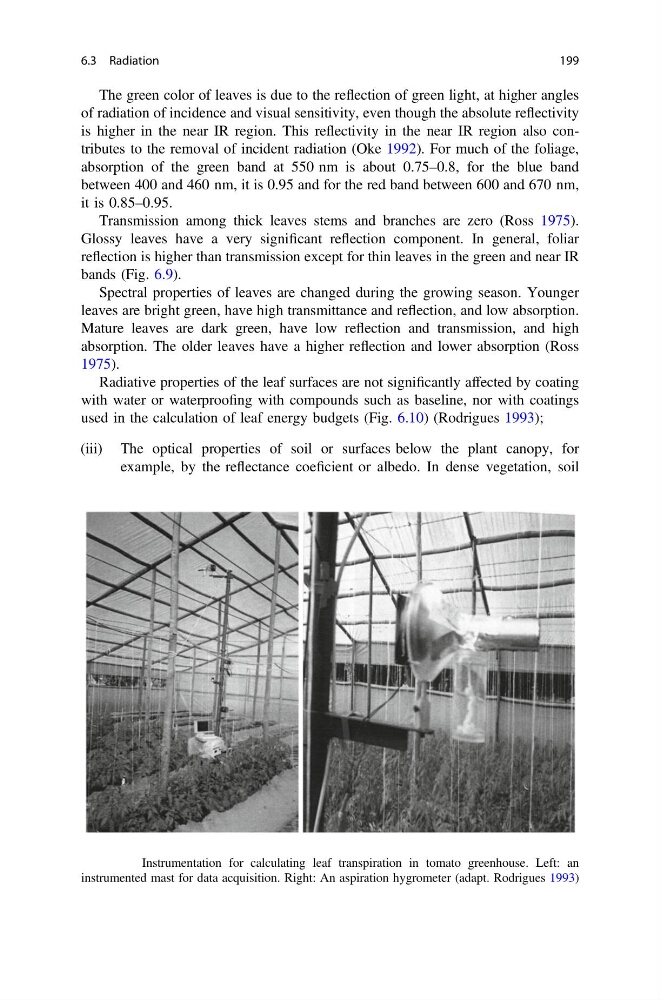
used in the calculation of leaf energy budgets (Fig. 6.10) (Rodrigues 1993);
(iii) The optical properties of soil or surfaces below the plant canopy, for
example, by the reflectance coeficient or albedo. In dense vegetation, soil
Fig. 6.10 Instrumentation for calculating leaf transpiration in tomato greenhouse. Left: an
instrumented mast for data acquisition. Right: An aspiration hygrometer (adapt. Rodrigues 1993)
6.3 Radiation
199
of radiation of incidence and visual sensitivity, even though the absolute reflectivity
is higher in the near IR region. This reflectivity in the near IR region also contributes to the removal of incident radiation (Oke 1992). For much of the foliage,
absorption of the green band at 550 nm is about 0.75–0.8, for the blue band
between 400 and 460 nm, it is 0.95 and for the red band between 600 and 670 nm,
it is 0.85–0.95.
Transmission among thick leaves stems and branches are zero (Ross 1975).
Glossy leaves have a very significant reflection component. In general, foliar
reflection is higher than transmission except for thin leaves in the green and near IR
bands (Fig. 6.9).
Spectral properties of leaves are changed during the growing season. Younger
leaves are bright green, have high transmittance and reflection, and low absorption.
Mature leaves are dark green, have low reflection and transmission, and high
absorption. The older leaves have a higher reflection and lower absorption (Ross
1975).
Radiative properties of the leaf surfaces are not significantly affected by coating
with water or waterproofing with compounds such as baseline, nor with coatings
used in the calculation of leaf energy budgets (Fig. 6.10) (Rodrigues 1993);
(iii) The optical properties of soil or surfaces below the plant canopy, for
example, by the reflectance coeficient or albedo. In dense vegetation, soil
Fig. 6.10 Instrumentation for calculating leaf transpiration in tomato greenhouse. Left: an
instrumented mast for data acquisition. Right: An aspiration hygrometer (adapt. Rodrigues 1993)
6.3 Radiation
199