

where x is the volume fraction occupied by each component and s, l, and g indexes
refer to the solid, liquid, and gaseous soil components. The value of where x for
sandy and clay soils ranges from 0.3 to 0.4, increases with organic matter content,
and is about 0.8 in organic soils. Since the air density is low, the third term on the
right side of Eq. (6.13) can be neglected. The equation for obtaining the apparent
bulk density is no longer strictly linear for moisture saturated swelling soils. If q s
and x s are constant, the bulk density increases linearly with the liquid fraction
(Monteith and Unsworth 1991).
The specific heat of a material c is defined as the heat absorbed or released per
unit mass during a 1 °C change in temperature. The product of mass density and
specific heat is called the specific heat per unit volume (Jm
−3 K
−1 ) or thermal
capacity. For a given soil, without swelling, its value is the sum
q
0 c
0
¼ q s c s x s þ q l c l x l þ q g c g x g
ð6:14Þ
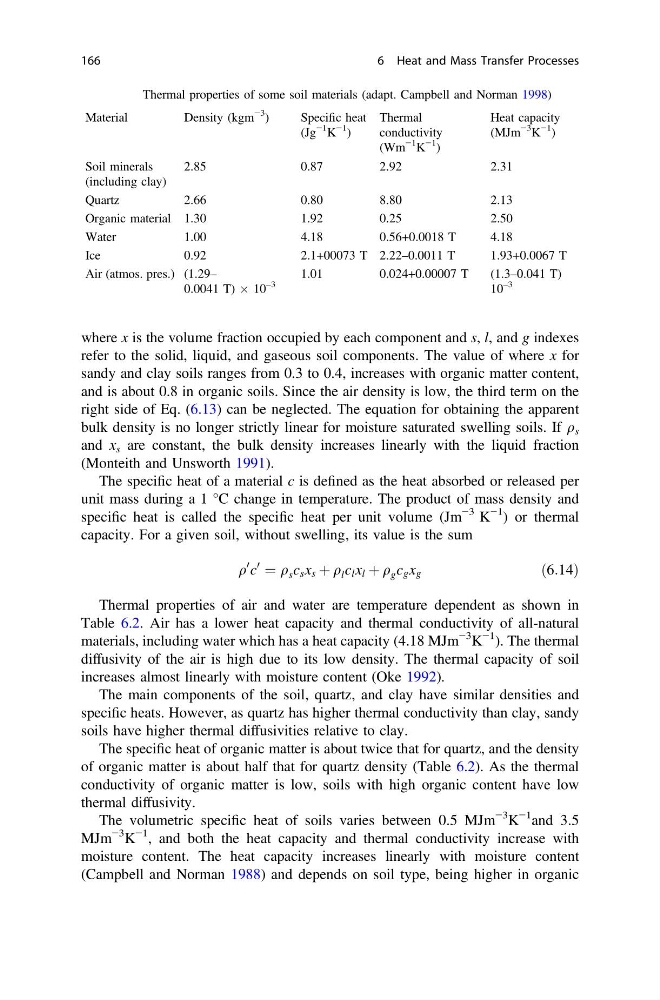
Thermal properties of air and water are temperature dependent as shown in
Table 6.2. Air has a lower heat capacity and thermal conductivity of all-natural
materials, including water which has a heat capacity (4.18 MJm
−3 K
−1 ). The thermal
diffusivity of the air is high due to its low density. The thermal capacity of soil
increases almost linearly with moisture content (Oke 1992).
The main components of the soil, quartz, and clay have similar densities and
specific heats. However, as quartz has higher thermal conductivity than clay, sandy
soils have higher thermal diffusivities relative to clay.
The specific heat of organic matter is about twice that for quartz, and the density
of organic matter is about half that for quartz density (Table 6.2). As the thermal
conductivity of organic matter is low, soils with high organic content have low
thermal diffusivity.
The volumetric specific heat of soils varies between 0.5 MJm
−3 K
−1 and 3.5
MJm
−3 K
−1 , and both the heat capacity and thermal conductivity increase with
moisture content. The heat capacity increases linearly with moisture content
(Campbell and Norman 1988) and depends on soil type, being higher in organic
Table 6.2 Thermal properties of some soil materials (adapt. Campbell and Norman 1998)
Material
Density (kgm
−3
)
Specific heat
(Jg
−1
K
−1
)
Thermal
conductivity
(Wm
−1
K
−1
)
Heat capacity
(MJm
−3
K
−1
)
Soil minerals
(including clay)
2.85
0.87
2.92
2.31
Quartz
2.66
0.80
8.80
2.13
Organic material 1.30
1.92
0.25
2.50
Water
1.00
4.18
0.56+0.0018 T
4.18
Ice
0.92
2.1+00073 T 2.22–0.0011 T
1.93+0.0067 T
Air (atmos. pres.) (1.29–
0.0041 T) Â 10
–3
1.01
0.024+0.00007 T
(1.3–0.041 T)
10
–3
166
6 Heat and Mass Transfer Processes
refer to the solid, liquid, and gaseous soil components. The value of where x for
sandy and clay soils ranges from 0.3 to 0.4, increases with organic matter content,
and is about 0.8 in organic soils. Since the air density is low, the third term on the
right side of Eq. (6.13) can be neglected. The equation for obtaining the apparent
bulk density is no longer strictly linear for moisture saturated swelling soils. If q s
and x s are constant, the bulk density increases linearly with the liquid fraction
(Monteith and Unsworth 1991).
The specific heat of a material c is defined as the heat absorbed or released per
unit mass during a 1 °C change in temperature. The product of mass density and
specific heat is called the specific heat per unit volume (Jm
−3 K
−1 ) or thermal
capacity. For a given soil, without swelling, its value is the sum
q
0 c
0
¼ q s c s x s þ q l c l x l þ q g c g x g
ð6:14Þ
Thermal properties of air and water are temperature dependent as shown in
Table 6.2. Air has a lower heat capacity and thermal conductivity of all-natural
materials, including water which has a heat capacity (4.18 MJm
−3 K
−1 ). The thermal
diffusivity of the air is high due to its low density. The thermal capacity of soil
increases almost linearly with moisture content (Oke 1992).
The main components of the soil, quartz, and clay have similar densities and
specific heats. However, as quartz has higher thermal conductivity than clay, sandy
soils have higher thermal diffusivities relative to clay.
The specific heat of organic matter is about twice that for quartz, and the density
of organic matter is about half that for quartz density (Table 6.2). As the thermal
conductivity of organic matter is low, soils with high organic content have low
thermal diffusivity.
The volumetric specific heat of soils varies between 0.5 MJm
−3 K
−1 and 3.5
MJm
−3 K
−1 , and both the heat capacity and thermal conductivity increase with
moisture content. The heat capacity increases linearly with moisture content
(Campbell and Norman 1988) and depends on soil type, being higher in organic
Table 6.2 Thermal properties of some soil materials (adapt. Campbell and Norman 1998)
Material
Density (kgm
−3
)
Specific heat
(Jg
−1
K
−1
)
Thermal
conductivity
(Wm
−1
K
−1
)
Heat capacity
(MJm
−3
K
−1
)
Soil minerals
(including clay)
2.85
0.87
2.92
2.31
Quartz
2.66
0.80
8.80
2.13
Organic material 1.30
1.92
0.25
2.50
Water
1.00
4.18
0.56+0.0018 T
4.18
Ice
0.92
2.1+00073 T 2.22–0.0011 T
1.93+0.0067 T
Air (atmos. pres.) (1.29–
0.0041 T) Â 10
–3
1.01
0.024+0.00007 T
(1.3–0.041 T)
10
–3
166
6 Heat and Mass Transfer Processes