

Aspects of urban planning such as the spatial distribution of streets, green areas,
pavements, playgrounds, or parking lots, are associated with the range of previously
described factors. Clearly, buildings need to have large bases in comparison to
height, corresponding to a ratio W/H of about 2, so that recirculation effects are
confined to the upper part of the base and should have open spaces for air cross
circulation (Oke 1992). Atmospheric flow also determines the distribution and
accumulation of pollutants, e.g., from motor vehicles so that open spaces and street
width are adequate to promote good air displacement, mitigating the poor recirculation typical of narrow streets.
5.5 Flow Over Gently Sloping Hills
This topic deals with the effects of small hills, ridges, and escarpments on flow in
the atmospheric boundary layer. The effects of high mountain chains go well
beyond the atmospheric boundary layer, involving mesoscale motions. Flows
around hills and gentle ridges are sensitive to the dominant wind regime, unlike
flows around urban canopies in which mechanically and thermally generated turbulence is mainly responsible for fluctuations in the mean flow (Arya 1988). The
interaction between these obstacles and the wind regime must consider conditions
for thermal stability or instability.
5.5.1 Flow Under Different Conditions of Stability
The effects of topography on the dominant flow are affected by thermal stratification. The Froude number, F r , is the dimensionless ratio often used for quantification
of stratification of atmospheric flow around topography. Physically, the Froude
number represents the ratio of inertia to gravity forces determining the flow over
topography.
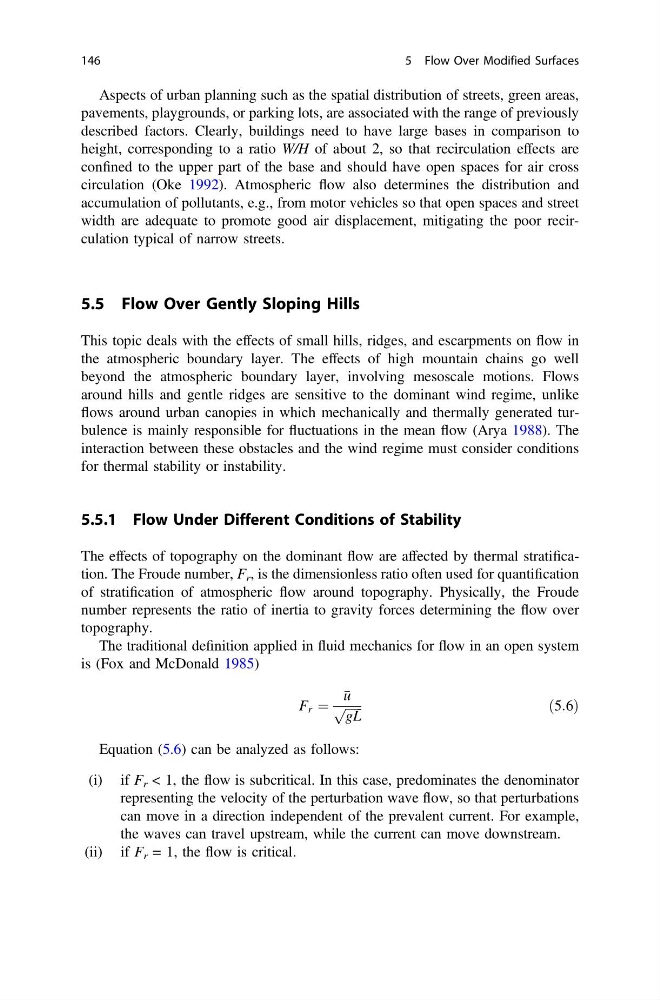
The traditional definition applied in fluid mechanics for flow in an open system
is (Fox and McDonald 1985)
F r ¼
u
ffiffiffiffiffi ffi
gL
p
ð5:6Þ
Equation (5.6) can be analyzed as follows:
(i) if F r < 1, the flow is subcritical. In this case, predominates the denominator
representing the velocity of the perturbation wave flow, so that perturbations
can move in a direction independent of the prevalent current. For example,
the waves can travel upstream, while the current can move downstream.
(ii) if F r = 1, the flow is critical.
146
5 Flow Over Modified Surfaces
pavements, playgrounds, or parking lots, are associated with the range of previously
described factors. Clearly, buildings need to have large bases in comparison to
height, corresponding to a ratio W/H of about 2, so that recirculation effects are
confined to the upper part of the base and should have open spaces for air cross
circulation (Oke 1992). Atmospheric flow also determines the distribution and
accumulation of pollutants, e.g., from motor vehicles so that open spaces and street
width are adequate to promote good air displacement, mitigating the poor recirculation typical of narrow streets.
5.5 Flow Over Gently Sloping Hills
This topic deals with the effects of small hills, ridges, and escarpments on flow in
the atmospheric boundary layer. The effects of high mountain chains go well
beyond the atmospheric boundary layer, involving mesoscale motions. Flows
around hills and gentle ridges are sensitive to the dominant wind regime, unlike
flows around urban canopies in which mechanically and thermally generated turbulence is mainly responsible for fluctuations in the mean flow (Arya 1988). The
interaction between these obstacles and the wind regime must consider conditions
for thermal stability or instability.
5.5.1 Flow Under Different Conditions of Stability
The effects of topography on the dominant flow are affected by thermal stratification. The Froude number, F r , is the dimensionless ratio often used for quantification
of stratification of atmospheric flow around topography. Physically, the Froude
number represents the ratio of inertia to gravity forces determining the flow over
topography.
The traditional definition applied in fluid mechanics for flow in an open system
is (Fox and McDonald 1985)
F r ¼
u
ffiffiffiffiffi ffi
gL
p
ð5:6Þ
Equation (5.6) can be analyzed as follows:
(i) if F r < 1, the flow is subcritical. In this case, predominates the denominator
representing the velocity of the perturbation wave flow, so that perturbations
can move in a direction independent of the prevalent current. For example,
the waves can travel upstream, while the current can move downstream.
(ii) if F r = 1, the flow is critical.
146
5 Flow Over Modified Surfaces