

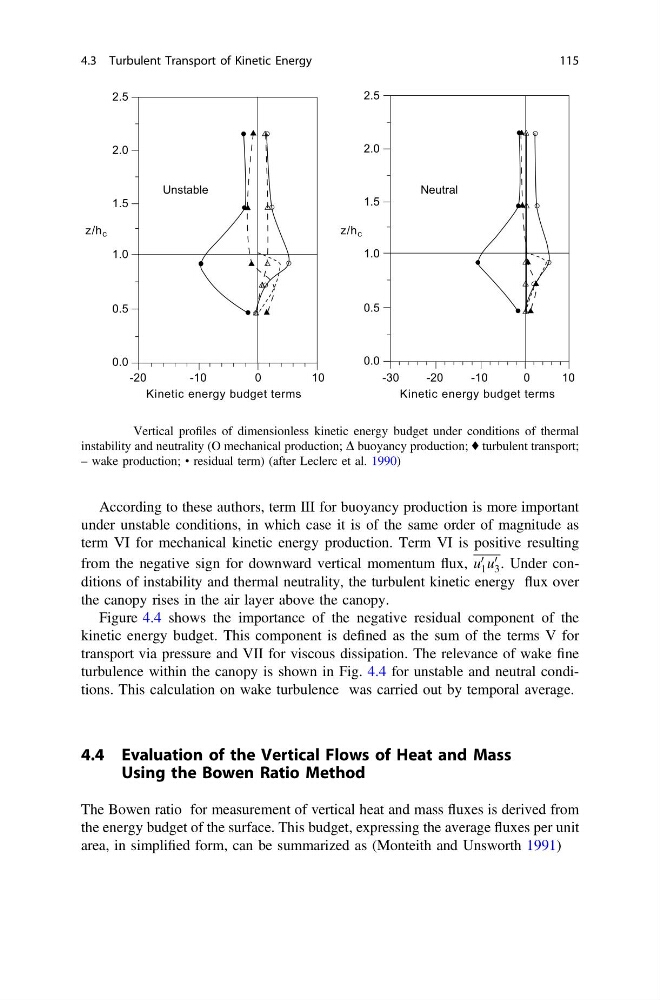
According to these authors, term III for buoyancy production is more important
under unstable conditions, in which case it is of the same order of magnitude as
term VI for mechanical kinetic energy production. Term VI is positive resulting
from the negative sign for downward vertical momentum flux, u 0
1 u 0
3 . Under conditions of instability and thermal neutrality, the turbulent kinetic energy flux over
the canopy rises in the air layer above the canopy.
Figure 4.4 shows the importance of the negative residual component of the
kinetic energy budget. This component is defined as the sum of the terms V for
transport via pressure and VII for viscous dissipation. The relevance of wake fine
turbulence within the canopy is shown in Fig. 4.4 for unstable and neutral conditions. This calculation on wake turbulence was carried out by temporal average.
4.4 Evaluation of the Vertical Flows of Heat and Mass
Using the Bowen Ratio Method
The Bowen ratio for measurement of vertical heat and mass fluxes is derived from
the energy budget of the surface. This budget, expressing the average fluxes per unit
area, in simplified form, can be summarized as (Monteith and Unsworth 1991)
Unstable
z/h c
z/h c
Kinetic energy budget terms
Kinetic energy budget terms
2.5
1.5
0.5
2.0
1.0
0.0
0
1 0
-10
-20
2.5
1.5
0.5
2.0
1.0
0.0
0
1 0
-10
-20
-30
Neutral
Fig. 4.4 Vertical profiles of dimensionless kinetic energy budget under conditions of thermal
instability and neutrality (O mechanical production; D buoyancy production; ♦ turbulent transport;
– wake production; • residual term) (after Leclerc et al. 1990)
4.3 Turbulent Transport of Kinetic Energy
115
under unstable conditions, in which case it is of the same order of magnitude as
term VI for mechanical kinetic energy production. Term VI is positive resulting
from the negative sign for downward vertical momentum flux, u 0
1 u 0
3 . Under conditions of instability and thermal neutrality, the turbulent kinetic energy flux over
the canopy rises in the air layer above the canopy.
Figure 4.4 shows the importance of the negative residual component of the
kinetic energy budget. This component is defined as the sum of the terms V for
transport via pressure and VII for viscous dissipation. The relevance of wake fine
turbulence within the canopy is shown in Fig. 4.4 for unstable and neutral conditions. This calculation on wake turbulence was carried out by temporal average.
4.4 Evaluation of the Vertical Flows of Heat and Mass
Using the Bowen Ratio Method
The Bowen ratio for measurement of vertical heat and mass fluxes is derived from
the energy budget of the surface. This budget, expressing the average fluxes per unit
area, in simplified form, can be summarized as (Monteith and Unsworth 1991)
Unstable
z/h c
z/h c
Kinetic energy budget terms
Kinetic energy budget terms
2.5
1.5
0.5
2.0
1.0
0.0
0
1 0
-10
-20
2.5
1.5
0.5
2.0
1.0
0.0
0
1 0
-10
-20
-30
Neutral
Fig. 4.4 Vertical profiles of dimensionless kinetic energy budget under conditions of thermal
instability and neutrality (O mechanical production; D buoyancy production; ♦ turbulent transport;
– wake production; • residual term) (after Leclerc et al. 1990)
4.3 Turbulent Transport of Kinetic Energy
115