

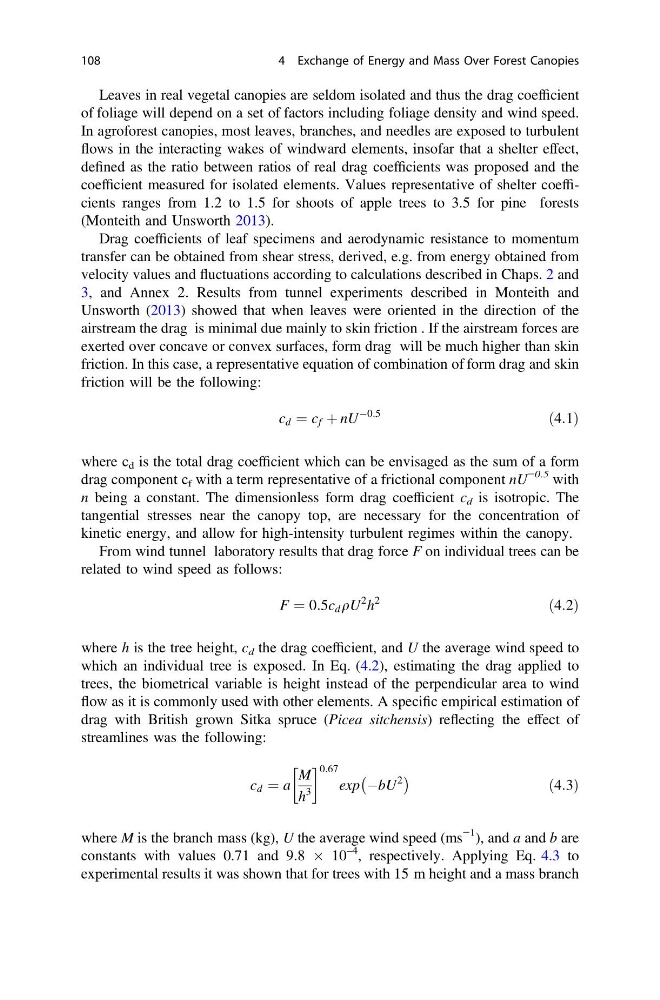
Leaves in real vegetal canopies are seldom isolated and thus the drag coefficient
of foliage will depend on a set of factors including foliage density and wind speed.
In agroforest canopies, most leaves, branches, and needles are exposed to turbulent
flows in the interacting wakes of windward elements, insofar that a shelter effect,
defined as the ratio between ratios of real drag coefficients was proposed and the
coefficient measured for isolated elements. Values representative of shelter coefficients ranges from 1.2 to 1.5 for shoots of apple trees to 3.5 for pine forests
(Monteith and Unsworth 2013).
Drag coefficients of leaf specimens and aerodynamic resistance to momentum
transfer can be obtained from shear stress, derived, e.g. from energy obtained from
velocity values and fluctuations according to calculations described in Chaps. 2 and
3, and Annex 2. Results from tunnel experiments described in Monteith and
Unsworth (2013) showed that when leaves were oriented in the direction of the
airstream the drag is minimal due mainly to skin friction . If the airstream forces are
exerted over concave or convex surfaces, form drag will be much higher than skin
friction. In this case, a representative equation of combination of form drag and skin
friction will be the following:
c d ¼ c f þ nU
À0:5
ð4:1Þ
where c d is the total drag coefficient which can be envisaged as the sum of a form
drag component c f with a term representative of a frictional component nU
−0.5 with
n being a constant. The dimensionless form drag coefficient c d is isotropic. The
tangential stresses near the canopy top, are necessary for the concentration of
kinetic energy, and allow for high-intensity turbulent regimes within the canopy.
From wind tunnel laboratory results that drag force F on individual trees can be
related to wind speed as follows:
F ¼ 0:5c d qU
2 h
2
ð4:2Þ
where h is the tree height, c d the drag coefficient, and U the average wind speed to
which an individual tree is exposed. In Eq. (4.2), estimating the drag applied to
trees, the biometrical variable is height instead of the perpendicular area to wind
flow as it is commonly used with other elements. A specific empirical estimation of
drag with British grown Sitka spruce (Picea sitchensis) reflecting the effect of
streamlines was the following:
c d ¼ a
M
h
3
! 0:67
exp ÀbU
2
À
Á
ð4:3Þ
where M is the branch mass (kg), U the average wind speed (ms
−1 ), and a and b are
constants with values 0.71 and 9.8 Â 10
–4 , respectively. Applying Eq. 4.3 to
experimental results it was shown that for trees with 15 m height and a mass branch
108
4 Exchange of Energy and Mass Over Forest Canopies
of foliage will depend on a set of factors including foliage density and wind speed.
In agroforest canopies, most leaves, branches, and needles are exposed to turbulent
flows in the interacting wakes of windward elements, insofar that a shelter effect,
defined as the ratio between ratios of real drag coefficients was proposed and the
coefficient measured for isolated elements. Values representative of shelter coefficients ranges from 1.2 to 1.5 for shoots of apple trees to 3.5 for pine forests
(Monteith and Unsworth 2013).
Drag coefficients of leaf specimens and aerodynamic resistance to momentum
transfer can be obtained from shear stress, derived, e.g. from energy obtained from
velocity values and fluctuations according to calculations described in Chaps. 2 and
3, and Annex 2. Results from tunnel experiments described in Monteith and
Unsworth (2013) showed that when leaves were oriented in the direction of the
airstream the drag is minimal due mainly to skin friction . If the airstream forces are
exerted over concave or convex surfaces, form drag will be much higher than skin
friction. In this case, a representative equation of combination of form drag and skin
friction will be the following:
c d ¼ c f þ nU
À0:5
ð4:1Þ
where c d is the total drag coefficient which can be envisaged as the sum of a form
drag component c f with a term representative of a frictional component nU
−0.5 with
n being a constant. The dimensionless form drag coefficient c d is isotropic. The
tangential stresses near the canopy top, are necessary for the concentration of
kinetic energy, and allow for high-intensity turbulent regimes within the canopy.
From wind tunnel laboratory results that drag force F on individual trees can be
related to wind speed as follows:
F ¼ 0:5c d qU
2 h
2
ð4:2Þ
where h is the tree height, c d the drag coefficient, and U the average wind speed to
which an individual tree is exposed. In Eq. (4.2), estimating the drag applied to
trees, the biometrical variable is height instead of the perpendicular area to wind
flow as it is commonly used with other elements. A specific empirical estimation of
drag with British grown Sitka spruce (Picea sitchensis) reflecting the effect of
streamlines was the following:
c d ¼ a
M
h
3
! 0:67
exp ÀbU
2
À
Á
ð4:3Þ
where M is the branch mass (kg), U the average wind speed (ms
−1 ), and a and b are
constants with values 0.71 and 9.8 Â 10
–4 , respectively. Applying Eq. 4.3 to
experimental results it was shown that for trees with 15 m height and a mass branch
108
4 Exchange of Energy and Mass Over Forest Canopies