

78
sweetened beverages per day. In 2011, the rate
was 30% in Santa Cruz County versus 41% in
California. By 2015, those numbers were 17%
and 43%, respectively.
According to the 2019 CAP report, binge
drinking has increased in Santa Cruz County,
moving from a low of 12.2% in 2009 to a high of
21.2% in 2019. Likewise, adolescents who ever
have had an alcoholic drink have moved from a
low of 18.6% in 2014 to a level of 54.3% in 2019.
However, that has decreased from a high of
65.1% in 2015.
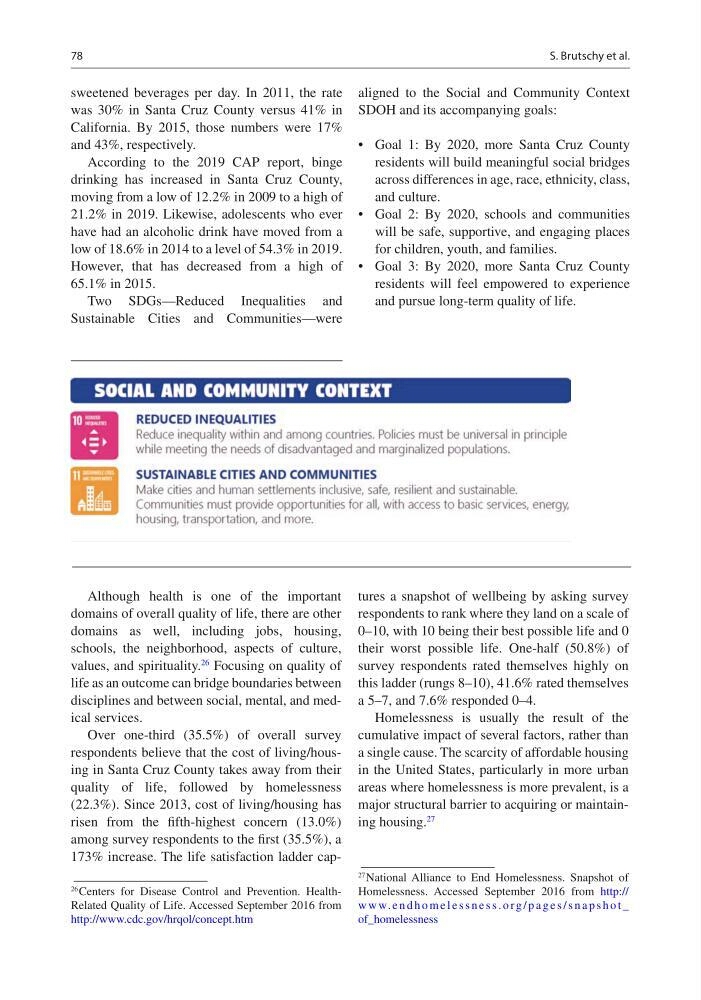
Two SDGs—Reduced Inequalities and
Sustainable Cities and Communities—were
aligned to the Social and Community Context
SDOH and its accompanying goals:
• Goal 1: By 2020, more Santa Cruz County
residents will build meaningful social bridges
across differences in age, race, ethnicity, class,
and culture.
• Goal 2: By 2020, schools and communities
will be safe, supportive, and engaging places
for children, youth, and families.
• Goal 3: By 2020, more Santa Cruz County
residents will feel empowered to experience
and pursue long-term quality of life.
Although health is one of the important
domains of overall quality of life, there are other
domains as well, including jobs, housing,
schools, the neighborhood, aspects of culture,
values, and spirituality.
26
Focusing on quality of
life as an outcome can bridge boundaries between
disciplines and between social, mental, and medical services.
Over one-third (35.5%) of overall survey
respondents believe that the cost of living/housing in Santa Cruz County takes away from their
quality of life, followed by homelessness
(22.3%). Since 2013, cost of living/housing has
risen from the fifth-highest concern (13.0%)
among survey respondents to the first (35.5%), a
173% increase. The life satisfaction ladder cap26 Centers for Disease Control and Prevention. HealthRelated Quality of Life. Accessed September 2016 from
http://www.cdc.gov/hrqol/concept.htm
tures a snapshot of wellbeing by asking survey
respondents to rank where they land on a scale of
0–10, with 10 being their best possible life and 0
their worst possible life. One-half (50.8%) of
survey respondents rated themselves highly on
this ladder (rungs 8–10), 41.6% rated themselves
a 5–7, and 7.6% responded 0–4.
Homelessness is usually the result of the
cumulative impact of several factors, rather than
a single cause. The scarcity of affordable housing
in the United States, particularly in more urban
areas where homelessness is more prevalent, is a
major structural barrier to acquiring or maintaining housing.
27
27 National Alliance to End Homelessness. Snapshot of
Homelessness. Accessed September 2016 from http://
w w w. e n d h o m e l e s s n e s s . o r g / p a g e s / s n a p s h o t _
of_homelessness
S. Brutschy et al.
sweetened beverages per day. In 2011, the rate
was 30% in Santa Cruz County versus 41% in
California. By 2015, those numbers were 17%
and 43%, respectively.
According to the 2019 CAP report, binge
drinking has increased in Santa Cruz County,
moving from a low of 12.2% in 2009 to a high of
21.2% in 2019. Likewise, adolescents who ever
have had an alcoholic drink have moved from a
low of 18.6% in 2014 to a level of 54.3% in 2019.
However, that has decreased from a high of
65.1% in 2015.
Two SDGs—Reduced Inequalities and
Sustainable Cities and Communities—were
aligned to the Social and Community Context
SDOH and its accompanying goals:
• Goal 1: By 2020, more Santa Cruz County
residents will build meaningful social bridges
across differences in age, race, ethnicity, class,
and culture.
• Goal 2: By 2020, schools and communities
will be safe, supportive, and engaging places
for children, youth, and families.
• Goal 3: By 2020, more Santa Cruz County
residents will feel empowered to experience
and pursue long-term quality of life.
Although health is one of the important
domains of overall quality of life, there are other
domains as well, including jobs, housing,
schools, the neighborhood, aspects of culture,
values, and spirituality.
26
Focusing on quality of
life as an outcome can bridge boundaries between
disciplines and between social, mental, and medical services.
Over one-third (35.5%) of overall survey
respondents believe that the cost of living/housing in Santa Cruz County takes away from their
quality of life, followed by homelessness
(22.3%). Since 2013, cost of living/housing has
risen from the fifth-highest concern (13.0%)
among survey respondents to the first (35.5%), a
173% increase. The life satisfaction ladder cap26 Centers for Disease Control and Prevention. HealthRelated Quality of Life. Accessed September 2016 from
http://www.cdc.gov/hrqol/concept.htm
tures a snapshot of wellbeing by asking survey
respondents to rank where they land on a scale of
0–10, with 10 being their best possible life and 0
their worst possible life. One-half (50.8%) of
survey respondents rated themselves highly on
this ladder (rungs 8–10), 41.6% rated themselves
a 5–7, and 7.6% responded 0–4.
Homelessness is usually the result of the
cumulative impact of several factors, rather than
a single cause. The scarcity of affordable housing
in the United States, particularly in more urban
areas where homelessness is more prevalent, is a
major structural barrier to acquiring or maintaining housing.
27
27 National Alliance to End Homelessness. Snapshot of
Homelessness. Accessed September 2016 from http://
w w w. e n d h o m e l e s s n e s s . o r g / p a g e s / s n a p s h o t _
of_homelessness
S. Brutschy et al.