

62
5.4.2 Interview Findings
The interviews analysis through the SDG lens
involved two sets of data: (1) mixed quantitative
and qualitative data in response to a question on
SDG awareness and familiarity and (2) entirely
qualitative data in response to the open-ended
question on perceptions of impact of the SDGs
on local decision-making and other perceptions
regarding glocal-local connections.
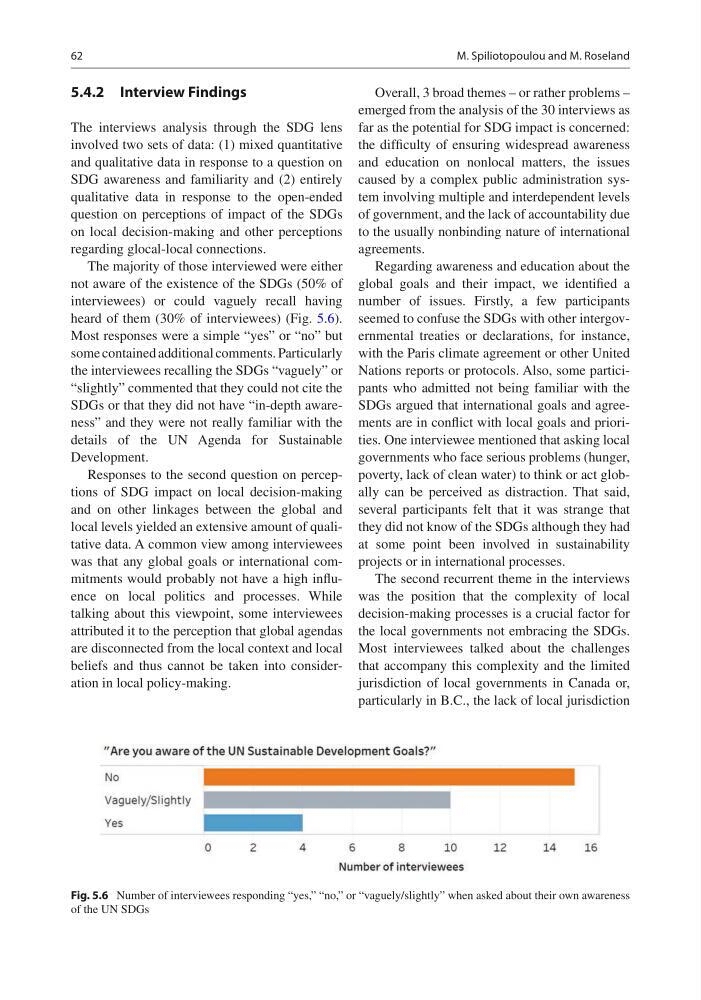
The majority of those interviewed were either
not aware of the existence of the SDGs (50% of
interviewees) or could vaguely recall having
heard of them (30% of interviewees) (Fig. 5.6).
Most responses were a simple “yes” or “no” but
some contained additional comments. Particularly
the interviewees recalling the SDGs “vaguely” or
“slightly” commented that they could not cite the
SDGs or that they did not have “in-depth awareness” and they were not really familiar with the
details of the UN Agenda for Sustainable
Development.
Responses to the second question on perceptions of SDG impact on local decision-making
and on other linkages between the global and
local levels yielded an extensive amount of qualitative data. A common view among interviewees
was that any global goals or international commitments would probably not have a high influence on local politics and processes. While
talking about this viewpoint, some interviewees
attributed it to the perception that global agendas
are disconnected from the local context and local
beliefs and thus cannot be taken into consideration in local policy-making.
Overall, 3 broad themes – or rather problems –
emerged from the analysis of the 30 interviews as
far as the potential for SDG impact is concerned:
the difficulty of ensuring widespread awareness
and education on nonlocal matters, the issues
caused by a complex public administration system involving multiple and interdependent levels
of government, and the lack of accountability due
to the usually nonbinding nature of international
agreements.
Regarding awareness and education about the
global goals and their impact, we identified a
number of issues. Firstly, a few participants
seemed to confuse the SDGs with other intergovernmental treaties or declarations, for instance,
with the Paris climate agreement or other United
Nations reports or protocols. Also, some participants who admitted not being familiar with the
SDGs argued that international goals and agreements are in conflict with local goals and priorities. One interviewee mentioned that asking local
governments who face serious problems (hunger,
poverty, lack of clean water) to think or act globally can be perceived as distraction. That said,
several participants felt that it was strange that
they did not know of the SDGs although they had
at some point been involved in sustainability
projects or in international processes.
The second recurrent theme in the interviews
was the position that the complexity of local
decision-making processes is a crucial factor for
the local governments not embracing the SDGs.
Most interviewees talked about the challenges
that accompany this complexity and the limited
jurisdiction of local governments in Canada or,
particularly in B.C., the lack of local jurisdiction
Fig. 5.6 Number of interviewees responding “yes,” “no,” or “vaguely/slightly” when asked about their own awareness
of the UN SDGs
M. Spiliotopoulou and M. Roseland
5.4.2 Interview Findings
The interviews analysis through the SDG lens
involved two sets of data: (1) mixed quantitative
and qualitative data in response to a question on
SDG awareness and familiarity and (2) entirely
qualitative data in response to the open-ended
question on perceptions of impact of the SDGs
on local decision-making and other perceptions
regarding glocal-local connections.
The majority of those interviewed were either
not aware of the existence of the SDGs (50% of
interviewees) or could vaguely recall having
heard of them (30% of interviewees) (Fig. 5.6).
Most responses were a simple “yes” or “no” but
some contained additional comments. Particularly
the interviewees recalling the SDGs “vaguely” or
“slightly” commented that they could not cite the
SDGs or that they did not have “in-depth awareness” and they were not really familiar with the
details of the UN Agenda for Sustainable
Development.
Responses to the second question on perceptions of SDG impact on local decision-making
and on other linkages between the global and
local levels yielded an extensive amount of qualitative data. A common view among interviewees
was that any global goals or international commitments would probably not have a high influence on local politics and processes. While
talking about this viewpoint, some interviewees
attributed it to the perception that global agendas
are disconnected from the local context and local
beliefs and thus cannot be taken into consideration in local policy-making.
Overall, 3 broad themes – or rather problems –
emerged from the analysis of the 30 interviews as
far as the potential for SDG impact is concerned:
the difficulty of ensuring widespread awareness
and education on nonlocal matters, the issues
caused by a complex public administration system involving multiple and interdependent levels
of government, and the lack of accountability due
to the usually nonbinding nature of international
agreements.
Regarding awareness and education about the
global goals and their impact, we identified a
number of issues. Firstly, a few participants
seemed to confuse the SDGs with other intergovernmental treaties or declarations, for instance,
with the Paris climate agreement or other United
Nations reports or protocols. Also, some participants who admitted not being familiar with the
SDGs argued that international goals and agreements are in conflict with local goals and priorities. One interviewee mentioned that asking local
governments who face serious problems (hunger,
poverty, lack of clean water) to think or act globally can be perceived as distraction. That said,
several participants felt that it was strange that
they did not know of the SDGs although they had
at some point been involved in sustainability
projects or in international processes.
The second recurrent theme in the interviews
was the position that the complexity of local
decision-making processes is a crucial factor for
the local governments not embracing the SDGs.
Most interviewees talked about the challenges
that accompany this complexity and the limited
jurisdiction of local governments in Canada or,
particularly in B.C., the lack of local jurisdiction
Fig. 5.6 Number of interviewees responding “yes,” “no,” or “vaguely/slightly” when asked about their own awareness
of the UN SDGs
M. Spiliotopoulou and M. Roseland