

58
the Community Capital Tool for the two case
studies.
We then studied the socioeconomic, environmental, political, and cultural context in the City
of Maple Ridge (CMR) and the District of North
Vancouver (DNV) and collected some quantitative data to evaluate the capacity of each city to
source reliable and timely sustainability data and
to establish an initial picture of their current sustainability situation. This quantitative data was
retrieved from various archival sources and was
measured against specific set goals and targets
found in policy and other community plans and
documents. Sources included Statistics Canada,
BC Stats (provincial statistics authority), BC
Assessment (provincial authority for property
assessment), BC Hydro (provincial electricity
utility), local health authorities, and CMR or
DNV databases.
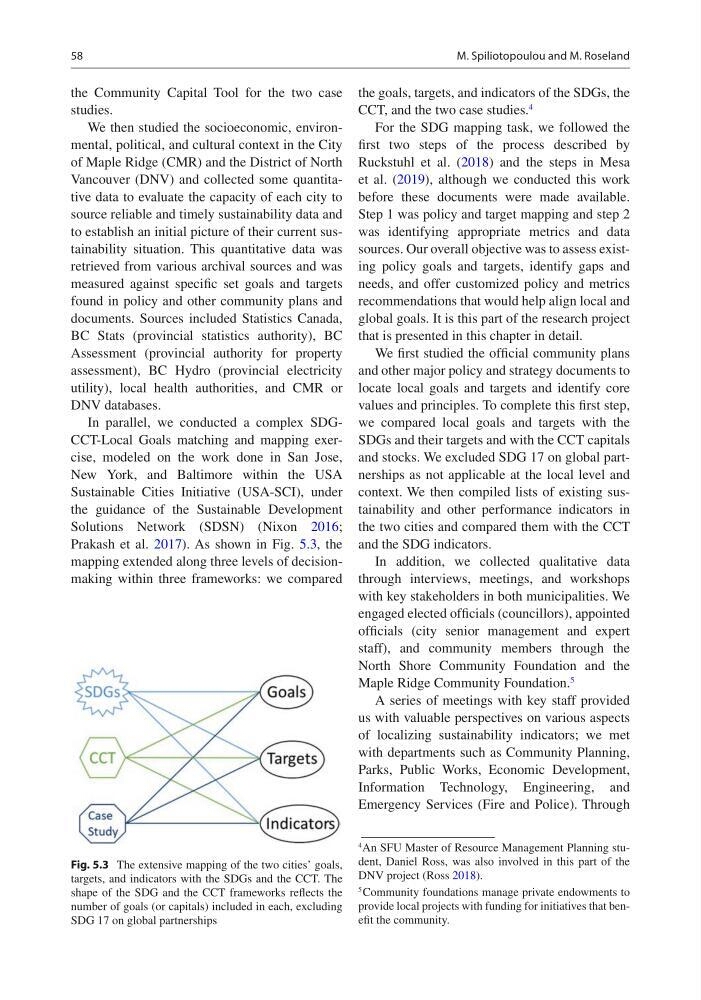
In parallel, we conducted a complex SDGCCT- Local Goals matching and mapping exercise, modeled on the work done in San Jose,
New York, and Baltimore within the USA
Sustainable Cities Initiative (USA-SCI), under
the guidance of the Sustainable Development
Solutions Network (SDSN) (Nixon 2016;
Prakash et al. 2017). As shown in Fig. 5.3, the
mapping extended along three levels of decisionmaking within three frameworks: we compared
the goals, targets, and indicators of the SDGs, the
CCT, and the two case studies.
4
For the SDG mapping task, we followed the
first two steps of the process described by
Ruckstuhl et al. (2018) and the steps in Mesa
et al. (2019), although we conducted this work
before these documents were made available.
Step 1 was policy and target mapping and step 2
was identifying appropriate metrics and data
sources. Our overall objective was to assess existing policy goals and targets, identify gaps and
needs, and offer customized policy and metrics
recommendations that would help align local and
global goals. It is this part of the research project
that is presented in this chapter in detail.
We first studied the official community plans
and other major policy and strategy documents to
locate local goals and targets and identify core
values and principles. To complete this first step,
we compared local goals and targets with the
SDGs and their targets and with the CCT capitals
and stocks. We excluded SDG 17 on global partnerships as not applicable at the local level and
context. We then compiled lists of existing sustainability and other performance indicators in
the two cities and compared them with the CCT
and the SDG indicators.
In addition, we collected qualitative data
through interviews, meetings, and workshops
with key stakeholders in both municipalities. We
engaged elected officials (councillors), appointed
officials (city senior management and expert
staff), and community members through the
North Shore Community Foundation and the
Maple Ridge Community Foundation.
5
A series of meetings with key staff provided
us with valuable perspectives on various aspects
of localizing sustainability indicators; we met
with departments such as Community Planning,
Parks, Public Works, Economic Development,
Information Technology, Engineering, and
Emergency Services (Fire and Police). Through
4 An SFU Master of Resource Management Planning student, Daniel Ross, was also involved in this part of the
DNV project (Ross 2018).
5 Community foundations manage private endowments to
provide local projects with funding for initiatives that benefit the community.
Fig. 5.3 The extensive mapping of the two cities’ goals,
targets, and indicators with the SDGs and the CCT. The
shape of the SDG and the CCT frameworks reflects the
number of goals (or capitals) included in each, excluding
SDG 17 on global partnerships
M. Spiliotopoulou and M. Roseland
the Community Capital Tool for the two case
studies.
We then studied the socioeconomic, environmental, political, and cultural context in the City
of Maple Ridge (CMR) and the District of North
Vancouver (DNV) and collected some quantitative data to evaluate the capacity of each city to
source reliable and timely sustainability data and
to establish an initial picture of their current sustainability situation. This quantitative data was
retrieved from various archival sources and was
measured against specific set goals and targets
found in policy and other community plans and
documents. Sources included Statistics Canada,
BC Stats (provincial statistics authority), BC
Assessment (provincial authority for property
assessment), BC Hydro (provincial electricity
utility), local health authorities, and CMR or
DNV databases.
In parallel, we conducted a complex SDGCCT- Local Goals matching and mapping exercise, modeled on the work done in San Jose,
New York, and Baltimore within the USA
Sustainable Cities Initiative (USA-SCI), under
the guidance of the Sustainable Development
Solutions Network (SDSN) (Nixon 2016;
Prakash et al. 2017). As shown in Fig. 5.3, the
mapping extended along three levels of decisionmaking within three frameworks: we compared
the goals, targets, and indicators of the SDGs, the
CCT, and the two case studies.
4
For the SDG mapping task, we followed the
first two steps of the process described by
Ruckstuhl et al. (2018) and the steps in Mesa
et al. (2019), although we conducted this work
before these documents were made available.
Step 1 was policy and target mapping and step 2
was identifying appropriate metrics and data
sources. Our overall objective was to assess existing policy goals and targets, identify gaps and
needs, and offer customized policy and metrics
recommendations that would help align local and
global goals. It is this part of the research project
that is presented in this chapter in detail.
We first studied the official community plans
and other major policy and strategy documents to
locate local goals and targets and identify core
values and principles. To complete this first step,
we compared local goals and targets with the
SDGs and their targets and with the CCT capitals
and stocks. We excluded SDG 17 on global partnerships as not applicable at the local level and
context. We then compiled lists of existing sustainability and other performance indicators in
the two cities and compared them with the CCT
and the SDG indicators.
In addition, we collected qualitative data
through interviews, meetings, and workshops
with key stakeholders in both municipalities. We
engaged elected officials (councillors), appointed
officials (city senior management and expert
staff), and community members through the
North Shore Community Foundation and the
Maple Ridge Community Foundation.
5
A series of meetings with key staff provided
us with valuable perspectives on various aspects
of localizing sustainability indicators; we met
with departments such as Community Planning,
Parks, Public Works, Economic Development,
Information Technology, Engineering, and
Emergency Services (Fire and Police). Through
4 An SFU Master of Resource Management Planning student, Daniel Ross, was also involved in this part of the
DNV project (Ross 2018).
5 Community foundations manage private endowments to
provide local projects with funding for initiatives that benefit the community.
Fig. 5.3 The extensive mapping of the two cities’ goals,
targets, and indicators with the SDGs and the CCT. The
shape of the SDG and the CCT frameworks reflects the
number of goals (or capitals) included in each, excluding
SDG 17 on global partnerships
M. Spiliotopoulou and M. Roseland