

55
each capital account and each of their constituent
stocks.
Community leaders, planners, and citizens
can use this information to compare the current
sustainability status of their community with past
results and potentially with other comparable
communities. The CCT was designed based on
strong sustainability principles that advocate for
the preservation of adequate amounts of all natural assets while avoiding terminal damage to
critical natural assets and consciously seeking to
address key social issues. It focuses on
community- specific issues in a way that recognizes each community’s regional and global
impact on the environment and on society at
large. The CCT is intended to incorporate the
democratic input of citizens in terms of values
and priorities and provides planners and decisionmakers with a tool that helps them ensure that
these values and priorities are reflected in policy
decisions (Roseland 2012).
In the case studies presented here, we also consulted several other sustainability assessment
frameworks. These frameworks contributed to our
improved understanding of this field and played an
important role in shaping the CCT for the two
municipalities we worked with (see more details in
the next section). These sustainability frameworks
are (in no particular order) the UN Sustainable
Development Goals, STAR Communities (recently
merged with LEED for Cities), One Planet Living
(or Eco Communities), ISO 37120, Community
Foundations of Canada Vital Signs, Green City
Index, Living Community Challenge, the EU
Reference Framework for Sustainable Cities,
LEED-ND and LEED for Cities, EcoDistricts, the
International Eco-City Framework and Standards,
and the City Resilience Index.
With regard to the SDGs in particular, we
were able to demonstrate through our case studies that the CCT is very much aligned with the
SDG framework. As we will explain in detail
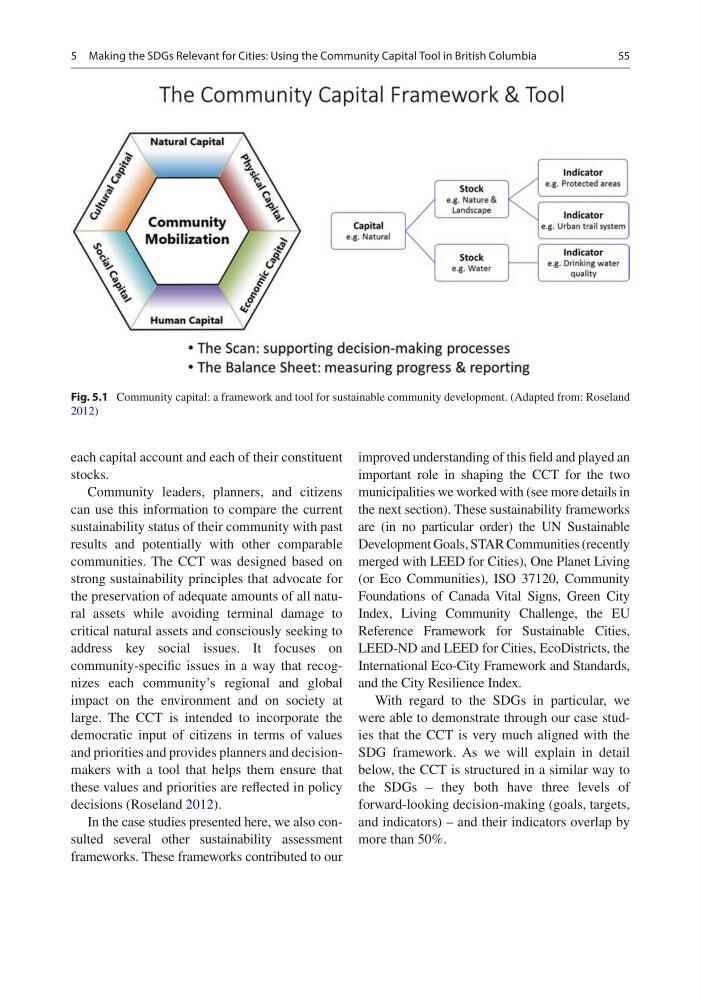
below, the CCT is structured in a similar way to
the SDGs – they both have three levels of
forward- looking decision-making (goals, targets,
and indicators) – and their indicators overlap by
more than 50%.
Fig. 5.1 Community capital: a framework and tool for sustainable community development. (Adapted from: Roseland
2012)
5 Making the SDGs Relevant for Cities: Using the Community Capital Tool in British Columbia
each capital account and each of their constituent
stocks.
Community leaders, planners, and citizens
can use this information to compare the current
sustainability status of their community with past
results and potentially with other comparable
communities. The CCT was designed based on
strong sustainability principles that advocate for
the preservation of adequate amounts of all natural assets while avoiding terminal damage to
critical natural assets and consciously seeking to
address key social issues. It focuses on
community- specific issues in a way that recognizes each community’s regional and global
impact on the environment and on society at
large. The CCT is intended to incorporate the
democratic input of citizens in terms of values
and priorities and provides planners and decisionmakers with a tool that helps them ensure that
these values and priorities are reflected in policy
decisions (Roseland 2012).
In the case studies presented here, we also consulted several other sustainability assessment
frameworks. These frameworks contributed to our
improved understanding of this field and played an
important role in shaping the CCT for the two
municipalities we worked with (see more details in
the next section). These sustainability frameworks
are (in no particular order) the UN Sustainable
Development Goals, STAR Communities (recently
merged with LEED for Cities), One Planet Living
(or Eco Communities), ISO 37120, Community
Foundations of Canada Vital Signs, Green City
Index, Living Community Challenge, the EU
Reference Framework for Sustainable Cities,
LEED-ND and LEED for Cities, EcoDistricts, the
International Eco-City Framework and Standards,
and the City Resilience Index.
With regard to the SDGs in particular, we
were able to demonstrate through our case studies that the CCT is very much aligned with the
SDG framework. As we will explain in detail
below, the CCT is structured in a similar way to
the SDGs – they both have three levels of
forward- looking decision-making (goals, targets,
and indicators) – and their indicators overlap by
more than 50%.
Fig. 5.1 Community capital: a framework and tool for sustainable community development. (Adapted from: Roseland
2012)
5 Making the SDGs Relevant for Cities: Using the Community Capital Tool in British Columbia