

16
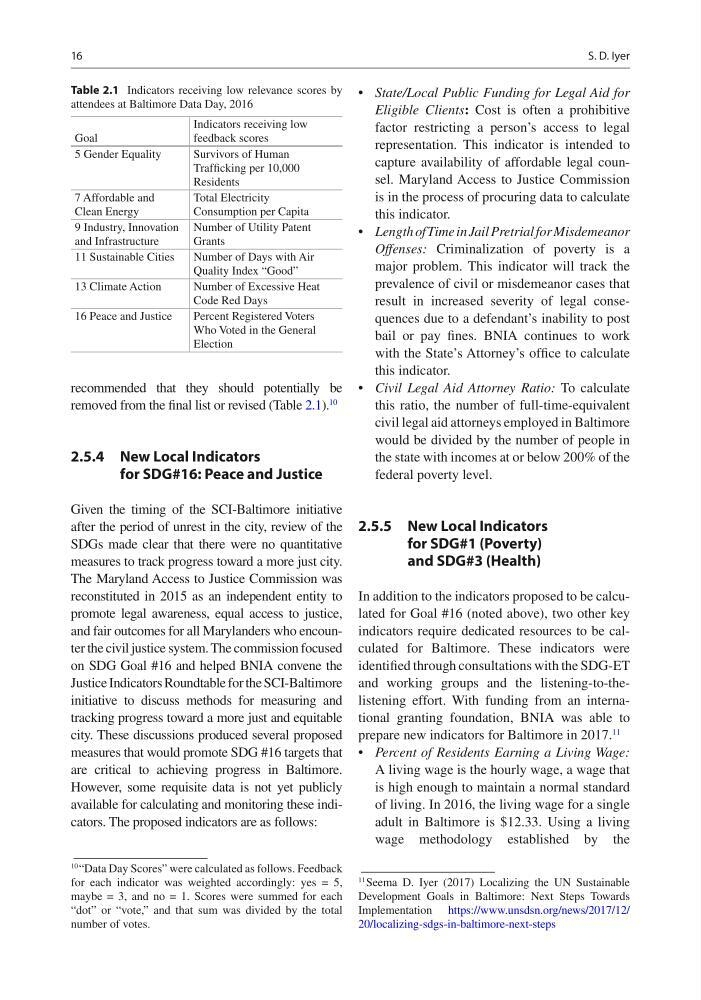
recommended that they should potentially be
removed from the final list or revised (Table 2.1).
10
2.5.4 New Local Indicators
for SDG#16: Peace and Justice
Given the timing of the SCI-Baltimore initiative
after the period of unrest in the city, review of the
SDGs made clear that there were no quantitative
measures to track progress toward a more just city.
The Maryland Access to Justice Commission was
reconstituted in 2015 as an independent entity to
promote legal awareness, equal access to justice,
and fair outcomes for all Marylanders who encounter the civil justice system. The commission focused
on SDG Goal #16 and helped BNIA convene the
Justice Indicators Roundtable for the SCI-Baltimore
initiative to discuss methods for measuring and
tracking progress toward a more just and equitable
city. These discussions produced several proposed
measures that would promote SDG #16 targets that
are critical to achieving progress in Baltimore.
However, some requisite data is not yet publicly
available for calculating and monitoring these indicators. The proposed indicators are as follows:
10 “Data Day Scores” were calculated as follows. Feedback
for each indicator was weighted accordingly: yes = 5,
maybe = 3, and no = 1. Scores were summed for each
“dot” or “vote,” and that sum was divided by the total
number of votes.
• State/Local Public Funding for Legal Aid for
Eligible Clients: Cost is often a prohibitive
factor restricting a person’s access to legal
representation. This indicator is intended to
capture availability of affordable legal counsel. Maryland Access to Justice Commission
is in the process of procuring data to calculate
this indicator.
• Length of Time in Jail Pretrial for Misdemeanor
Offenses: Criminalization of poverty is a
major problem. This indicator will track the
prevalence of civil or misdemeanor cases that
result in increased severity of legal consequences due to a defendant’s inability to post
bail or pay fines. BNIA continues to work
with the State’s Attorney’s office to calculate
this indicator.
• Civil Legal Aid Attorney Ratio: To calculate
this ratio, the number of full-time-equivalent
civil legal aid attorneys employed in Baltimore
would be divided by the number of people in
the state with incomes at or below 200% of the
federal poverty level.
2.5.5 New Local Indicators
for SDG#1 (Poverty)
and SDG#3 (Health)
In addition to the indicators proposed to be calculated for Goal #16 (noted above), two other key
indicators require dedicated resources to be calculated for Baltimore. These indicators were
identified through consultations with the SDG-ET
and working groups and the listening-to-thelistening effort. With funding from an international granting foundation, BNIA was able to
prepare new indicators for Baltimore in 2017.
11
• Percent of Residents Earning a Living Wage:
A living wage is the hourly wage, a wage that
is high enough to maintain a normal standard
of living. In 2016, the living wage for a single
adult in Baltimore is $12.33. Using a living
wage methodology established by the
11 Seema D. Iyer (2017) Localizing the UN Sustainable
Development Goals in Baltimore: Next Steps Towards
Implementation https://www.unsdsn.org/news/2017/12/
20/localizing-sdgs-in-baltimore-next-steps
Table 2.1 Indicators receiving low relevance scores by
attendees at Baltimore Data Day, 2016
Goal
Indicators receiving low
feedback scores
5 Gender Equality
Survivors of Human
Trafficking per 10,000
Residents
7 Affordable and
Clean Energy
Total Electricity
Consumption per Capita
9 Industry, Innovation
and Infrastructure
Number of Utility Patent
Grants
11 Sustainable Cities
Number of Days with Air
Quality Index “Good”
13 Climate Action
Number of Excessive Heat
Code Red Days
16 Peace and Justice
Percent Registered Voters
Who Voted in the General
Election
S. D. Iyer
recommended that they should potentially be
removed from the final list or revised (Table 2.1).
10
2.5.4 New Local Indicators
for SDG#16: Peace and Justice
Given the timing of the SCI-Baltimore initiative
after the period of unrest in the city, review of the
SDGs made clear that there were no quantitative
measures to track progress toward a more just city.
The Maryland Access to Justice Commission was
reconstituted in 2015 as an independent entity to
promote legal awareness, equal access to justice,
and fair outcomes for all Marylanders who encounter the civil justice system. The commission focused
on SDG Goal #16 and helped BNIA convene the
Justice Indicators Roundtable for the SCI-Baltimore
initiative to discuss methods for measuring and
tracking progress toward a more just and equitable
city. These discussions produced several proposed
measures that would promote SDG #16 targets that
are critical to achieving progress in Baltimore.
However, some requisite data is not yet publicly
available for calculating and monitoring these indicators. The proposed indicators are as follows:
10 “Data Day Scores” were calculated as follows. Feedback
for each indicator was weighted accordingly: yes = 5,
maybe = 3, and no = 1. Scores were summed for each
“dot” or “vote,” and that sum was divided by the total
number of votes.
• State/Local Public Funding for Legal Aid for
Eligible Clients: Cost is often a prohibitive
factor restricting a person’s access to legal
representation. This indicator is intended to
capture availability of affordable legal counsel. Maryland Access to Justice Commission
is in the process of procuring data to calculate
this indicator.
• Length of Time in Jail Pretrial for Misdemeanor
Offenses: Criminalization of poverty is a
major problem. This indicator will track the
prevalence of civil or misdemeanor cases that
result in increased severity of legal consequences due to a defendant’s inability to post
bail or pay fines. BNIA continues to work
with the State’s Attorney’s office to calculate
this indicator.
• Civil Legal Aid Attorney Ratio: To calculate
this ratio, the number of full-time-equivalent
civil legal aid attorneys employed in Baltimore
would be divided by the number of people in
the state with incomes at or below 200% of the
federal poverty level.
2.5.5 New Local Indicators
for SDG#1 (Poverty)
and SDG#3 (Health)
In addition to the indicators proposed to be calculated for Goal #16 (noted above), two other key
indicators require dedicated resources to be calculated for Baltimore. These indicators were
identified through consultations with the SDG-ET
and working groups and the listening-to-thelistening effort. With funding from an international granting foundation, BNIA was able to
prepare new indicators for Baltimore in 2017.
11
• Percent of Residents Earning a Living Wage:
A living wage is the hourly wage, a wage that
is high enough to maintain a normal standard
of living. In 2016, the living wage for a single
adult in Baltimore is $12.33. Using a living
wage methodology established by the
11 Seema D. Iyer (2017) Localizing the UN Sustainable
Development Goals in Baltimore: Next Steps Towards
Implementation https://www.unsdsn.org/news/2017/12/
20/localizing-sdgs-in-baltimore-next-steps
Table 2.1 Indicators receiving low relevance scores by
attendees at Baltimore Data Day, 2016
Goal
Indicators receiving low
feedback scores
5 Gender Equality
Survivors of Human
Trafficking per 10,000
Residents
7 Affordable and
Clean Energy
Total Electricity
Consumption per Capita
9 Industry, Innovation
and Infrastructure
Number of Utility Patent
Grants
11 Sustainable Cities
Number of Days with Air
Quality Index “Good”
13 Climate Action
Number of Excessive Heat
Code Red Days
16 Peace and Justice
Percent Registered Voters
Who Voted in the General
Election
S. D. Iyer