

142
Cultivating the workforce readiness and
career paths requires the development of an
articulated skills pathway, where a credential or
nationally recognized skill achievement will
simultaneously provide credits for a degree.
The degree credits will contribute to a degree
program and ultimately to a 2-year and then a
4-year diploma. The call for an accelerated
effort to attain 70% post-secondary credential
or degree attainment with adults age 25–44
makes this an excellent time to create a distinct
strategy for a youth workforce development
system. In 2015 the Minnesota Legislature
enacted a state postsecondary educational
attainment goal that 70% of Minnesota adults
(age 25 to 44) will have attained a postsecondary certificate or degree by 2025 (Minn. Laws
2015 Chapter 69 Article 3 Sec. 6). Achieving
this goal has been uneven and markedly slow
(Hermida and Fergus 2019). Accelerating progress towards the goal makes this an excellent
time to create a distinct strategy for a youth
workforce development system as identified in
SDG 8.b.1.
10.10.2 The Need for
the Implementation
of a Formal Youth Training
Model to Inspire
Collaborations to Collect
Common Indicators
Requires Coordination
and Large Measurable
Goals Such as the UN SDGs
SDG #8 measures both formal and informal workforce development. Informal models historically
make up the informal economic sectors, which
exist in many areas of the world and which are also
found in American cities. Youth and other marginalized people have long engaged in entrepreneurship as a means of survival. As a result, in many
areas “young people (and women of all ages)
make up a significant portion of the informal sector due to the systemic disenfranchisement that
limits their participation in formal employment”
(Kruse 2019). Nonprofits and government units in
American cities would do well to use formal models to create and capture common indicators.
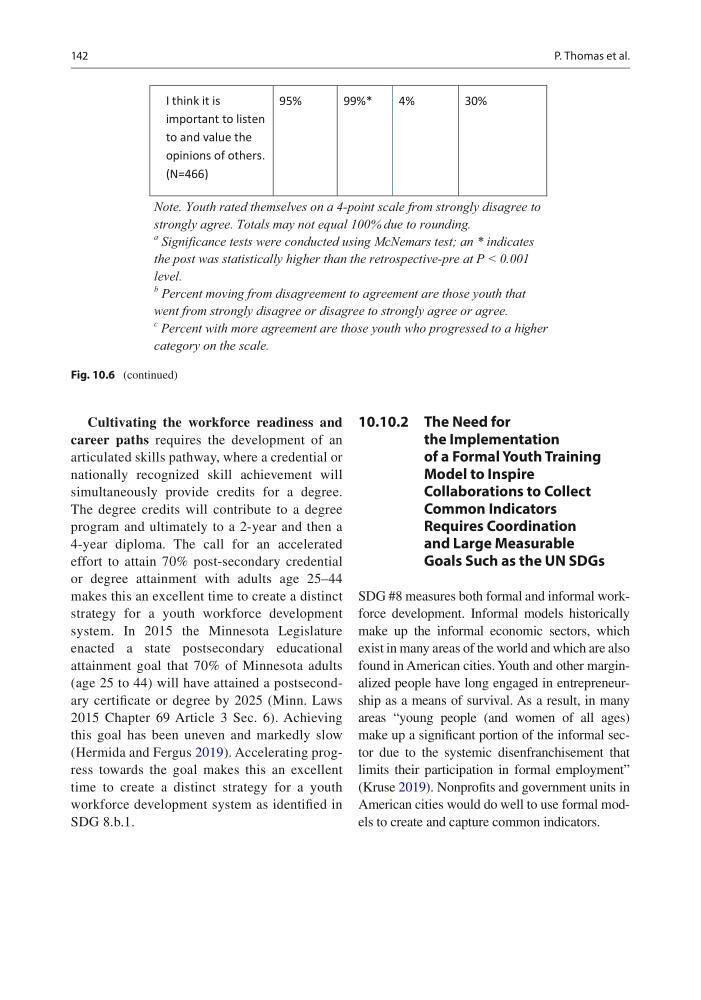
I think it is
important to listen
to and value the
opinions of others.
(N=466)
95%
9 9%*
4%
3 0%
Note. Youth rated themselves on a 4-point scale from strongly disagree to
strongly agree. Totals may not equal 100% due to rounding.
a
Significance tests were conducted using McNemars test; an * indicates
the post was statistically higher than the retrospective-pre at P < 0.001
level.
b
Percent moving from disagreement to agreement are those youth that
went from strongly disagree or disagree to strongly agree or agree.
c
Percent with more agreement are those youth who progressed to a higher
category on the scale.
Fig. 10.6 (continued)
P. Thomas et al.
Cultivating the workforce readiness and
career paths requires the development of an
articulated skills pathway, where a credential or
nationally recognized skill achievement will
simultaneously provide credits for a degree.
The degree credits will contribute to a degree
program and ultimately to a 2-year and then a
4-year diploma. The call for an accelerated
effort to attain 70% post-secondary credential
or degree attainment with adults age 25–44
makes this an excellent time to create a distinct
strategy for a youth workforce development
system. In 2015 the Minnesota Legislature
enacted a state postsecondary educational
attainment goal that 70% of Minnesota adults
(age 25 to 44) will have attained a postsecondary certificate or degree by 2025 (Minn. Laws
2015 Chapter 69 Article 3 Sec. 6). Achieving
this goal has been uneven and markedly slow
(Hermida and Fergus 2019). Accelerating progress towards the goal makes this an excellent
time to create a distinct strategy for a youth
workforce development system as identified in
SDG 8.b.1.
10.10.2 The Need for
the Implementation
of a Formal Youth Training
Model to Inspire
Collaborations to Collect
Common Indicators
Requires Coordination
and Large Measurable
Goals Such as the UN SDGs
SDG #8 measures both formal and informal workforce development. Informal models historically
make up the informal economic sectors, which
exist in many areas of the world and which are also
found in American cities. Youth and other marginalized people have long engaged in entrepreneurship as a means of survival. As a result, in many
areas “young people (and women of all ages)
make up a significant portion of the informal sector due to the systemic disenfranchisement that
limits their participation in formal employment”
(Kruse 2019). Nonprofits and government units in
American cities would do well to use formal models to create and capture common indicators.
I think it is
important to listen
to and value the
opinions of others.
(N=466)
95%
9 9%*
4%
3 0%
Note. Youth rated themselves on a 4-point scale from strongly disagree to
strongly agree. Totals may not equal 100% due to rounding.
a
Significance tests were conducted using McNemars test; an * indicates
the post was statistically higher than the retrospective-pre at P < 0.001
level.
b
Percent moving from disagreement to agreement are those youth that
went from strongly disagree or disagree to strongly agree or agree.
c
Percent with more agreement are those youth who progressed to a higher
category on the scale.
Fig. 10.6 (continued)
P. Thomas et al.