

137
Response to
supervision
64%
86%*
46%
24%
Other (N=311)
B lank
Blank
Blank
Blank
Job application
skills
46%
79%*
48%
34%
Financial selfsufficiency
46%
75%*
41%
30%
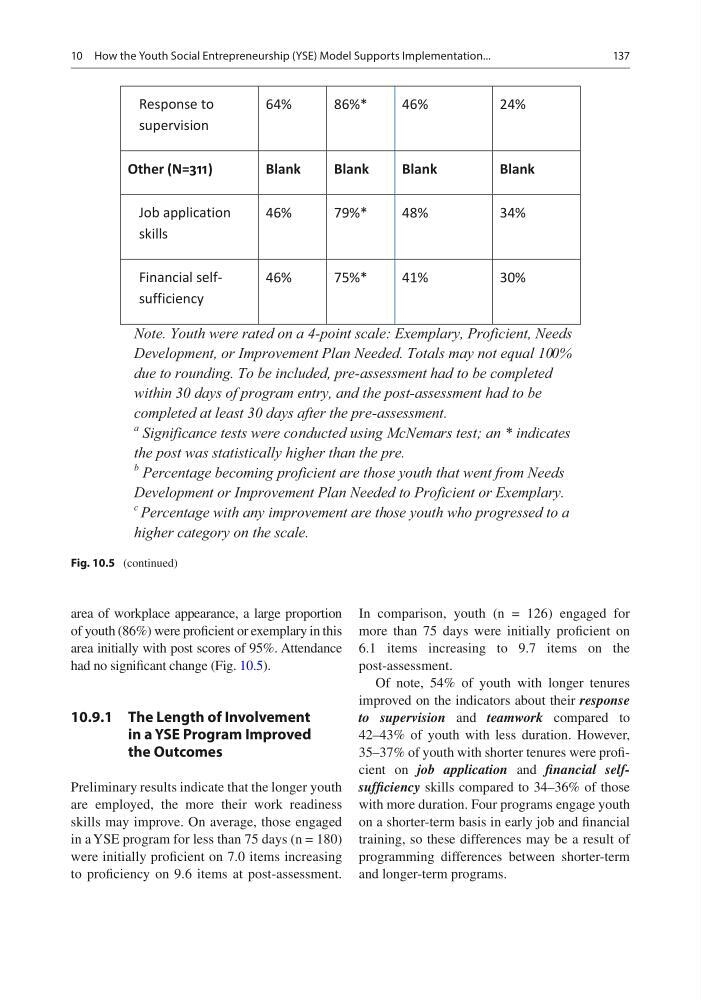
Note. Youth were rated on a 4-point scale: Exemplary, Proficient, Needs
Development, or Improvement Plan Needed. Totals may not equal 100%
due to rounding. To be included, pre-assessment had to be completed
within 30 days of program entry, and the post-assessment had to be
completed at least 30 days after the pre-assessment.
a
Significance tests were conducted using McNemars test; an * indicates
the post was statistically higher than the pre.
b
Percentage becoming proficient are those youth that went from Needs
Development or Improvement Plan Needed to Proficient or Exemplary.
c
Percentage with any improvement are those youth who progressed to a
higher category on the scale.
Fig. 10.5 (continued)
area of workplace appearance, a large proportion
of youth (86%) were proficient or exemplary in this
area initially with post scores of 95%. Attendance
had no significant change (Fig. 10.5).
10.9.1 The Length of Involvement
in a YSE Program Improved
the Outcomes
Preliminary results indicate that the longer youth
are employed, the more their work readiness
skills may improve. On average, those engaged
in a YSE program for less than 75 days (n = 180)
were initially proficient on 7.0 items increasing
to proficiency on 9.6 items at post-assessment.
In comparison, youth (n = 126) engaged for
more than 75 days were initially proficient on
6.1 items increasing to 9.7 items on the
post-assessment.
Of note, 54% of youth with longer tenures
improved on the indicators about their response
to supervision and teamwork compared to
42–43% of youth with less duration. However,
35–37% of youth with shorter tenures were proficient on job application and financial selfsufficiency skills compared to 34–36% of those
with more duration. Four programs engage youth
on a shorter-term basis in early job and financial
training, so these differences may be a result of
programming differences between shorter-term
and longer-term programs.
10 How the Youth Social Entrepreneurship (YSE) Model Supports Implementation...
Response to
supervision
64%
86%*
46%
24%
Other (N=311)
B lank
Blank
Blank
Blank
Job application
skills
46%
79%*
48%
34%
Financial selfsufficiency
46%
75%*
41%
30%
Note. Youth were rated on a 4-point scale: Exemplary, Proficient, Needs
Development, or Improvement Plan Needed. Totals may not equal 100%
due to rounding. To be included, pre-assessment had to be completed
within 30 days of program entry, and the post-assessment had to be
completed at least 30 days after the pre-assessment.
a
Significance tests were conducted using McNemars test; an * indicates
the post was statistically higher than the pre.
b
Percentage becoming proficient are those youth that went from Needs
Development or Improvement Plan Needed to Proficient or Exemplary.
c
Percentage with any improvement are those youth who progressed to a
higher category on the scale.
Fig. 10.5 (continued)
area of workplace appearance, a large proportion
of youth (86%) were proficient or exemplary in this
area initially with post scores of 95%. Attendance
had no significant change (Fig. 10.5).
10.9.1 The Length of Involvement
in a YSE Program Improved
the Outcomes
Preliminary results indicate that the longer youth
are employed, the more their work readiness
skills may improve. On average, those engaged
in a YSE program for less than 75 days (n = 180)
were initially proficient on 7.0 items increasing
to proficiency on 9.6 items at post-assessment.
In comparison, youth (n = 126) engaged for
more than 75 days were initially proficient on
6.1 items increasing to 9.7 items on the
post-assessment.
Of note, 54% of youth with longer tenures
improved on the indicators about their response
to supervision and teamwork compared to
42–43% of youth with less duration. However,
35–37% of youth with shorter tenures were proficient on job application and financial selfsufficiency skills compared to 34–36% of those
with more duration. Four programs engage youth
on a shorter-term basis in early job and financial
training, so these differences may be a result of
programming differences between shorter-term
and longer-term programs.
10 How the Youth Social Entrepreneurship (YSE) Model Supports Implementation...