

131
terms of work output, or a financial return on
investment (ROI), it creates a learning lab where
youth can naturally apply learned skills toward
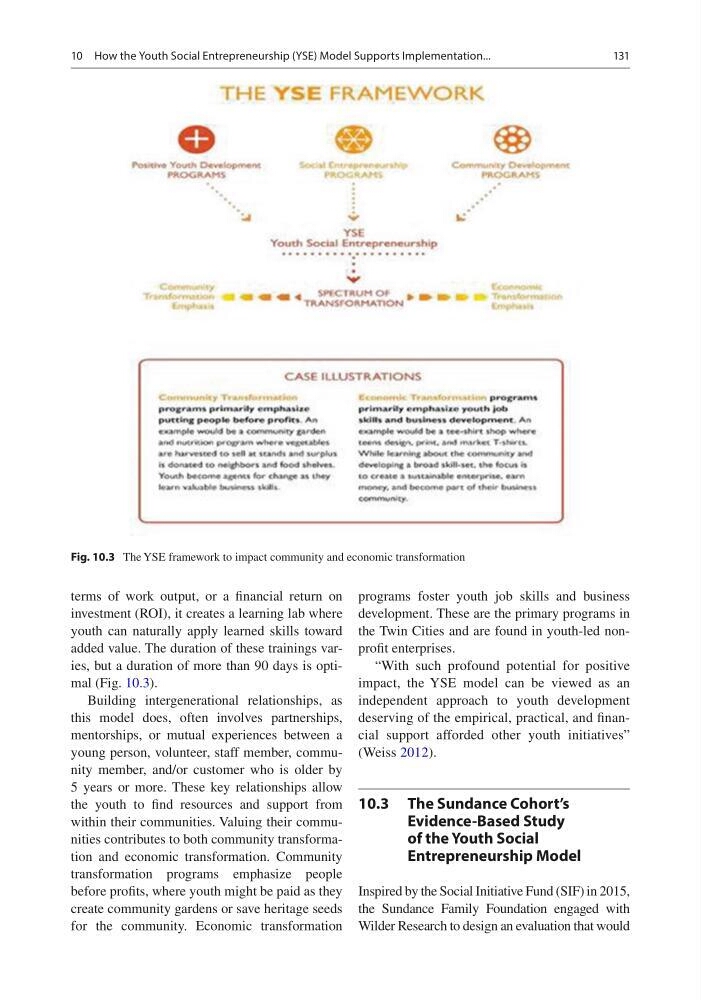
added value. The duration of these trainings varies, but a duration of more than 90 days is optimal (Fig. 10.3).
Building intergenerational relationships, as
this model does, often involves partnerships,
mentorships, or mutual experiences between a
young person, volunteer, staff member, community member, and/or customer who is older by
5 years or more. These key relationships allow
the youth to find resources and support from
within their communities. Valuing their communities contributes to both community transformation and economic transformation. Community
transformation programs emphasize people
before profits, where youth might be paid as they
create community gardens or save heritage seeds
for the community. Economic transformation
programs foster youth job skills and business
development. These are the primary programs in
the Twin Cities and are found in youth-led nonprofit enterprises.
“With such profound potential for positive
impact, the YSE model can be viewed as an
independent approach to youth development
deserving of the empirical, practical, and financial support afforded other youth initiatives”
(Weiss 2012).
10.3 The Sundance Cohort’s
Evidence-Based Study
of the Youth Social
Entrepreneurship Model
Inspired by the Social Initiative Fund (SIF) in 2015,
the Sundance Family Foundation engaged with
Wilder Research to design an evaluation that would
Fig. 10.3 The YSE framework to impact community and economic transformation
10 How the Youth Social Entrepreneurship (YSE) Model Supports Implementation...
terms of work output, or a financial return on
investment (ROI), it creates a learning lab where
youth can naturally apply learned skills toward
added value. The duration of these trainings varies, but a duration of more than 90 days is optimal (Fig. 10.3).
Building intergenerational relationships, as
this model does, often involves partnerships,
mentorships, or mutual experiences between a
young person, volunteer, staff member, community member, and/or customer who is older by
5 years or more. These key relationships allow
the youth to find resources and support from
within their communities. Valuing their communities contributes to both community transformation and economic transformation. Community
transformation programs emphasize people
before profits, where youth might be paid as they
create community gardens or save heritage seeds
for the community. Economic transformation
programs foster youth job skills and business
development. These are the primary programs in
the Twin Cities and are found in youth-led nonprofit enterprises.
“With such profound potential for positive
impact, the YSE model can be viewed as an
independent approach to youth development
deserving of the empirical, practical, and financial support afforded other youth initiatives”
(Weiss 2012).
10.3 The Sundance Cohort’s
Evidence-Based Study
of the Youth Social
Entrepreneurship Model
Inspired by the Social Initiative Fund (SIF) in 2015,
the Sundance Family Foundation engaged with
Wilder Research to design an evaluation that would
Fig. 10.3 The YSE framework to impact community and economic transformation
10 How the Youth Social Entrepreneurship (YSE) Model Supports Implementation...