

114
index was tested by Smith (2003) with promising
results. The second composite measure (hereafter
“housing quality index”) gives the community
not only detailed information on inadequate
housing but also details about the conditions of
particular dimensions. This will help the neighborhood in its decision-making process moving
forward with specific goals and objectives for the
area.
Recent empirical evidence in the literature
shows that external physical conditions are among
the most significant dimensions when determining quality of housing; therefore, the instrument
was conceived under this assumption. The survey
was designed in collaboration with the neighborhood association through focus groups. Elected
officials offered input for the instrument as well.
Once the instrument was created, it was tested in
the field and adjusted to correct for mistakes and
better use. The survey was implemented by students in university courses from the geography
and planning department. The data was then processed and reviewed using the software IBM
SPSS Version 25.
Information was collected on 362 dwelling
units, from which 61 (16%) are multifamily
units,
6
149 (41%) single-family residential units,
and 152 (42%) duplexes and triplexes. In terms
6 Four or more units.
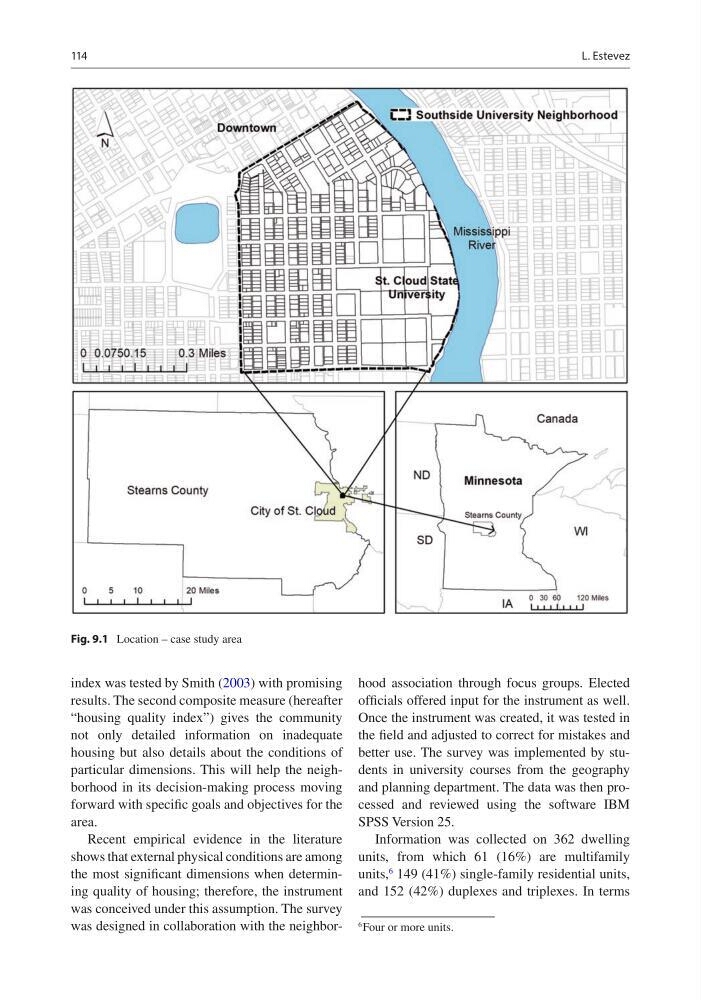
Fig. 9.1 Location – case study area
L. Estevez
index was tested by Smith (2003) with promising
results. The second composite measure (hereafter
“housing quality index”) gives the community
not only detailed information on inadequate
housing but also details about the conditions of
particular dimensions. This will help the neighborhood in its decision-making process moving
forward with specific goals and objectives for the
area.
Recent empirical evidence in the literature
shows that external physical conditions are among
the most significant dimensions when determining quality of housing; therefore, the instrument
was conceived under this assumption. The survey
was designed in collaboration with the neighborhood association through focus groups. Elected
officials offered input for the instrument as well.
Once the instrument was created, it was tested in
the field and adjusted to correct for mistakes and
better use. The survey was implemented by students in university courses from the geography
and planning department. The data was then processed and reviewed using the software IBM
SPSS Version 25.
Information was collected on 362 dwelling
units, from which 61 (16%) are multifamily
units,
6
149 (41%) single-family residential units,
and 152 (42%) duplexes and triplexes. In terms
6 Four or more units.
Fig. 9.1 Location – case study area
L. Estevez