

104
understanding and empathy for patients. In addition, Peg’s work in the Winnipeg district school
board has provided social studies teachers with
resource materials and tools to assist students in
learning about their neighborhoods through data
and carrying out local action projects in their
communities. Finally, over the years, the City of
Winnipeg has used Peg’s data as a source of
information when developing plans and policies
that impact local citizens, such as in the development of the current long-range official plan, Our
Winnipeg.
8.4.4 Peg 2.0 and TrackingProgress: 2018–Present
While Peg has been considered a model CIS with
a well-structured indicator framework and user
interface, it was recognized that improvements
were needed for Peg to continue to be relevant
and sustainable. In 2018, IISD and UWW saw
the SDGs as an opportunity to both update the
system and integrate SDG localization. IISD
therefore developed a new CIS platform technology and began a process to include and localize
the SDGs.
Technology
Building upon lessons from the original Peg website, the IISD technical team built the new
Tracking-Progress CIS platform. In June 2018,
Peg was the first CIS launched on the new
Tracking-Progress platform.
Similar to the original Peg technology,
Tracking-Progress is based on an open-source
software platform – WordPress content management software. The ability to customize themes
and indicators was designed specifically for
Tracking-Progress; however, most features are
standard WordPress plugins. Selecting opensource software reduced platform development
costs and the time and technical skill needed to
manage CIS content. The system is designed to
develop a dataset template based on predetermined geographical boundaries. Once an indicator has been developed, updating data is a simple
three-step process of (1) downloading the archived
dataset, (2) updating and reuploading the new
data points, and (3) performing quality control.
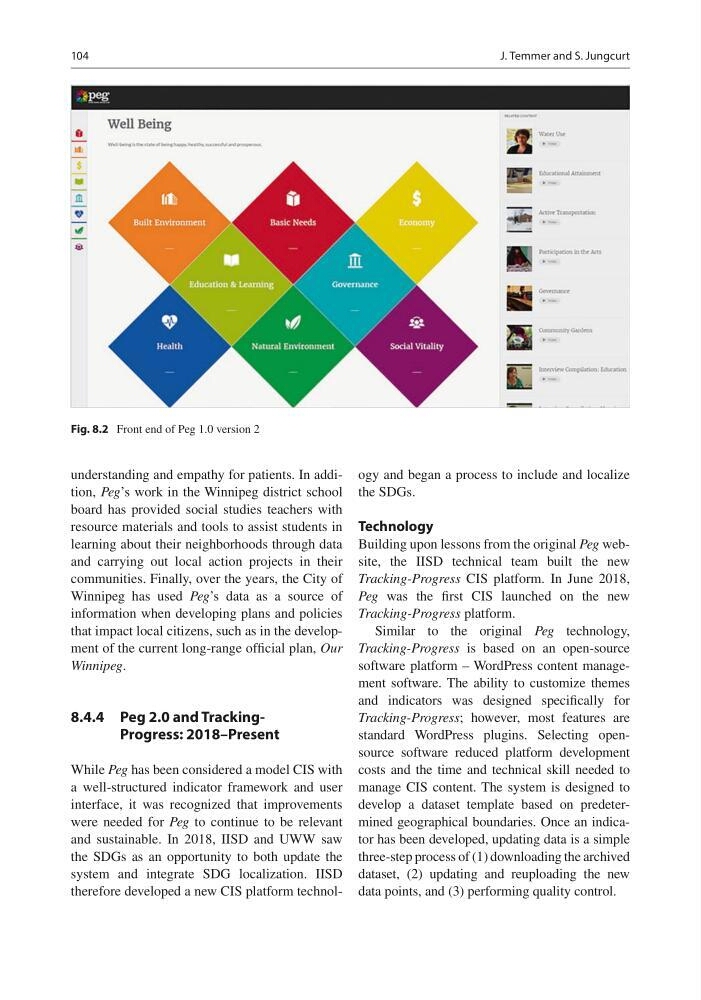
Fig. 8.2 Front end of Peg 1.0 version 2
J. Temmer and S. Jungcurt
understanding and empathy for patients. In addition, Peg’s work in the Winnipeg district school
board has provided social studies teachers with
resource materials and tools to assist students in
learning about their neighborhoods through data
and carrying out local action projects in their
communities. Finally, over the years, the City of
Winnipeg has used Peg’s data as a source of
information when developing plans and policies
that impact local citizens, such as in the development of the current long-range official plan, Our
Winnipeg.
8.4.4 Peg 2.0 and TrackingProgress: 2018–Present
While Peg has been considered a model CIS with
a well-structured indicator framework and user
interface, it was recognized that improvements
were needed for Peg to continue to be relevant
and sustainable. In 2018, IISD and UWW saw
the SDGs as an opportunity to both update the
system and integrate SDG localization. IISD
therefore developed a new CIS platform technology and began a process to include and localize
the SDGs.
Technology
Building upon lessons from the original Peg website, the IISD technical team built the new
Tracking-Progress CIS platform. In June 2018,
Peg was the first CIS launched on the new
Tracking-Progress platform.
Similar to the original Peg technology,
Tracking-Progress is based on an open-source
software platform – WordPress content management software. The ability to customize themes
and indicators was designed specifically for
Tracking-Progress; however, most features are
standard WordPress plugins. Selecting opensource software reduced platform development
costs and the time and technical skill needed to
manage CIS content. The system is designed to
develop a dataset template based on predetermined geographical boundaries. Once an indicator has been developed, updating data is a simple
three-step process of (1) downloading the archived
dataset, (2) updating and reuploading the new
data points, and (3) performing quality control.
Fig. 8.2 Front end of Peg 1.0 version 2
J. Temmer and S. Jungcurt