

70
R. Bruggemann et al.
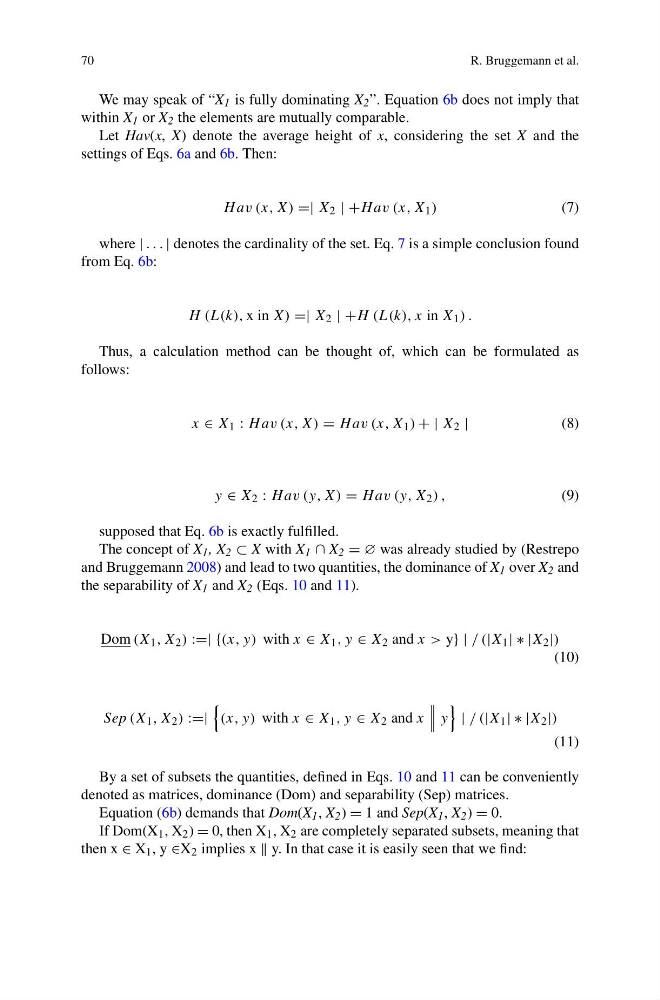
We may speak of “X 1 is fully dominating X 2 ”. Equation 6b does not imply that
within X 1 or X 2 the elements are mutually comparable.
Let Hav(x, X) denote the average height of x, considering the set X and the
settings of Eqs. 6a and 6b. Then:
H av (x, X) =| X 2 | +H av (x, X 1 )
(7)
where | . . . | denotes the cardinality of the set. Eq. 7 is a simple conclusion found
from Eq. 6b:
H (L(k), x in X) =| X 2 | +H (L(k), x in X 1 ) .
Thus, a calculation method can be thought of, which can be formulated as
follows:
x ∈ X 1 : H av (x, X) = H av (x, X 1 ) + | X 2 |
(8)
y ∈ X 2 : H av (y, X) = H av (y, X 2 ) ,
(9)
supposed that Eq. 6b is exactly fulfilled.
The concept of X 1 , X 2 ⊂ X with X 1 ∩ X 2 = ∅ was already studied by (Restrepo
and Bruggemann 2008) and lead to two quantities, the dominance of X 1 over X 2 and
the separability of X 1 and X 2 (Eqs. 10 and 11).
Dom (X 1 , X 2 ) :=| {(x, y) with x ∈ X 1 , y ∈ X 2 and x > y} | / (|X 1 | ∗ |X 2 |)
(10)
Sep (X 1 , X 2 ) :=|
(x, y) with x ∈ X 1 , y ∈ X 2 and x
y
| / (|X 1 | ∗ |X 2 |)
(11)
By a set of subsets the quantities, defined in Eqs. 10 and 11 can be conveniently
denoted as matrices, dominance (Dom) and separability (Sep) matrices.
Equation (6b) demands that Dom(X 1 , X 2 ) = 1 and Sep(X 1 , X 2 ) = 0.
If Dom(X 1 , X 2 ) = 0, then X 1 , X 2 are completely separated subsets, meaning that
then x ∈ X 1 , y ∈X 2 implies x y. In that case it is easily seen that we find:
R. Bruggemann et al.
We may speak of “X 1 is fully dominating X 2 ”. Equation 6b does not imply that
within X 1 or X 2 the elements are mutually comparable.
Let Hav(x, X) denote the average height of x, considering the set X and the
settings of Eqs. 6a and 6b. Then:
H av (x, X) =| X 2 | +H av (x, X 1 )
(7)
where | . . . | denotes the cardinality of the set. Eq. 7 is a simple conclusion found
from Eq. 6b:
H (L(k), x in X) =| X 2 | +H (L(k), x in X 1 ) .
Thus, a calculation method can be thought of, which can be formulated as
follows:
x ∈ X 1 : H av (x, X) = H av (x, X 1 ) + | X 2 |
(8)
y ∈ X 2 : H av (y, X) = H av (y, X 2 ) ,
(9)
supposed that Eq. 6b is exactly fulfilled.
The concept of X 1 , X 2 ⊂ X with X 1 ∩ X 2 = ∅ was already studied by (Restrepo
and Bruggemann 2008) and lead to two quantities, the dominance of X 1 over X 2 and
the separability of X 1 and X 2 (Eqs. 10 and 11).
Dom (X 1 , X 2 ) :=| {(x, y) with x ∈ X 1 , y ∈ X 2 and x > y} | / (|X 1 | ∗ |X 2 |)
(10)
Sep (X 1 , X 2 ) :=|
(x, y) with x ∈ X 1 , y ∈ X 2 and x
y
| / (|X 1 | ∗ |X 2 |)
(11)
By a set of subsets the quantities, defined in Eqs. 10 and 11 can be conveniently
denoted as matrices, dominance (Dom) and separability (Sep) matrices.
Equation (6b) demands that Dom(X 1 , X 2 ) = 1 and Sep(X 1 , X 2 ) = 0.
If Dom(X 1 , X 2 ) = 0, then X 1 , X 2 are completely separated subsets, meaning that
then x ∈ X 1 , y ∈X 2 implies x y. In that case it is easily seen that we find: