

Uncertainty in Weights for Composite Indicators Generated by Weighted Sums
49
The concepts (4)–(6) are explained in more details below:
4. Evolution:
Let g(j) be a value taken from [0,1] then the selection of a series of the pairs
(gjmin, gjmax) induces a set of posets. Let for example consider asystem with m = 2
and select as weights g(1) = 0.5, g(2) = 0.5. If s = 0 then there is a sharp knowledge
and no uncertainty with respect to g(1) and g(2). Consequently, there is one and only
one CI, and U, i.e., the number of incomparabilities equals 0. Now let gjmin = 0.45
and gjmax = 0.55., then the resulting s equals 0.1 and weights g(1), g(2) may be
selected within this range. There is obviously a slight uncertainty, which, however,
may not lead to incomparabilities. Let now be gjmin = 0.3 and gjmax = 0.7,
then s = 0.4 and there is considerable uncertainty concerning the selection of
weights. With other words: Around a fixed tuple g defined by (g(1), g(2), . . . ,g(m))
a (mathematical) environment, env(g,s), is of interest, where the starting tuple g and
its uncertainty s is to be specified. Consequently to each environment belongs a
set of composite indicators, which can, but most no be co-monotonic. Increasing s
from 0 (sharp knowledge about the weights) until s = 1 (no knowledge at all) and
regarding Eqs. (4, 5 and 6) leads to a series of environments as follows:
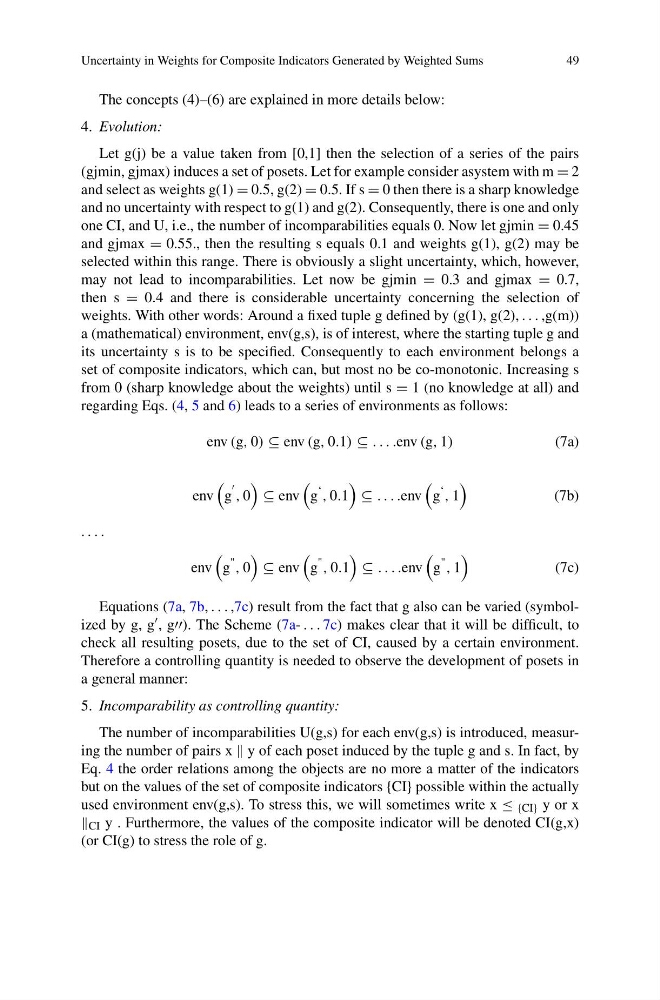
env (g, 0) ⊆ env (g, 0.1) ⊆ . . . .env (g, 1)
(7a)
env
g
, 0
⊆ env
g
‘ , 0.1
⊆ . . . .env
g
‘ , 1
(7b)
. . . .
env
g
" , 0
⊆ env
g
" , 0.1
⊆ . . . .env
g
" , 1
(7c)
Equations (7a, 7b, . . . ,7c) result from the fact that g also can be varied (symbolized by g, g , g). The Scheme (7a- . . . 7c) makes clear that it will be difficult, to
check all resulting posets, due to the set of CI, caused by a certain environment.
Therefore a controlling quantity is needed to observe the development of posets in
a general manner:
5. Incomparability as controlling quantity:
The number of incomparabilities U(g,s) for each env(g,s) is introduced, measuring the number of pairs x y of each poset induced by the tuple g and s. In fact, by
Eq. 4 the order relations among the objects are no more a matter of the indicators
but on the values of the set of composite indicators {CI} possible within the actually
used environment env(g,s). To stress this, we will sometimes write x ≤ {CI} y or x
CI y . Furthermore, the values of the composite indicator will be denoted CI(g,x)
(or CI(g) to stress the role of g.
49
The concepts (4)–(6) are explained in more details below:
4. Evolution:
Let g(j) be a value taken from [0,1] then the selection of a series of the pairs
(gjmin, gjmax) induces a set of posets. Let for example consider asystem with m = 2
and select as weights g(1) = 0.5, g(2) = 0.5. If s = 0 then there is a sharp knowledge
and no uncertainty with respect to g(1) and g(2). Consequently, there is one and only
one CI, and U, i.e., the number of incomparabilities equals 0. Now let gjmin = 0.45
and gjmax = 0.55., then the resulting s equals 0.1 and weights g(1), g(2) may be
selected within this range. There is obviously a slight uncertainty, which, however,
may not lead to incomparabilities. Let now be gjmin = 0.3 and gjmax = 0.7,
then s = 0.4 and there is considerable uncertainty concerning the selection of
weights. With other words: Around a fixed tuple g defined by (g(1), g(2), . . . ,g(m))
a (mathematical) environment, env(g,s), is of interest, where the starting tuple g and
its uncertainty s is to be specified. Consequently to each environment belongs a
set of composite indicators, which can, but most no be co-monotonic. Increasing s
from 0 (sharp knowledge about the weights) until s = 1 (no knowledge at all) and
regarding Eqs. (4, 5 and 6) leads to a series of environments as follows:
env (g, 0) ⊆ env (g, 0.1) ⊆ . . . .env (g, 1)
(7a)
env
g
, 0
⊆ env
g
‘ , 0.1
⊆ . . . .env
g
‘ , 1
(7b)
. . . .
env
g
" , 0
⊆ env
g
" , 0.1
⊆ . . . .env
g
" , 1
(7c)
Equations (7a, 7b, . . . ,7c) result from the fact that g also can be varied (symbolized by g, g , g). The Scheme (7a- . . . 7c) makes clear that it will be difficult, to
check all resulting posets, due to the set of CI, caused by a certain environment.
Therefore a controlling quantity is needed to observe the development of posets in
a general manner:
5. Incomparability as controlling quantity:
The number of incomparabilities U(g,s) for each env(g,s) is introduced, measuring the number of pairs x y of each poset induced by the tuple g and s. In fact, by
Eq. 4 the order relations among the objects are no more a matter of the indicators
but on the values of the set of composite indicators {CI} possible within the actually
used environment env(g,s). To stress this, we will sometimes write x ≤ {CI} y or x
CI y . Furthermore, the values of the composite indicator will be denoted CI(g,x)
(or CI(g) to stress the role of g.