

Assessing Inhomogeneous Indicator-Related Typologies Through the Reverse. . .
37
Table 1
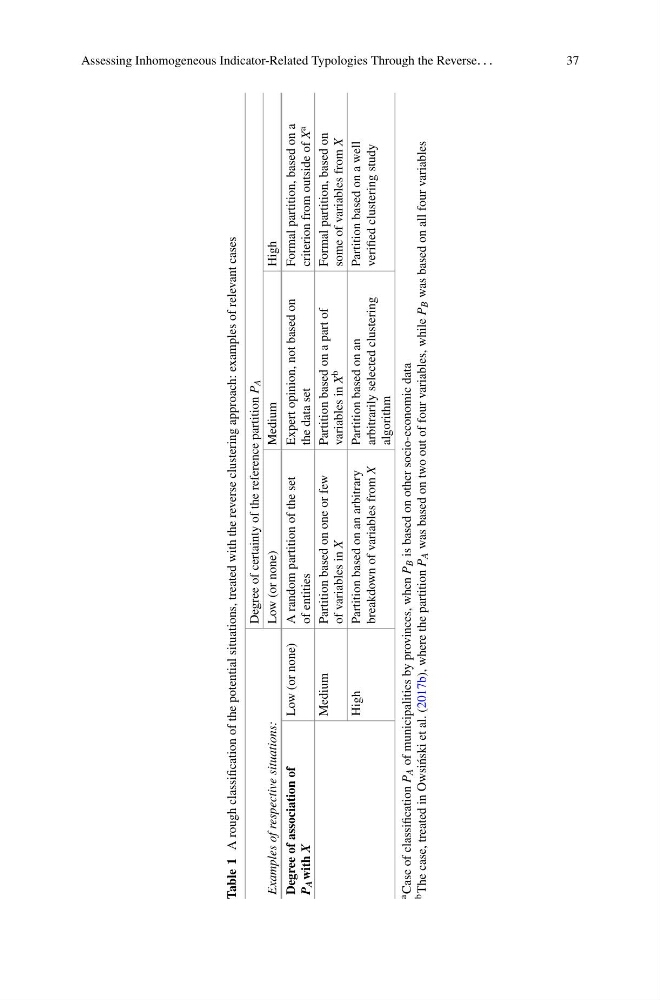
A rough classification of the potential situations, treated with the reverse clustering approach: examples of relevant cases
Degree of certainty of the reference partition P
A
Examples of respective situations:
Low (or none)
Medium
High
Degree of association of
P
A with X
Low (or none)
A random partition of the set
of entities
Expert opinion, not based on
the data set
Formal partition, based on a
criterion from outside of X a
Medium
Partition based on one or few
of variables in X
Partition based on a part of
variables in X b
Formal partition, based on
some of variables from X
High
Partition based on an arbitrary
breakdown of variables from X
Partition based on an
arbitrarily selected clustering
algorithm
Partition based on a well
verified clustering study
a
Case of classification P
A of municipalities by provinces, when P
B is based on other socio-economic data
b
The case, treated in Owsi´ nski et al. (2017b), where the partition P
A was based on two out of four variables, while P
B was based on all four variables
37
Table 1
A rough classification of the potential situations, treated with the reverse clustering approach: examples of relevant cases
Degree of certainty of the reference partition P
A
Examples of respective situations:
Low (or none)
Medium
High
Degree of association of
P
A with X
Low (or none)
A random partition of the set
of entities
Expert opinion, not based on
the data set
Formal partition, based on a
criterion from outside of X a
Medium
Partition based on one or few
of variables in X
Partition based on a part of
variables in X b
Formal partition, based on
some of variables from X
High
Partition based on an arbitrary
breakdown of variables from X
Partition based on an
arbitrarily selected clustering
algorithm
Partition based on a well
verified clustering study
a
Case of classification P
A of municipalities by provinces, when P
B is based on other socio-economic data
b
The case, treated in Owsi´ nski et al. (2017b), where the partition P
A was based on two out of four variables, while P
B was based on all four variables