

298
R. Bruggemann et al.
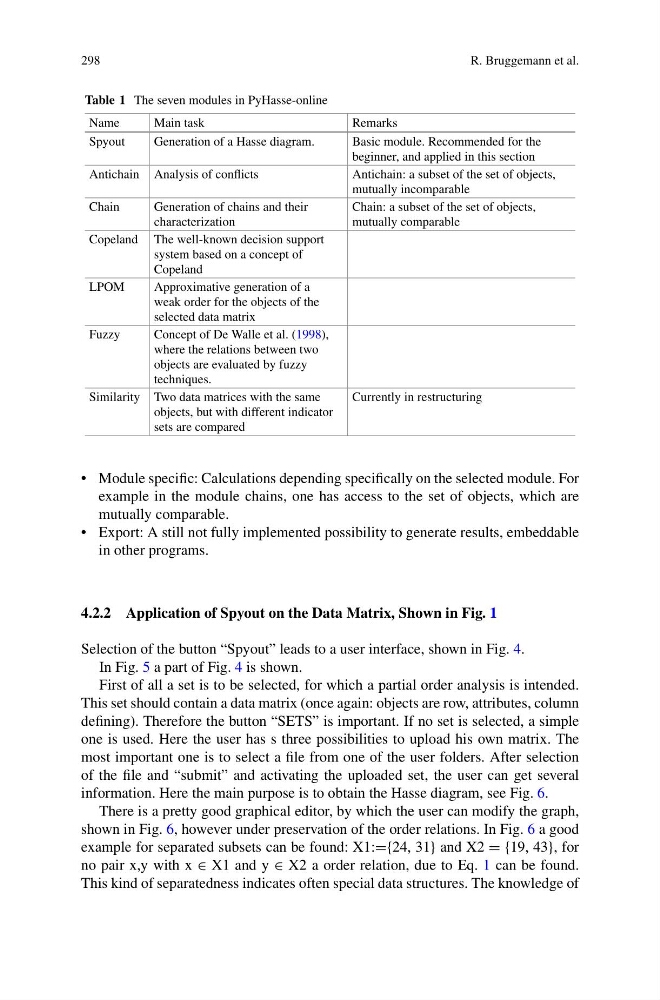
Table 1 The seven modules in PyHasse-online
Name
Main task
Remarks
Spyout
Generation of a Hasse diagram.
Basic module. Recommended for the
beginner, and applied in this section
Antichain Analysis of conflicts
Antichain: a subset of the set of objects,
mutually incomparable
Chain
Generation of chains and their
characterization
Chain: a subset of the set of objects,
mutually comparable
Copeland The well-known decision support
system based on a concept of
Copeland
LPOM
Approximative generation of a
weak order for the objects of the
selected data matrix
Fuzzy
Concept of De Walle et al. (1998),
where the relations between two
objects are evaluated by fuzzy
techniques.
Similarity Two data matrices with the same
objects, but with different indicator
sets are compared
Currently in restructuring
• Module specific: Calculations depending specifically on the selected module. For
example in the module chains, one has access to the set of objects, which are
mutually comparable.
• Export: A still not fully implemented possibility to generate results, embeddable
in other programs.
4.2.2 Application of Spyout on the Data Matrix, Shown in Fig. 1
Selection of the button “Spyout” leads to a user interface, shown in Fig. 4.
In Fig. 5 a part of Fig. 4 is shown.
First of all a set is to be selected, for which a partial order analysis is intended.
This set should contain a data matrix (once again: objects are row, attributes, column
defining). Therefore the button “SETS” is important. If no set is selected, a simple
one is used. Here the user has s three possibilities to upload his own matrix. The
most important one is to select a file from one of the user folders. After selection
of the file and “submit” and activating the uploaded set, the user can get several
information. Here the main purpose is to obtain the Hasse diagram, see Fig. 6.
There is a pretty good graphical editor, by which the user can modify the graph,
shown in Fig. 6, however under preservation of the order relations. In Fig. 6 a good
example for separated subsets can be found: X1:={24, 31} and X2 = {19, 43}, for
no pair x,y with x ∈ X1 and y ∈ X2 a order relation, due to Eq. 1 can be found.
This kind of separatedness indicates often special data structures. The knowledge of
R. Bruggemann et al.
Table 1 The seven modules in PyHasse-online
Name
Main task
Remarks
Spyout
Generation of a Hasse diagram.
Basic module. Recommended for the
beginner, and applied in this section
Antichain Analysis of conflicts
Antichain: a subset of the set of objects,
mutually incomparable
Chain
Generation of chains and their
characterization
Chain: a subset of the set of objects,
mutually comparable
Copeland The well-known decision support
system based on a concept of
Copeland
LPOM
Approximative generation of a
weak order for the objects of the
selected data matrix
Fuzzy
Concept of De Walle et al. (1998),
where the relations between two
objects are evaluated by fuzzy
techniques.
Similarity Two data matrices with the same
objects, but with different indicator
sets are compared
Currently in restructuring
• Module specific: Calculations depending specifically on the selected module. For
example in the module chains, one has access to the set of objects, which are
mutually comparable.
• Export: A still not fully implemented possibility to generate results, embeddable
in other programs.
4.2.2 Application of Spyout on the Data Matrix, Shown in Fig. 1
Selection of the button “Spyout” leads to a user interface, shown in Fig. 4.
In Fig. 5 a part of Fig. 4 is shown.
First of all a set is to be selected, for which a partial order analysis is intended.
This set should contain a data matrix (once again: objects are row, attributes, column
defining). Therefore the button “SETS” is important. If no set is selected, a simple
one is used. Here the user has s three possibilities to upload his own matrix. The
most important one is to select a file from one of the user folders. After selection
of the file and “submit” and activating the uploaded set, the user can get several
information. Here the main purpose is to obtain the Hasse diagram, see Fig. 6.
There is a pretty good graphical editor, by which the user can modify the graph,
shown in Fig. 6, however under preservation of the order relations. In Fig. 6 a good
example for separated subsets can be found: X1:={24, 31} and X2 = {19, 43}, for
no pair x,y with x ∈ X1 and y ∈ X2 a order relation, due to Eq. 1 can be found.
This kind of separatedness indicates often special data structures. The knowledge of