

Some Basic Considerations on the Design and the Interpretation of Indicators. . .
7
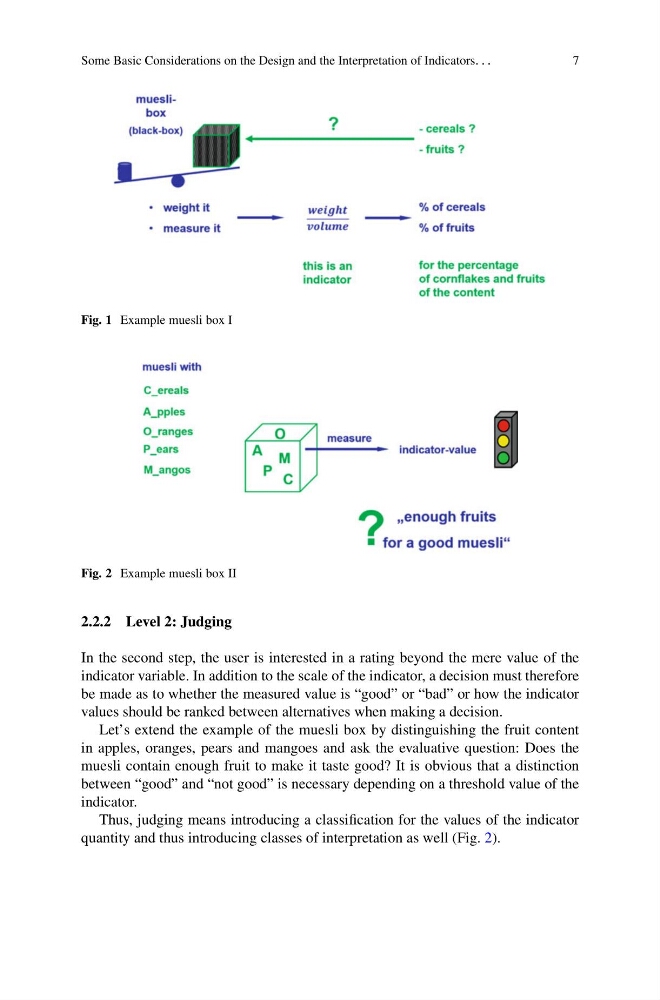
Fig. 1 Example muesli box I
Fig. 2 Example muesli box II
2.2.2 Level 2: Judging
In the second step, the user is interested in a rating beyond the mere value of the
indicator variable. In addition to the scale of the indicator, a decision must therefore
be made as to whether the measured value is “good” or “bad” or how the indicator
values should be ranked between alternatives when making a decision.
Let’s extend the example of the muesli box by distinguishing the fruit content
in apples, oranges, pears and mangoes and ask the evaluative question: Does the
muesli contain enough fruit to make it taste good? It is obvious that a distinction
between “good” and “not good” is necessary depending on a threshold value of the
indicator.
Thus, judging means introducing a classification for the values of the indicator
quantity and thus introducing classes of interpretation as well (Fig. 2).
7
Fig. 1 Example muesli box I
Fig. 2 Example muesli box II
2.2.2 Level 2: Judging
In the second step, the user is interested in a rating beyond the mere value of the
indicator variable. In addition to the scale of the indicator, a decision must therefore
be made as to whether the measured value is “good” or “bad” or how the indicator
values should be ranked between alternatives when making a decision.
Let’s extend the example of the muesli box by distinguishing the fruit content
in apples, oranges, pears and mangoes and ask the evaluative question: Does the
muesli contain enough fruit to make it taste good? It is obvious that a distinction
between “good” and “not good” is necessary depending on a threshold value of the
indicator.
Thus, judging means introducing a classification for the values of the indicator
quantity and thus introducing classes of interpretation as well (Fig. 2).