

Uranium Trappers, a Partial Order Study
193
(2017), it was shown that the arbitrary selection of attributes within intervals led to
drawing different conclusions as if other arbitrary selection within the interval were
made. According to (Quintero et al. 2017), in the current study, microorganisms
having %U> 90 and 0 ≤eff ≤ 1 were set up to %U= 90.5 and eff = 1. The
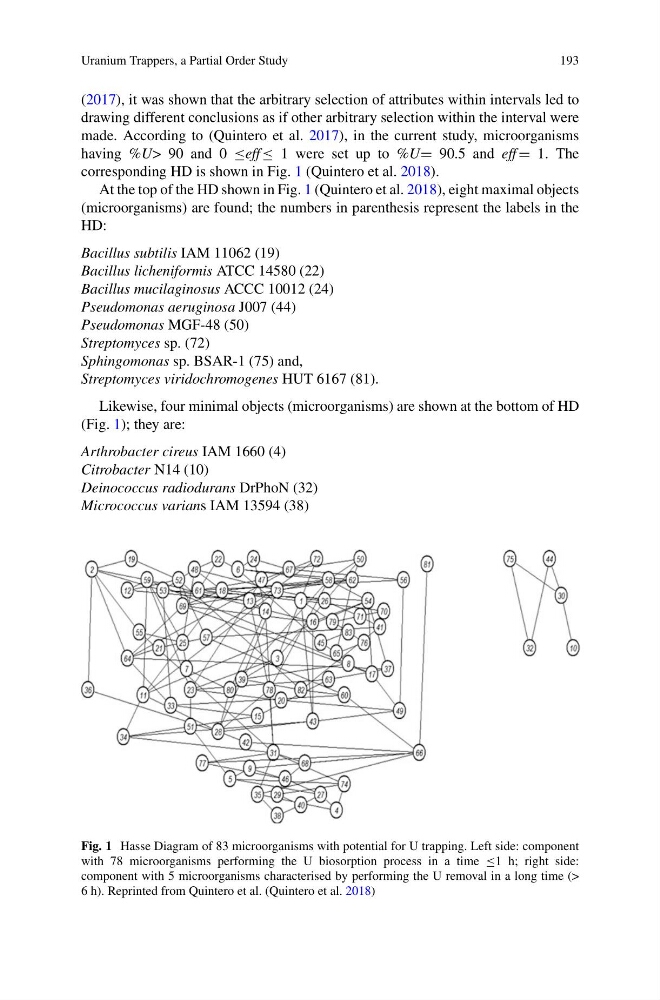
corresponding HD is shown in Fig. 1 (Quintero et al. 2018).
At the top of the HD shown in Fig. 1 (Quintero et al. 2018), eight maximal objects
(microorganisms) are found; the numbers in parenthesis represent the labels in the
HD:
Bacillus subtilis IAM 11062 (19)
Bacillus licheniformis ATCC 14580 (22)
Bacillus mucilaginosus ACCC 10012 (24)
Pseudomonas aeruginosa J007 (44)
Pseudomonas MGF-48 (50)
Streptomyces sp. (72)
Sphingomonas sp. BSAR-1 (75) and,
Streptomyces viridochromogenes HUT 6167 (81).
Likewise, four minimal objects (microorganisms) are shown at the bottom of HD
(Fig. 1); they are:
Arthrobacter cireus IAM 1660 (4)
Citrobacter N14 (10)
Deinococcus radiodurans DrPhoN (32)
Micrococcus varians IAM 13594 (38)
Fig. 1 Hasse Diagram of 83 microorganisms with potential for U trapping. Left side: component
with 78 microorganisms performing the U biosorption process in a time ≤1 h; right side:
component with 5 microorganisms characterised by performing the U removal in a long time (>
6 h). Reprinted from Quintero et al. (Quintero et al. 2018)
193
(2017), it was shown that the arbitrary selection of attributes within intervals led to
drawing different conclusions as if other arbitrary selection within the interval were
made. According to (Quintero et al. 2017), in the current study, microorganisms
having %U> 90 and 0 ≤eff ≤ 1 were set up to %U= 90.5 and eff = 1. The
corresponding HD is shown in Fig. 1 (Quintero et al. 2018).
At the top of the HD shown in Fig. 1 (Quintero et al. 2018), eight maximal objects
(microorganisms) are found; the numbers in parenthesis represent the labels in the
HD:
Bacillus subtilis IAM 11062 (19)
Bacillus licheniformis ATCC 14580 (22)
Bacillus mucilaginosus ACCC 10012 (24)
Pseudomonas aeruginosa J007 (44)
Pseudomonas MGF-48 (50)
Streptomyces sp. (72)
Sphingomonas sp. BSAR-1 (75) and,
Streptomyces viridochromogenes HUT 6167 (81).
Likewise, four minimal objects (microorganisms) are shown at the bottom of HD
(Fig. 1); they are:
Arthrobacter cireus IAM 1660 (4)
Citrobacter N14 (10)
Deinococcus radiodurans DrPhoN (32)
Micrococcus varians IAM 13594 (38)
Fig. 1 Hasse Diagram of 83 microorganisms with potential for U trapping. Left side: component
with 78 microorganisms performing the U biosorption process in a time ≤1 h; right side:
component with 5 microorganisms characterised by performing the U removal in a long time (>
6 h). Reprinted from Quintero et al. (Quintero et al. 2018)