

Indicators for Sustainability Assessment in the Procurement of Civil. . .
115
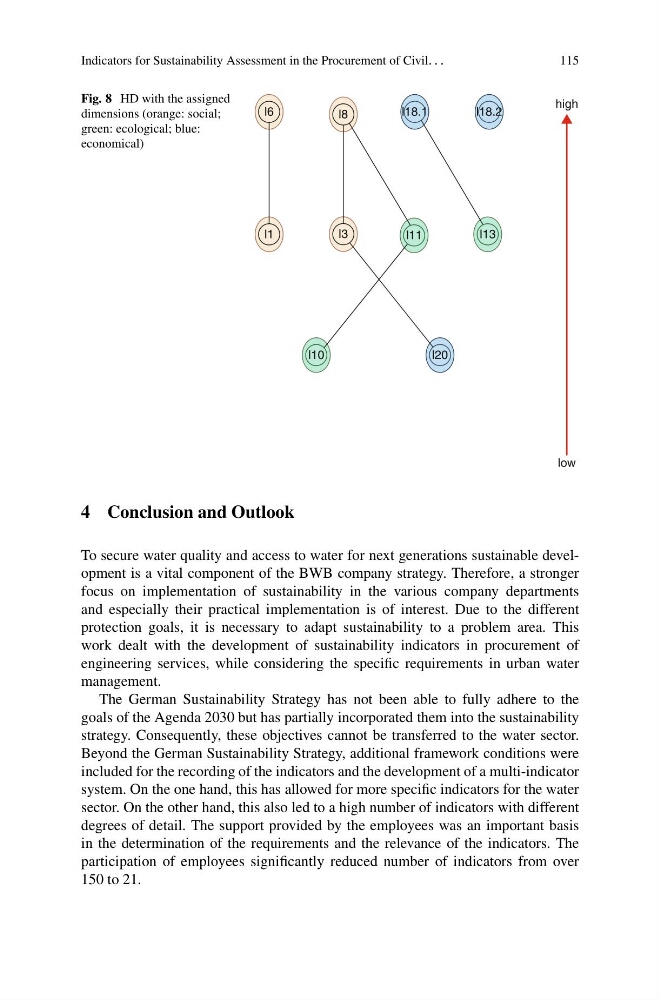
Fig. 8 HD with the assigned
dimensions (orange: social;
green: ecological; blue:
economical)
l6
l8
l1
l3
l11
l10
l20
low
l13
l18.1
l18.2
high
4 Conclusion and Outlook
To secure water quality and access to water for next generations sustainable development is a vital component of the BWB company strategy. Therefore, a stronger
focus on implementation of sustainability in the various company departments
and especially their practical implementation is of interest. Due to the different
protection goals, it is necessary to adapt sustainability to a problem area. This
work dealt with the development of sustainability indicators in procurement of
engineering services, while considering the specific requirements in urban water
management.
The German Sustainability Strategy has not been able to fully adhere to the
goals of the Agenda 2030 but has partially incorporated them into the sustainability
strategy. Consequently, these objectives cannot be transferred to the water sector.
Beyond the German Sustainability Strategy, additional framework conditions were
included for the recording of the indicators and the development of a multi-indicator
system. On the one hand, this has allowed for more specific indicators for the water
sector. On the other hand, this also led to a high number of indicators with different
degrees of detail. The support provided by the employees was an important basis
in the determination of the requirements and the relevance of the indicators. The
participation of employees significantly reduced number of indicators from over
150 to 21.
115
Fig. 8 HD with the assigned
dimensions (orange: social;
green: ecological; blue:
economical)
l6
l8
l1
l3
l11
l10
l20
low
l13
l18.1
l18.2
high
4 Conclusion and Outlook
To secure water quality and access to water for next generations sustainable development is a vital component of the BWB company strategy. Therefore, a stronger
focus on implementation of sustainability in the various company departments
and especially their practical implementation is of interest. Due to the different
protection goals, it is necessary to adapt sustainability to a problem area. This
work dealt with the development of sustainability indicators in procurement of
engineering services, while considering the specific requirements in urban water
management.
The German Sustainability Strategy has not been able to fully adhere to the
goals of the Agenda 2030 but has partially incorporated them into the sustainability
strategy. Consequently, these objectives cannot be transferred to the water sector.
Beyond the German Sustainability Strategy, additional framework conditions were
included for the recording of the indicators and the development of a multi-indicator
system. On the one hand, this has allowed for more specific indicators for the water
sector. On the other hand, this also led to a high number of indicators with different
degrees of detail. The support provided by the employees was an important basis
in the determination of the requirements and the relevance of the indicators. The
participation of employees significantly reduced number of indicators from over
150 to 21.