

92
R. Bruggemann and A. Kerber
2 Materials and Methods
2.1 Notation
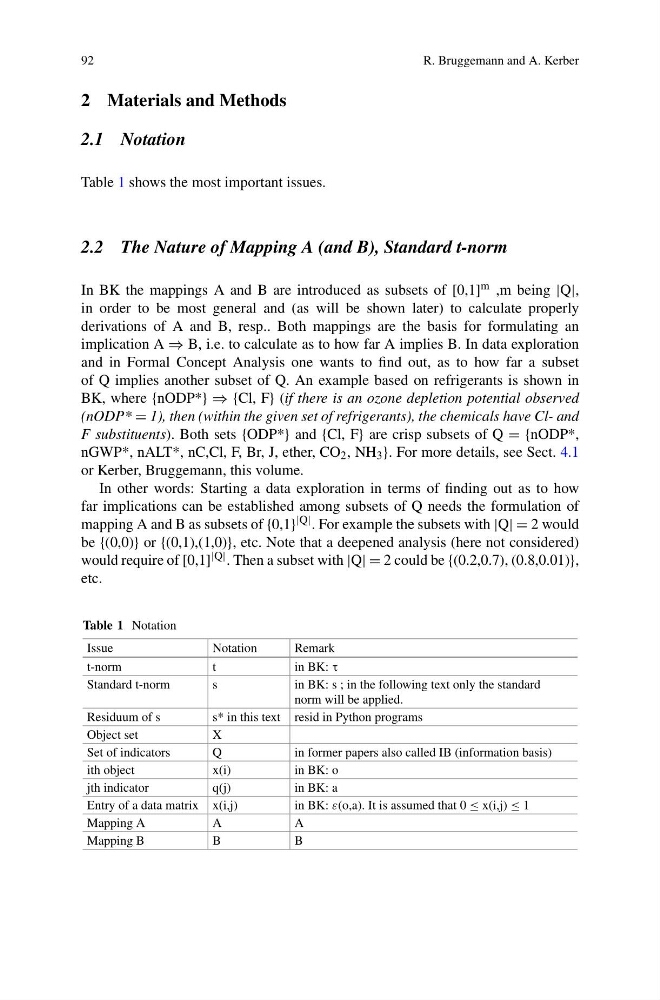
Table 1 shows the most important issues.
2.2 The Nature of Mapping A (and B), Standard t-norm
In BK the mappings A and B are introduced as subsets of [0,1] m ,m being |Q|,
in order to be most general and (as will be shown later) to calculate properly
derivations of A and B, resp.. Both mappings are the basis for formulating an
implication A ⇒ B, i.e. to calculate as to how far A implies B. In data exploration
and in Formal Concept Analysis one wants to find out, as to how far a subset
of Q implies another subset of Q. An example based on refrigerants is shown in
BK, where {nODP*} ⇒ {Cl, F} (if there is an ozone depletion potential observed
(nODP* = 1), then (within the given set of refrigerants), the chemicals have Cl- and
F substituents). Both sets {ODP*} and {Cl, F} are crisp subsets of Q = {nODP*,
nGWP*, nALT*, nC,Cl, F, Br, J, ether, CO 2 , NH 3 }. For more details, see Sect. 4.1
or Kerber, Bruggemann, this volume.
In other words: Starting a data exploration in terms of finding out as to how
far implications can be established among subsets of Q needs the formulation of
mapping A and B as subsets of {0,1} |Q| . For example the subsets with |Q| = 2 would
be {(0,0)} or {(0,1),(1,0)}, etc. Note that a deepened analysis (here not considered)
would require of [0,1] |Q| . Then a subset with |Q| = 2 could be {(0.2,0.7), (0.8,0.01)},
etc.
Table 1 Notation
Issue
Notation
Remark
t-norm
t
in BK: τ
Standard t-norm
s
in BK: s ; in the following text only the standard
norm will be applied.
Residuum of s
s* in this text resid in Python programs
Object set
X
Set of indicators
Q
in former papers also called IB (information basis)
ith object
x(i)
in BK: o
jth indicator
q(j)
in BK: a
Entry of a data matrix x(i,j)
in BK: ε(o,a). It is assumed that 0 ≤ x(i,j) ≤ 1
Mapping A
A
A
Mapping B
B
B
R. Bruggemann and A. Kerber
2 Materials and Methods
2.1 Notation
Table 1 shows the most important issues.
2.2 The Nature of Mapping A (and B), Standard t-norm
In BK the mappings A and B are introduced as subsets of [0,1] m ,m being |Q|,
in order to be most general and (as will be shown later) to calculate properly
derivations of A and B, resp.. Both mappings are the basis for formulating an
implication A ⇒ B, i.e. to calculate as to how far A implies B. In data exploration
and in Formal Concept Analysis one wants to find out, as to how far a subset
of Q implies another subset of Q. An example based on refrigerants is shown in
BK, where {nODP*} ⇒ {Cl, F} (if there is an ozone depletion potential observed
(nODP* = 1), then (within the given set of refrigerants), the chemicals have Cl- and
F substituents). Both sets {ODP*} and {Cl, F} are crisp subsets of Q = {nODP*,
nGWP*, nALT*, nC,Cl, F, Br, J, ether, CO 2 , NH 3 }. For more details, see Sect. 4.1
or Kerber, Bruggemann, this volume.
In other words: Starting a data exploration in terms of finding out as to how
far implications can be established among subsets of Q needs the formulation of
mapping A and B as subsets of {0,1} |Q| . For example the subsets with |Q| = 2 would
be {(0,0)} or {(0,1),(1,0)}, etc. Note that a deepened analysis (here not considered)
would require of [0,1] |Q| . Then a subset with |Q| = 2 could be {(0.2,0.7), (0.8,0.01)},
etc.
Table 1 Notation
Issue
Notation
Remark
t-norm
t
in BK: τ
Standard t-norm
s
in BK: s ; in the following text only the standard
norm will be applied.
Residuum of s
s* in this text resid in Python programs
Object set
X
Set of indicators
Q
in former papers also called IB (information basis)
ith object
x(i)
in BK: o
jth indicator
q(j)
in BK: a
Entry of a data matrix x(i,j)
in BK: ε(o,a). It is assumed that 0 ≤ x(i,j) ≤ 1
Mapping A
A
A
Mapping B
B
B