

1.7. LIMITS, CONTINUITY, AND DIFFERENTIABILITY
75
(a) A function f that is continuous at a = 2 but not differentiable at a = 2.
(b) A function g that is differentiable at a = 3 but does not have a limit at a = 3.
(c) A function h that has a limit at a = −2, is defined at a = −2, but is not
continuous at a = −2.
(d) A function p that satisfies all of the following:
• p(−1) = 3 and lim x→−1 p(x) = 2
• p(0) = 1 and p ′ (0) = 0
• lim x→1 p(x) = p(1) and p ′ (1) does not exist
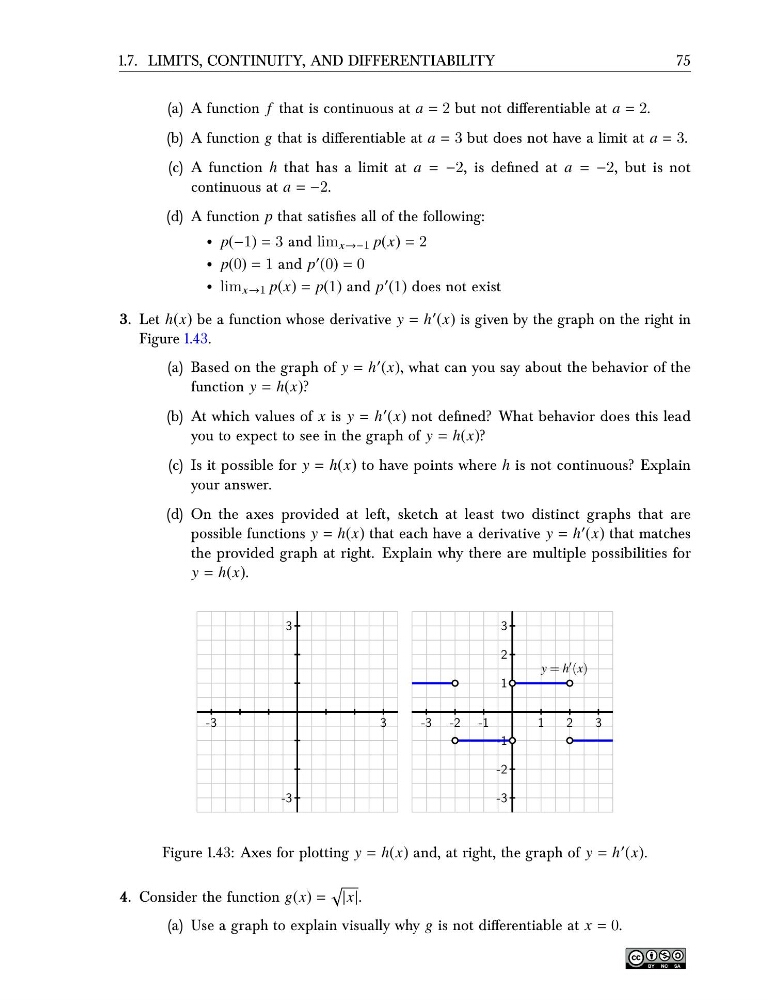
3. Let h(x) be a function whose derivative y = h ′ (x) is given by the graph on the right in
Figure 1.43.
(a) Based on the graph of y = h ′ (x), what can you say about the behavior of the
function y = h(x)?
(b) At which values of x is y = h ′ (x) not defined? What behavior does this lead
you to expect to see in the graph of y = h(x)?
(c) Is it possible for y = h(x) to have points where h is not continuous? Explain
your answer.
(d) On the axes provided at left, sketch at least two distinct graphs that are
possible functions y = h(x) that each have a derivative y = h ′ (x) that matches
the provided graph at right. Explain why there are multiple possibilities for
y = h(x).
-3
3
-3
3
-3 -2 -1
1
2
3
-3
-2
-1
1
2
3
y = h ′ (x)
Figure 1.43: Axes for plotting y = h(x) and, at right, the graph of y = h ′ (x).
4. Consider the function g(x) =
|x|.
(a) Use a graph to explain visually why g is not differentiable at x = 0.
75
(a) A function f that is continuous at a = 2 but not differentiable at a = 2.
(b) A function g that is differentiable at a = 3 but does not have a limit at a = 3.
(c) A function h that has a limit at a = −2, is defined at a = −2, but is not
continuous at a = −2.
(d) A function p that satisfies all of the following:
• p(−1) = 3 and lim x→−1 p(x) = 2
• p(0) = 1 and p ′ (0) = 0
• lim x→1 p(x) = p(1) and p ′ (1) does not exist
3. Let h(x) be a function whose derivative y = h ′ (x) is given by the graph on the right in
Figure 1.43.
(a) Based on the graph of y = h ′ (x), what can you say about the behavior of the
function y = h(x)?
(b) At which values of x is y = h ′ (x) not defined? What behavior does this lead
you to expect to see in the graph of y = h(x)?
(c) Is it possible for y = h(x) to have points where h is not continuous? Explain
your answer.
(d) On the axes provided at left, sketch at least two distinct graphs that are
possible functions y = h(x) that each have a derivative y = h ′ (x) that matches
the provided graph at right. Explain why there are multiple possibilities for
y = h(x).
-3
3
-3
3
-3 -2 -1
1
2
3
-3
-2
-1
1
2
3
y = h ′ (x)
Figure 1.43: Axes for plotting y = h(x) and, at right, the graph of y = h ′ (x).
4. Consider the function g(x) =
|x|.
(a) Use a graph to explain visually why g is not differentiable at x = 0.