

44
1.5. INTERPRETING, ESTIMATING, AND USING THE DERIVATIVE
20 40 60 80 100
20
40
60
80
100
t
s
(57, 63.8)
(68, 63.8)
(104, 106.8)
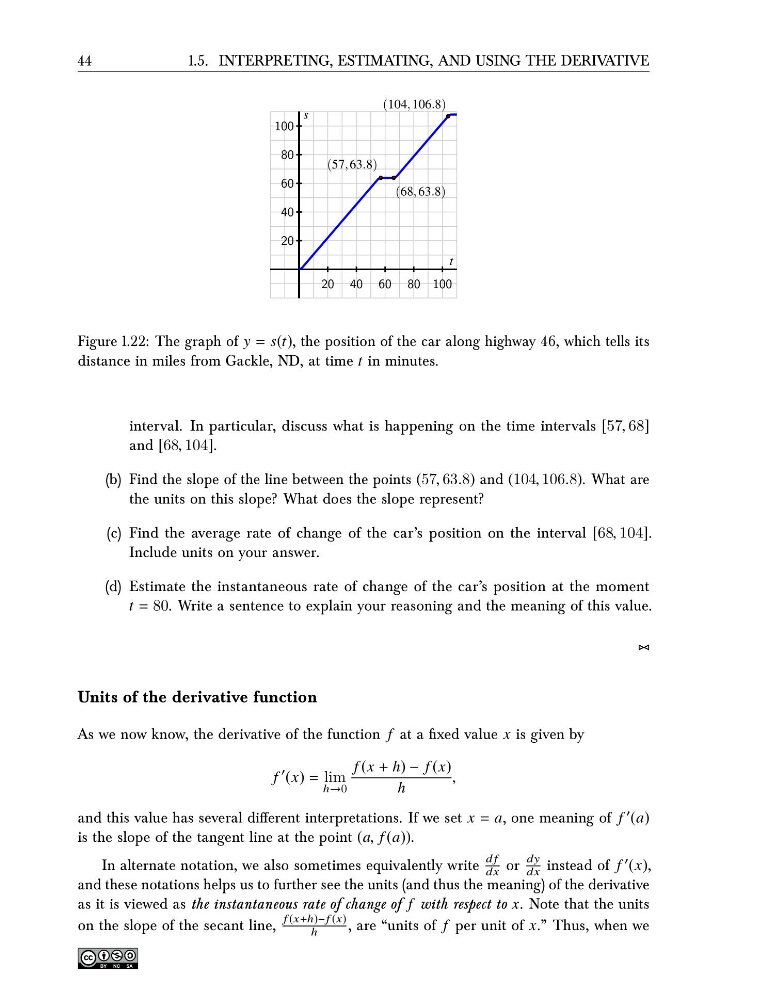
Figure 1.22: The graph of y = s(t), the position of the car along highway 46, which tells its
distance in miles from Gackle, ND, at time t in minutes.
interval. In particular, discuss what is happening on the time intervals [57, 68]
and [68, 104].
(b) Find the slope of the line between the points (57, 63.8) and (104, 106.8). What are
the units on this slope? What does the slope represent?
(c) Find the average rate of change of the car’s position on the interval [68, 104].
Include units on your answer.
(d) Estimate the instantaneous rate of change of the car’s position at the moment
t = 80. Write a sentence to explain your reasoning and the meaning of this value.
⊲⊳
Units of the derivative function
As we now know, the derivative of the function f at a fixed value x is given by
f
′ (x) = lim
h→0
f (x + h) − f (x)
h
,
and this value has several different interpretations. If we set x = a, one meaning of f ′ (a)
is the slope of the tangent line at the point (a, f (a)).
In alternate notation, we also sometimes equivalently write
d f
dx or
dy
dx instead of f ′ (x),
and these notations helps us to further see the units (and thus the meaning) of the derivative
as it is viewed as the instantaneous rate of change of f with respect to x. Note that the units
on the slope of the secant line,
f (x+h)− f (x)
h
, are “units of f per unit of x.” Thus, when we
1.5. INTERPRETING, ESTIMATING, AND USING THE DERIVATIVE
20 40 60 80 100
20
40
60
80
100
t
s
(57, 63.8)
(68, 63.8)
(104, 106.8)
Figure 1.22: The graph of y = s(t), the position of the car along highway 46, which tells its
distance in miles from Gackle, ND, at time t in minutes.
interval. In particular, discuss what is happening on the time intervals [57, 68]
and [68, 104].
(b) Find the slope of the line between the points (57, 63.8) and (104, 106.8). What are
the units on this slope? What does the slope represent?
(c) Find the average rate of change of the car’s position on the interval [68, 104].
Include units on your answer.
(d) Estimate the instantaneous rate of change of the car’s position at the moment
t = 80. Write a sentence to explain your reasoning and the meaning of this value.
⊲⊳
Units of the derivative function
As we now know, the derivative of the function f at a fixed value x is given by
f
′ (x) = lim
h→0
f (x + h) − f (x)
h
,
and this value has several different interpretations. If we set x = a, one meaning of f ′ (a)
is the slope of the tangent line at the point (a, f (a)).
In alternate notation, we also sometimes equivalently write
d f
dx or
dy
dx instead of f ′ (x),
and these notations helps us to further see the units (and thus the meaning) of the derivative
as it is viewed as the instantaneous rate of change of f with respect to x. Note that the units
on the slope of the secant line,
f (x+h)− f (x)
h
, are “units of f per unit of x.” Thus, when we