

8.6. POWER SERIES
529
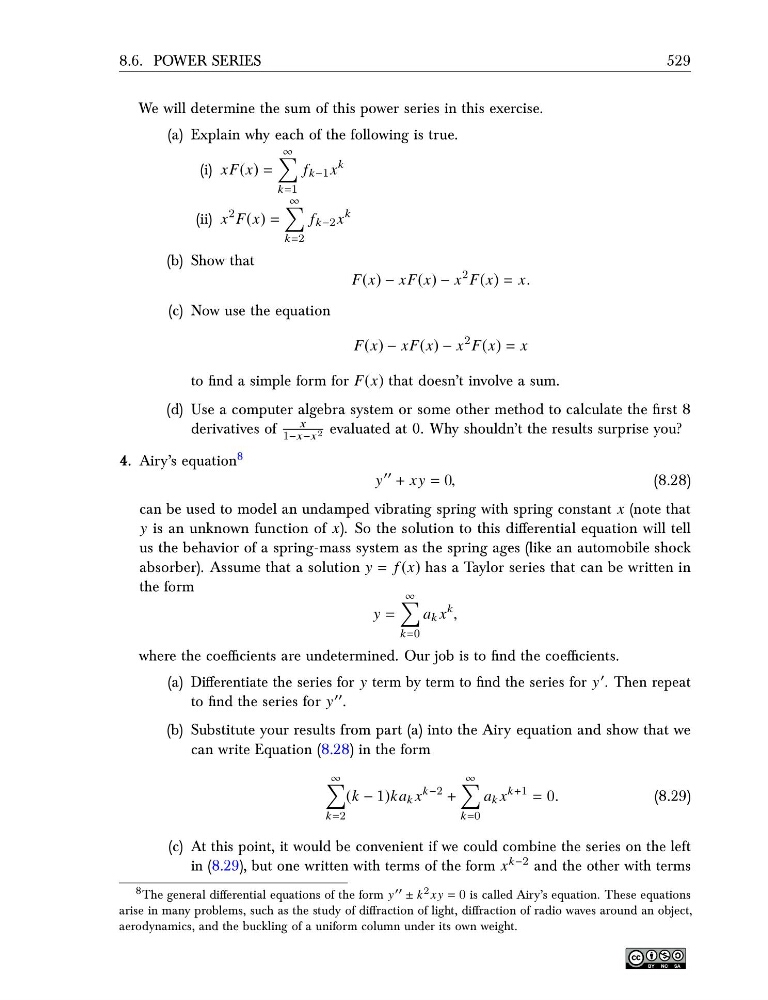
We will determine the sum of this power series in this exercise.
(a) Explain why each of the following is true.
(i) xF(x) =
∞
k=1
f k−1 x
k
(ii) x
2 F(x) =
∞
k=2
f k−2 x
k
(b) Show that
F(x) − xF(x) − x
2 F(x) = x.
(c) Now use the equation
F(x) − xF(x) − x
2 F(x) = x
to find a simple form for F(x) that doesn’t involve a sum.
(d) Use a computer algebra system or some other method to calculate the first 8
derivatives of
x
1−x−x 2 evaluated at 0. Why shouldn’t the results surprise you?
4. Airy’s equation 8
y
′′ + x y = 0,
(8.28)
can be used to model an undamped vibrating spring with spring constant x (note that
y is an unknown function of x). So the solution to this differential equation will tell
us the behavior of a spring-mass system as the spring ages (like an automobile shock
absorber). Assume that a solution y = f (x) has a Taylor series that can be written in
the form
y =
∞
k=0
a k x
k ,
where the coefficients are undetermined. Our job is to find the coefficients.
(a) Differentiate the series for y term by term to find the series for y ′ . Then repeat
to find the series for y ′′ .
(b) Substitute your results from part (a) into the Airy equation and show that we
can write Equation (8.28) in the form
∞
k=2
(k − 1)ka k x
k−2 +
∞
k=0
a k x
k+1 = 0.
(8.29)
(c) At this point, it would be convenient if we could combine the series on the left
in (8.29), but one written with terms of the form x k−2 and the other with terms
8 The general differential equations of the form y ′′ ± k 2 x y = 0 is called Airy’s equation. These equations
arise in many problems, such as the study of diffraction of light, diffraction of radio waves around an object,
aerodynamics, and the buckling of a uniform column under its own weight.
529
We will determine the sum of this power series in this exercise.
(a) Explain why each of the following is true.
(i) xF(x) =
∞
k=1
f k−1 x
k
(ii) x
2 F(x) =
∞
k=2
f k−2 x
k
(b) Show that
F(x) − xF(x) − x
2 F(x) = x.
(c) Now use the equation
F(x) − xF(x) − x
2 F(x) = x
to find a simple form for F(x) that doesn’t involve a sum.
(d) Use a computer algebra system or some other method to calculate the first 8
derivatives of
x
1−x−x 2 evaluated at 0. Why shouldn’t the results surprise you?
4. Airy’s equation 8
y
′′ + x y = 0,
(8.28)
can be used to model an undamped vibrating spring with spring constant x (note that
y is an unknown function of x). So the solution to this differential equation will tell
us the behavior of a spring-mass system as the spring ages (like an automobile shock
absorber). Assume that a solution y = f (x) has a Taylor series that can be written in
the form
y =
∞
k=0
a k x
k ,
where the coefficients are undetermined. Our job is to find the coefficients.
(a) Differentiate the series for y term by term to find the series for y ′ . Then repeat
to find the series for y ′′ .
(b) Substitute your results from part (a) into the Airy equation and show that we
can write Equation (8.28) in the form
∞
k=2
(k − 1)ka k x
k−2 +
∞
k=0
a k x
k+1 = 0.
(8.29)
(c) At this point, it would be convenient if we could combine the series on the left
in (8.29), but one written with terms of the form x k−2 and the other with terms
8 The general differential equations of the form y ′′ ± k 2 x y = 0 is called Airy’s equation. These equations
arise in many problems, such as the study of diffraction of light, diffraction of radio waves around an object,
aerodynamics, and the buckling of a uniform column under its own weight.