

8.5. TAYLOR POLYNOMIALS AND TAYLOR SERIES
507
The pattern we found for the derivatives f (k) (0) describe the higher-order Taylor polynomials, e.g.,
P 5 (x) = x −
x 3
3!
+
x (5)
5!
, P 7 (x) = x −
x 3
3!
+
x (5)
5!
−
x (7)
7!
, P 9 (x) = x −
x 3
3!
+
x (5)
5!
−
x (7)
7!
+
x (9)
9!
,
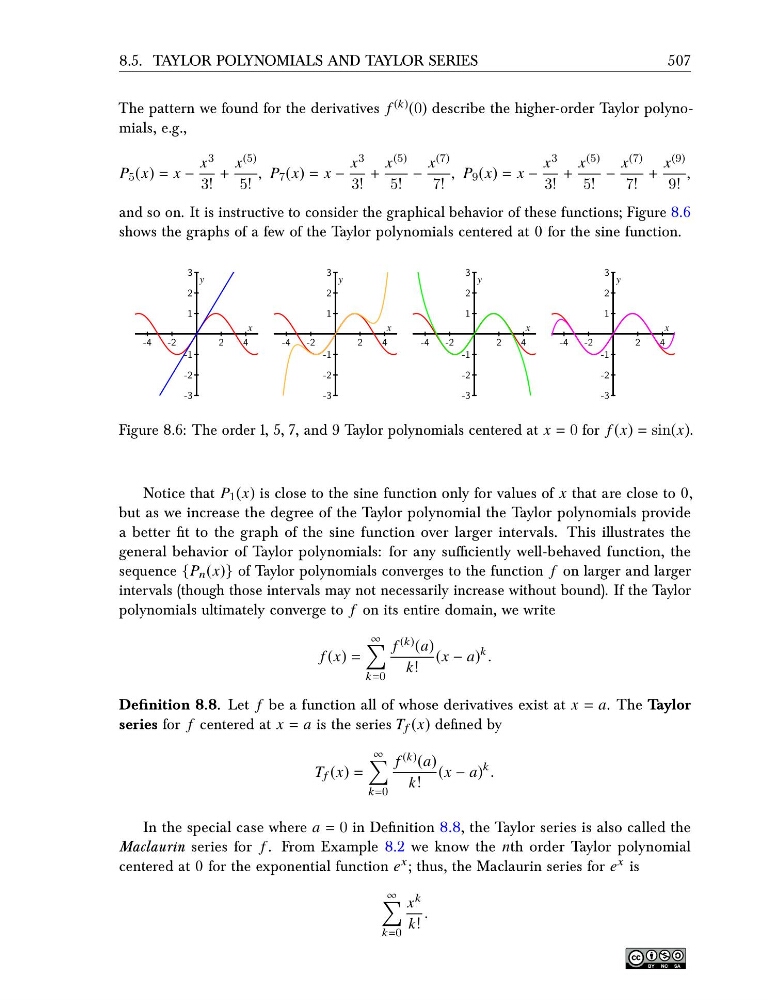
and so on. It is instructive to consider the graphical behavior of these functions; Figure 8.6
shows the graphs of a few of the Taylor polynomials centered at 0 for the sine function.
-4
-2
2
4
-3
-2
-1
1
2
3
x
y
-4
-2
2
4
-3
-2
-1
1
2
3
x
y
-4
-2
2
4
-3
-2
-1
1
2
3
x
y
-4
-2
2
4
-3
-2
-1
1
2
3
x
y
Figure 8.6: The order 1, 5, 7, and 9 Taylor polynomials centered at x = 0 for f (x) = sin(x).
Notice that P 1 (x) is close to the sine function only for values of x that are close to 0,
but as we increase the degree of the Taylor polynomial the Taylor polynomials provide
a better fit to the graph of the sine function over larger intervals. This illustrates the
general behavior of Taylor polynomials: for any sufficiently well-behaved function, the
sequence {P n (x)} of Taylor polynomials converges to the function f on larger and larger
intervals (though those intervals may not necessarily increase without bound). If the Taylor
polynomials ultimately converge to f on its entire domain, we write
f (x) =
∞
k=0
f (k) (a)
k!
(x − a)
k .
Definition 8.8. Let f be a function all of whose derivatives exist at x = a. The Taylor
series for f centered at x = a is the series T f (x) defined by
T f (x) =
∞
k=0
f (k) (a)
k!
(x − a)
k .
In the special case where a = 0 in Definition 8.8, the Taylor series is also called the
Maclaurin series for f . From Example 8.2 we know the nth order Taylor polynomial
centered at 0 for the exponential function e x ; thus, the Maclaurin series for e x is
∞
k=0
x k
k!
.
507
The pattern we found for the derivatives f (k) (0) describe the higher-order Taylor polynomials, e.g.,
P 5 (x) = x −
x 3
3!
+
x (5)
5!
, P 7 (x) = x −
x 3
3!
+
x (5)
5!
−
x (7)
7!
, P 9 (x) = x −
x 3
3!
+
x (5)
5!
−
x (7)
7!
+
x (9)
9!
,
and so on. It is instructive to consider the graphical behavior of these functions; Figure 8.6
shows the graphs of a few of the Taylor polynomials centered at 0 for the sine function.
-4
-2
2
4
-3
-2
-1
1
2
3
x
y
-4
-2
2
4
-3
-2
-1
1
2
3
x
y
-4
-2
2
4
-3
-2
-1
1
2
3
x
y
-4
-2
2
4
-3
-2
-1
1
2
3
x
y
Figure 8.6: The order 1, 5, 7, and 9 Taylor polynomials centered at x = 0 for f (x) = sin(x).
Notice that P 1 (x) is close to the sine function only for values of x that are close to 0,
but as we increase the degree of the Taylor polynomial the Taylor polynomials provide
a better fit to the graph of the sine function over larger intervals. This illustrates the
general behavior of Taylor polynomials: for any sufficiently well-behaved function, the
sequence {P n (x)} of Taylor polynomials converges to the function f on larger and larger
intervals (though those intervals may not necessarily increase without bound). If the Taylor
polynomials ultimately converge to f on its entire domain, we write
f (x) =
∞
k=0
f (k) (a)
k!
(x − a)
k .
Definition 8.8. Let f be a function all of whose derivatives exist at x = a. The Taylor
series for f centered at x = a is the series T f (x) defined by
T f (x) =
∞
k=0
f (k) (a)
k!
(x − a)
k .
In the special case where a = 0 in Definition 8.8, the Taylor series is also called the
Maclaurin series for f . From Example 8.2 we know the nth order Taylor polynomial
centered at 0 for the exponential function e x ; thus, the Maclaurin series for e x is
∞
k=0
x k
k!
.