

8.4. ALTERNATING SERIES
495
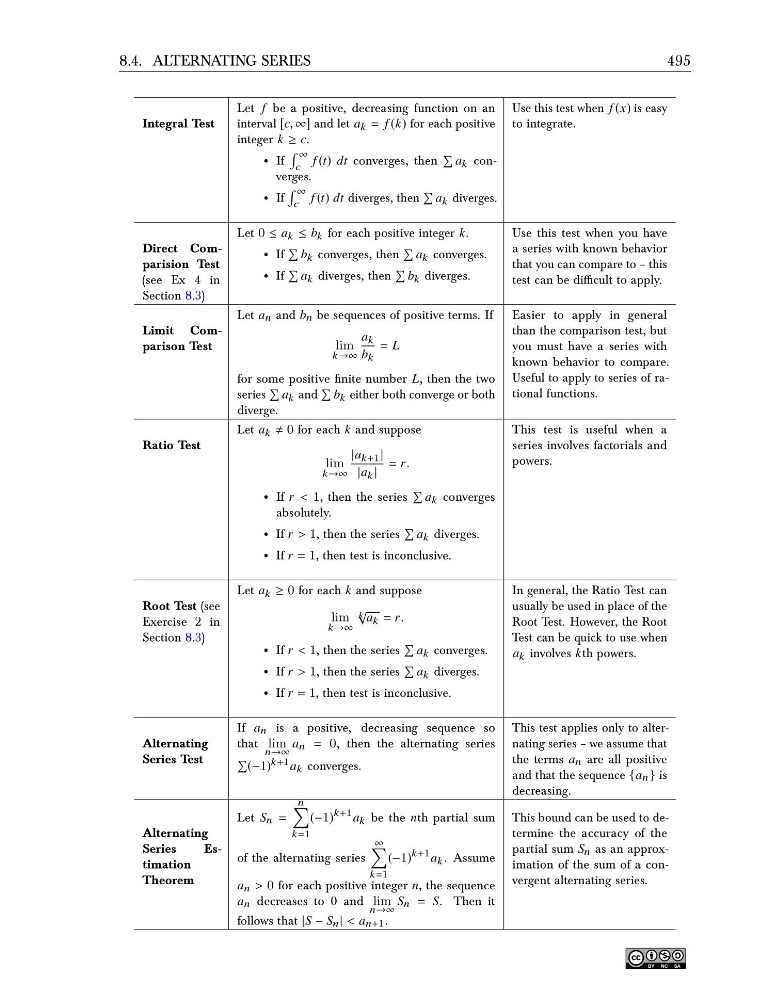
Integral Test
Let f be a positive, decreasing function on an
interval [c, ∞] and let a k = f (k) for each positive
integer k ≥ c.
• If
∞
c
f (t) dt converges, then
a k converges.
• If
∞
c
f (t) dt diverges, then
a k diverges.
Use this test when f (x) is easy
to integrate.
Direct Comparision Test
(see Ex 4 in
Section 8.3)
Let 0 ≤ a k ≤ b k for each positive integer k.
• If
b k converges, then
a k converges.
• If
a k diverges, then
b k diverges.
Use this test when you have
a series with known behavior
that you can compare to – this
test can be difficult to apply.
Limit Comparison Test
Let a n and b n be sequences of positive terms. If
lim
k→∞
a k
b k
= L
for some positive finite number L, then the two
series
a k and
b k either both converge or both
diverge.
Easier to apply in general
than the comparison test, but
you must have a series with
known behavior to compare.
Useful to apply to series of rational functions.
Ratio Test
Let a k 0 for each k and suppose
lim
k→∞
|a k+1 |
|a k |
= r.
• If r < 1, then the series
a k converges
absolutely.
• If r > 1, then the series
a k diverges.
• If r = 1, then test is inconclusive.
This test is useful when a
series involves factorials and
powers.
Root Test (see
Exercise 2 in
Section 8.3)
Let a k ≥ 0 for each k and suppose
lim
k→∞
k
√ a k = r.
• If r < 1, then the series
a k converges.
• If r > 1, then the series
a k diverges.
• If r = 1, then test is inconclusive.
In general, the Ratio Test can
usually be used in place of the
Root Test. However, the Root
Test can be quick to use when
a k involves kth powers.
Alternating
Series Test
If a n is a positive, decreasing sequence so
that lim
n→∞
a n = 0, then the alternating series
(−1) k+1 a k converges.
This test applies only to alternating series – we assume that
the terms a n are all positive
and that the sequence {a n } is
decreasing.
Alternating
Series
Estimation
Theorem
Let S n =
n
k=1
(−1)
k+1 a k be the nth partial sum
of the alternating series
∞
k=1
(−1)
k+1 a k . Assume
a n > 0 for each positive integer n, the sequence
a n decreases to 0 and lim
n→∞
S n = S. Then it
follows that |S − S n | < a n+1 .
This bound can be used to determine the accuracy of the
partial sum S n as an approximation of the sum of a convergent alternating series.
495
Integral Test
Let f be a positive, decreasing function on an
interval [c, ∞] and let a k = f (k) for each positive
integer k ≥ c.
• If
∞
c
f (t) dt converges, then
a k converges.
• If
∞
c
f (t) dt diverges, then
a k diverges.
Use this test when f (x) is easy
to integrate.
Direct Comparision Test
(see Ex 4 in
Section 8.3)
Let 0 ≤ a k ≤ b k for each positive integer k.
• If
b k converges, then
a k converges.
• If
a k diverges, then
b k diverges.
Use this test when you have
a series with known behavior
that you can compare to – this
test can be difficult to apply.
Limit Comparison Test
Let a n and b n be sequences of positive terms. If
lim
k→∞
a k
b k
= L
for some positive finite number L, then the two
series
a k and
b k either both converge or both
diverge.
Easier to apply in general
than the comparison test, but
you must have a series with
known behavior to compare.
Useful to apply to series of rational functions.
Ratio Test
Let a k 0 for each k and suppose
lim
k→∞
|a k+1 |
|a k |
= r.
• If r < 1, then the series
a k converges
absolutely.
• If r > 1, then the series
a k diverges.
• If r = 1, then test is inconclusive.
This test is useful when a
series involves factorials and
powers.
Root Test (see
Exercise 2 in
Section 8.3)
Let a k ≥ 0 for each k and suppose
lim
k→∞
k
√ a k = r.
• If r < 1, then the series
a k converges.
• If r > 1, then the series
a k diverges.
• If r = 1, then test is inconclusive.
In general, the Ratio Test can
usually be used in place of the
Root Test. However, the Root
Test can be quick to use when
a k involves kth powers.
Alternating
Series Test
If a n is a positive, decreasing sequence so
that lim
n→∞
a n = 0, then the alternating series
(−1) k+1 a k converges.
This test applies only to alternating series – we assume that
the terms a n are all positive
and that the sequence {a n } is
decreasing.
Alternating
Series
Estimation
Theorem
Let S n =
n
k=1
(−1)
k+1 a k be the nth partial sum
of the alternating series
∞
k=1
(−1)
k+1 a k . Assume
a n > 0 for each positive integer n, the sequence
a n decreases to 0 and lim
n→∞
S n = S. Then it
follows that |S − S n | < a n+1 .
This bound can be used to determine the accuracy of the
partial sum S n as an approximation of the sum of a convergent alternating series.