

8.4. ALTERNATING SERIES
493
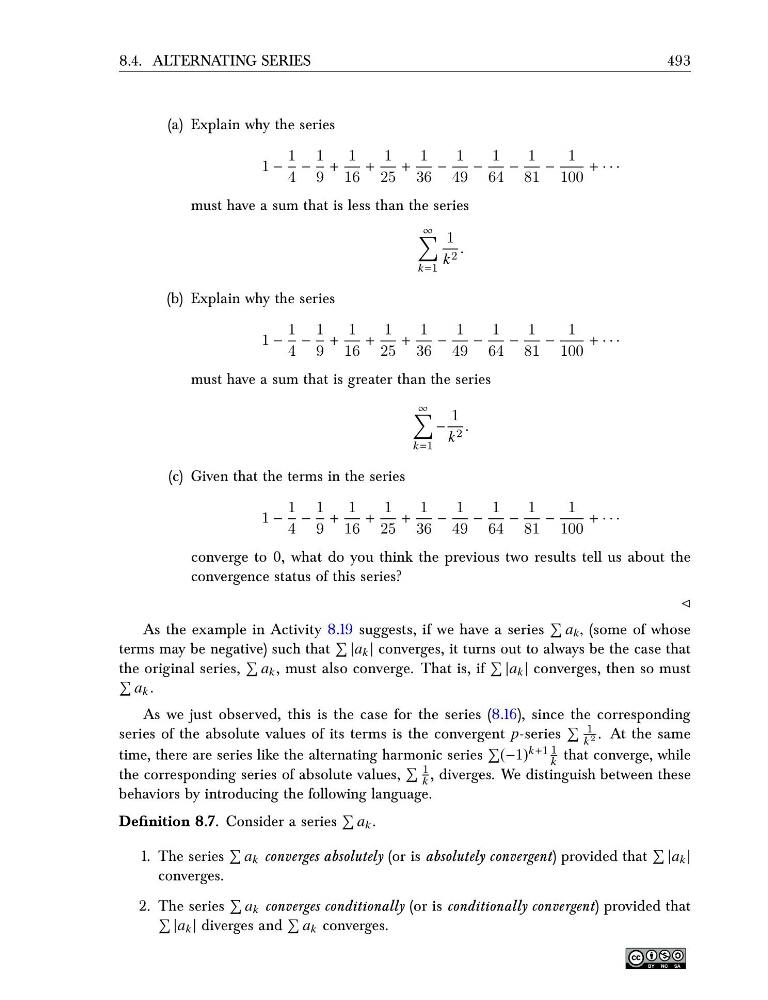
(a) Explain why the series
1 −
1
4
−
1
9
+
1
16
+
1
25
+
1
36
−
1
49
−
1
64
−
1
81
−
1
100
+ · · ·
must have a sum that is less than the series
∞
k=1
1
k 2 .
(b) Explain why the series
1 −
1
4
−
1
9
+
1
16
+
1
25
+
1
36
−
1
49
−
1
64
−
1
81
−
1
100
+ · · ·
must have a sum that is greater than the series
∞
k=1
−
1
k 2 .
(c) Given that the terms in the series
1 −
1
4
−
1
9
+
1
16
+
1
25
+
1
36
−
1
49
−
1
64
−
1
81
−
1
100
+ · · ·
converge to 0, what do you think the previous two results tell us about the
convergence status of this series?
⊳
As the example in Activity 8.19 suggests, if we have a series
a k , (some of whose
terms may be negative) such that
|a k | converges, it turns out to always be the case that
the original series,
a k , must also converge. That is, if
|a k | converges, then so must
a k .
As we just observed, this is the case for the series (8.16), since the corresponding
series of the absolute values of its terms is the convergent p-series
1
k 2 . At the same
time, there are series like the alternating harmonic series
(−1) k+1 1
k that converge, while
the corresponding series of absolute values,
1
k , diverges. We distinguish between these
behaviors by introducing the following language.
Definition 8.7. Consider a series
a k .
1. The series
a k converges absolutely (or is absolutely convergent) provided that
|a k |
converges.
2. The series
a k converges conditionally (or is conditionally convergent) provided that
|a k | diverges and
a k converges.
493
(a) Explain why the series
1 −
1
4
−
1
9
+
1
16
+
1
25
+
1
36
−
1
49
−
1
64
−
1
81
−
1
100
+ · · ·
must have a sum that is less than the series
∞
k=1
1
k 2 .
(b) Explain why the series
1 −
1
4
−
1
9
+
1
16
+
1
25
+
1
36
−
1
49
−
1
64
−
1
81
−
1
100
+ · · ·
must have a sum that is greater than the series
∞
k=1
−
1
k 2 .
(c) Given that the terms in the series
1 −
1
4
−
1
9
+
1
16
+
1
25
+
1
36
−
1
49
−
1
64
−
1
81
−
1
100
+ · · ·
converge to 0, what do you think the previous two results tell us about the
convergence status of this series?
⊳
As the example in Activity 8.19 suggests, if we have a series
a k , (some of whose
terms may be negative) such that
|a k | converges, it turns out to always be the case that
the original series,
a k , must also converge. That is, if
|a k | converges, then so must
a k .
As we just observed, this is the case for the series (8.16), since the corresponding
series of the absolute values of its terms is the convergent p-series
1
k 2 . At the same
time, there are series like the alternating harmonic series
(−1) k+1 1
k that converge, while
the corresponding series of absolute values,
1
k , diverges. We distinguish between these
behaviors by introducing the following language.
Definition 8.7. Consider a series
a k .
1. The series
a k converges absolutely (or is absolutely convergent) provided that
|a k |
converges.
2. The series
a k converges conditionally (or is conditionally convergent) provided that
|a k | diverges and
a k converges.