

8.4. ALTERNATING SERIES
487
(b) The linearization of ln(1 + x) does not provide a very good approximation to
ln(2) since 1 is not that close to 0. To obtain a better approximation, we alter
our approach; instead of using a straight line to approximate ln(2), we use a
quadratic function to account for the concavity of ln(1 + x) for x close to 0. With
the linearization, both the function’s value and slope agree with the linearization’s
value and slope at x = 0. We will now make a quadratic approximation P 2 (x)
to f (x) = ln(1 + x) centered at x = 0 with the property that P 2 (0) = f (0),
P ′
2 (0) = f ′ (0), and P ′′
2 (0) = f ′′ (0).
(i) Let P 2 (x) = x −
x 2
2 . Show that P 2 (0) = f (0), P ′
2 (0) = f ′ (0), and P ′′
2 (0) =
f ′′ (0). Use P 2 (x) to approximate ln(2) by using the fact that P 2 (1) ≈ f (1).
(ii) We can continue approximating ln(2) with polynomials of larger degree
whose derivatives agree with those of f at 0. This makes the polynomials
fit the graph of f better for more values of x around 0. For example, let
P 3 (x) = x −
x 2
2 +
x 3
3 . Show that P 3 (0) = f (0), P ′
3 (0) = f ′ (0), P ′′
3 (0) = f ′′ (0),
and P ′′′
3 (0) = f ′′′ (0). Taking a similar approach to preceding questions, use
P 3 (x) to approximate ln(2).
(iii) If we used a degree 4 or degree 5 polynomial to approximate ln(1 + x),
what approximations of ln(2) do you think would result? Use the preceding
questions to conjecture a pattern that holds, and state the degree 4 and
degree 5 approximation.
⊲⊳
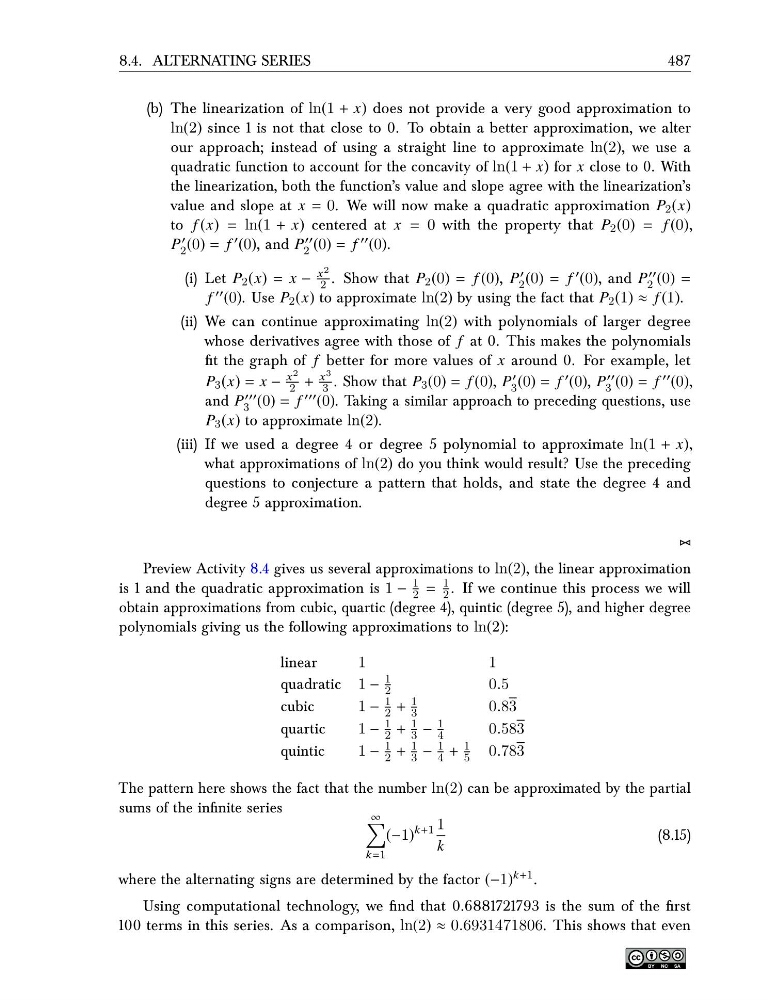
Preview Activity 8.4 gives us several approximations to ln(2), the linear approximation
is 1 and the quadratic approximation is 1 −
1
2 =
1
2 . If we continue this process we will
obtain approximations from cubic, quartic (degree 4), quintic (degree 5), and higher degree
polynomials giving us the following approximations to ln(2):
linear
1
1
quadratic 1 −
1
2
0.5
cubic
1 −
1
2 +
1
3
0.83
quartic
1 −
1
2 +
1
3 −
1
4
0.583
quintic
1 −
1
2 +
1
3 −
1
4 +
1
5
0.783
The pattern here shows the fact that the number ln(2) can be approximated by the partial
sums of the infinite series
∞
k=1
(−1)
k+1 1
k
(8.15)
where the alternating signs are determined by the factor (−1) k+1 .
Using computational technology, we find that 0.6881721793 is the sum of the first
100 terms in this series. As a comparison, ln(2) ≈ 0.6931471806. This shows that even
487
(b) The linearization of ln(1 + x) does not provide a very good approximation to
ln(2) since 1 is not that close to 0. To obtain a better approximation, we alter
our approach; instead of using a straight line to approximate ln(2), we use a
quadratic function to account for the concavity of ln(1 + x) for x close to 0. With
the linearization, both the function’s value and slope agree with the linearization’s
value and slope at x = 0. We will now make a quadratic approximation P 2 (x)
to f (x) = ln(1 + x) centered at x = 0 with the property that P 2 (0) = f (0),
P ′
2 (0) = f ′ (0), and P ′′
2 (0) = f ′′ (0).
(i) Let P 2 (x) = x −
x 2
2 . Show that P 2 (0) = f (0), P ′
2 (0) = f ′ (0), and P ′′
2 (0) =
f ′′ (0). Use P 2 (x) to approximate ln(2) by using the fact that P 2 (1) ≈ f (1).
(ii) We can continue approximating ln(2) with polynomials of larger degree
whose derivatives agree with those of f at 0. This makes the polynomials
fit the graph of f better for more values of x around 0. For example, let
P 3 (x) = x −
x 2
2 +
x 3
3 . Show that P 3 (0) = f (0), P ′
3 (0) = f ′ (0), P ′′
3 (0) = f ′′ (0),
and P ′′′
3 (0) = f ′′′ (0). Taking a similar approach to preceding questions, use
P 3 (x) to approximate ln(2).
(iii) If we used a degree 4 or degree 5 polynomial to approximate ln(1 + x),
what approximations of ln(2) do you think would result? Use the preceding
questions to conjecture a pattern that holds, and state the degree 4 and
degree 5 approximation.
⊲⊳
Preview Activity 8.4 gives us several approximations to ln(2), the linear approximation
is 1 and the quadratic approximation is 1 −
1
2 =
1
2 . If we continue this process we will
obtain approximations from cubic, quartic (degree 4), quintic (degree 5), and higher degree
polynomials giving us the following approximations to ln(2):
linear
1
1
quadratic 1 −
1
2
0.5
cubic
1 −
1
2 +
1
3
0.83
quartic
1 −
1
2 +
1
3 −
1
4
0.583
quintic
1 −
1
2 +
1
3 −
1
4 +
1
5
0.783
The pattern here shows the fact that the number ln(2) can be approximated by the partial
sums of the infinite series
∞
k=1
(−1)
k+1 1
k
(8.15)
where the alternating signs are determined by the factor (−1) k+1 .
Using computational technology, we find that 0.6881721793 is the sum of the first
100 terms in this series. As a comparison, ln(2) ≈ 0.6931471806. This shows that even