

480
8.3. SERIES OF REAL NUMBERS
The Ratio Test
The Limit Comparison Test works well if we can find a series with known behavior to
compare. But such series are not always easy to find. In this section we will examine a test
that allows us to examine the behavior of a series by comparing it to a geometric series,
without knowing in advance which geometric series we need.
Activity 8.14.
Consider the series defined by
∞
k=1
2 k
3 k − k
.
(8.14)
This series is not a geometric series, but this activity will illustrate how we might
compare this series to a geometric one. Recall that a series
a k is geometric if the
ratio
a k+1
a k
is always the same. For the series in (8.14), note that a k =
2 k
3 k −k
.
(a) To see if
2 k
3 k −k
is comparable to a geometric series, we analyze the ratios of
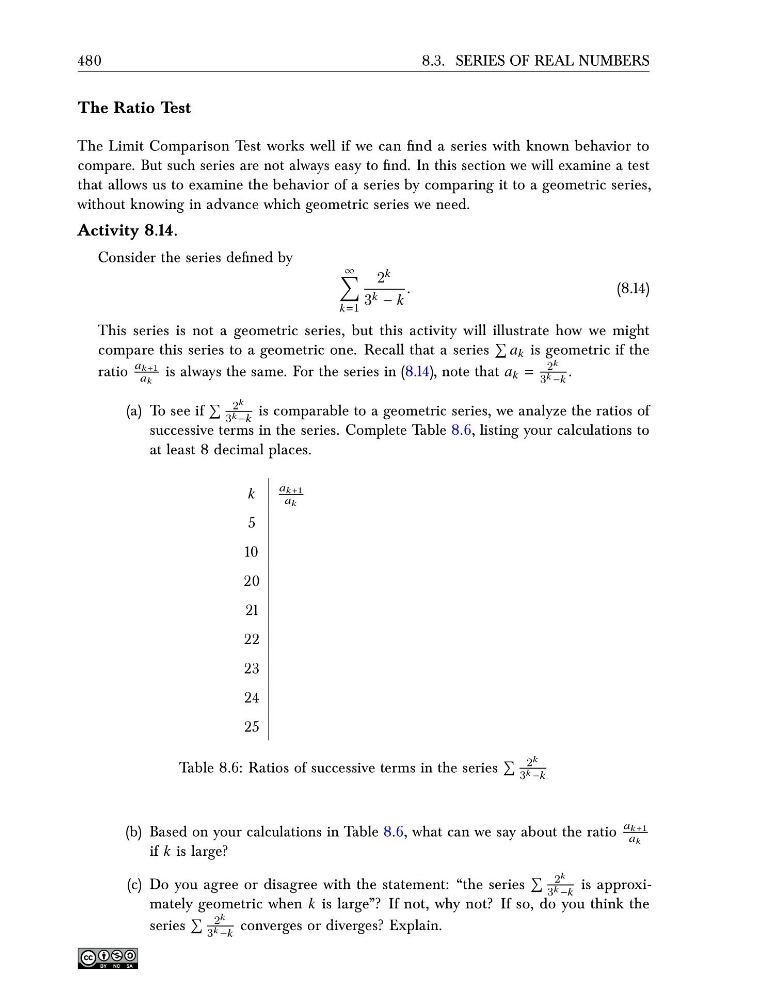
successive terms in the series. Complete Table 8.6, listing your calculations to
at least 8 decimal places.
k
a k+1
a k
5
10
20
21
22
23
24
25
Table 8.6: Ratios of successive terms in the series
2 k
3 k −k
(b) Based on your calculations in Table 8.6, what can we say about the ratio
a k+1
a k
if k is large?
(c) Do you agree or disagree with the statement: “the series
2 k
3 k −k
is approximately geometric when k is large”? If not, why not? If so, do you think the
series
2 k
3 k −k
converges or diverges? Explain.
8.3. SERIES OF REAL NUMBERS
The Ratio Test
The Limit Comparison Test works well if we can find a series with known behavior to
compare. But such series are not always easy to find. In this section we will examine a test
that allows us to examine the behavior of a series by comparing it to a geometric series,
without knowing in advance which geometric series we need.
Activity 8.14.
Consider the series defined by
∞
k=1
2 k
3 k − k
.
(8.14)
This series is not a geometric series, but this activity will illustrate how we might
compare this series to a geometric one. Recall that a series
a k is geometric if the
ratio
a k+1
a k
is always the same. For the series in (8.14), note that a k =
2 k
3 k −k
.
(a) To see if
2 k
3 k −k
is comparable to a geometric series, we analyze the ratios of
successive terms in the series. Complete Table 8.6, listing your calculations to
at least 8 decimal places.
k
a k+1
a k
5
10
20
21
22
23
24
25
Table 8.6: Ratios of successive terms in the series
2 k
3 k −k
(b) Based on your calculations in Table 8.6, what can we say about the ratio
a k+1
a k
if k is large?
(c) Do you agree or disagree with the statement: “the series
2 k
3 k −k
is approximately geometric when k is large”? If not, why not? If so, do you think the
series
2 k
3 k −k
converges or diverges? Explain.