

8.3. SERIES OF REAL NUMBERS
471
(a) Sum the first two numbers in this series. That is, find a numeric value for
2
k=1
1
k 2
(b) Next, add the first three numbers in the series.
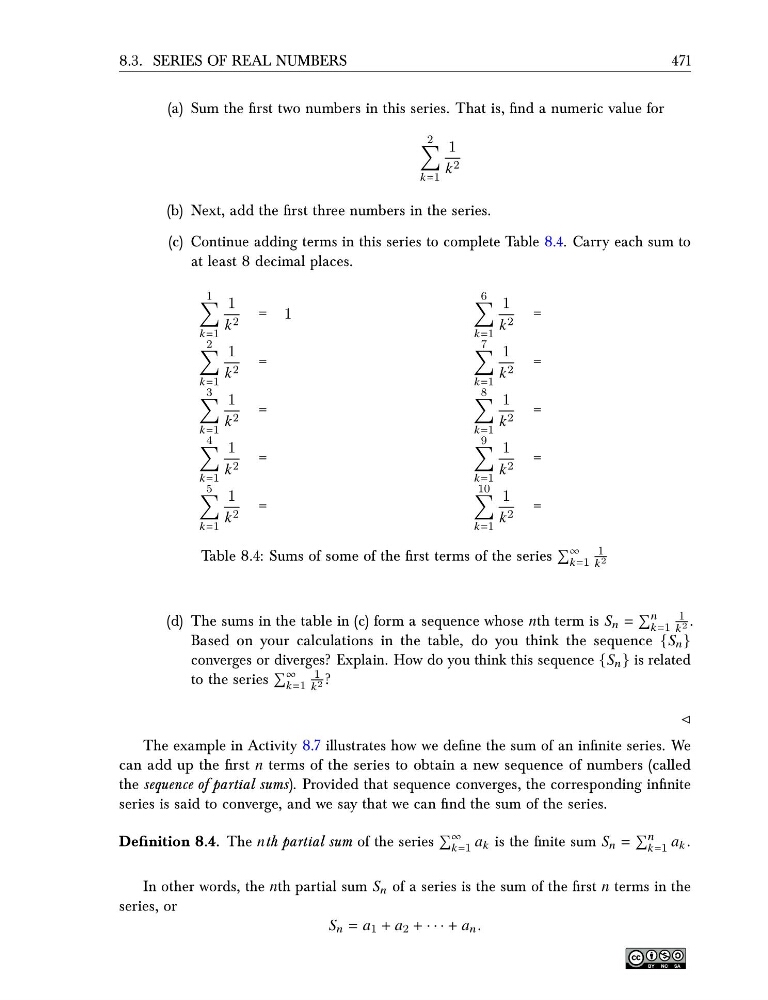
(c) Continue adding terms in this series to complete Table 8.4. Carry each sum to
at least 8 decimal places.
1
k=1
1
k 2 = 1
6
k=1
1
k 2 =
2
k=1
1
k 2 =
7
k=1
1
k 2 =
3
k=1
1
k 2 =
8
k=1
1
k 2 =
4
k=1
1
k 2 =
9
k=1
1
k 2 =
5
k=1
1
k 2 =
10
k=1
1
k 2 =
Table 8.4: Sums of some of the first terms of the series
∞
k=1
1
k 2
(d) The sums in the table in (c) form a sequence whose nth term is S n =
n
k=1
1
k 2 .
Based on your calculations in the table, do you think the sequence {S n }
converges or diverges? Explain. How do you think this sequence {S n } is related
to the series
∞
k=1
1
k 2 ?
⊳
The example in Activity 8.7 illustrates how we define the sum of an infinite series. We
can add up the first n terms of the series to obtain a new sequence of numbers (called
the sequence of partial sums). Provided that sequence converges, the corresponding infinite
series is said to converge, and we say that we can find the sum of the series.
Definition 8.4. The nth partial sum of the series
∞
k=1 a k is the finite sum S n =
n
k=1 a k .
In other words, the nth partial sum S n of a series is the sum of the first n terms in the
series, or
S n = a 1 + a 2 + · · · + a n .
471
(a) Sum the first two numbers in this series. That is, find a numeric value for
2
k=1
1
k 2
(b) Next, add the first three numbers in the series.
(c) Continue adding terms in this series to complete Table 8.4. Carry each sum to
at least 8 decimal places.
1
k=1
1
k 2 = 1
6
k=1
1
k 2 =
2
k=1
1
k 2 =
7
k=1
1
k 2 =
3
k=1
1
k 2 =
8
k=1
1
k 2 =
4
k=1
1
k 2 =
9
k=1
1
k 2 =
5
k=1
1
k 2 =
10
k=1
1
k 2 =
Table 8.4: Sums of some of the first terms of the series
∞
k=1
1
k 2
(d) The sums in the table in (c) form a sequence whose nth term is S n =
n
k=1
1
k 2 .
Based on your calculations in the table, do you think the sequence {S n }
converges or diverges? Explain. How do you think this sequence {S n } is related
to the series
∞
k=1
1
k 2 ?
⊳
The example in Activity 8.7 illustrates how we define the sum of an infinite series. We
can add up the first n terms of the series to obtain a new sequence of numbers (called
the sequence of partial sums). Provided that sequence converges, the corresponding infinite
series is said to converge, and we say that we can find the sum of the series.
Definition 8.4. The nth partial sum of the series
∞
k=1 a k is the finite sum S n =
n
k=1 a k .
In other words, the nth partial sum S n of a series is the sum of the first n terms in the
series, or
S n = a 1 + a 2 + · · · + a n .