

8.3. SERIES OF REAL NUMBERS
469
as the linearization at x = 0. We will now use a quadratic approximation P 2 (x)
to f (x) = e x centered at x = 0 which has the property that P 2 (0) = f (0),
P ′
2 (0) = f ′ (0), and P ′′
2 (0) = f ′′ (0).
(i) Let P 2 (x) = 1 + x +
x 2
2 . Show that P 2 (0) = f (0), P ′
2 (0) = f ′ (0), and P ′′
2 (0) =
f ′′ (0). Then, use P 2 (x) to approximate e by observing that P 2 (1) ≈ f (1).
(ii) We can continue approximating e with polynomials of larger degree whose
higher derivatives agree with those of f at 0. This turns out to make the
polynomials fit the graph of f better for more values of x around 0. For
example, let P 3 (x) = 1 + x +
x 2
2 +
x 3
6 . Show that P 3 (0) = f (0), P ′
3 (0) = f ′ (0),
P ′′
3 (0) = f ′′ (0), and P ′′′
3 (0) = f ′′′ (0). Use P 3 (x) to approximate e in a way
similar to how you did so with P 2 (x) above.
⊲⊳
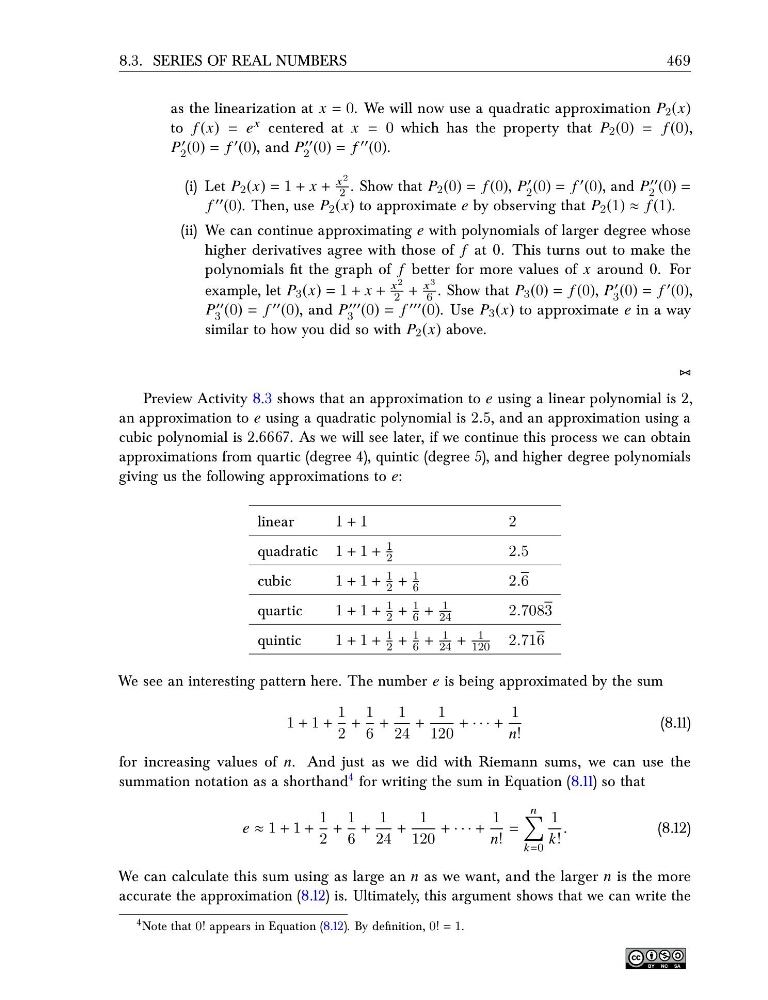
Preview Activity 8.3 shows that an approximation to e using a linear polynomial is 2,
an approximation to e using a quadratic polynomial is 2.5, and an approximation using a
cubic polynomial is 2.6667. As we will see later, if we continue this process we can obtain
approximations from quartic (degree 4), quintic (degree 5), and higher degree polynomials
giving us the following approximations to e:
linear
1 + 1
2
quadratic 1 + 1 +
1
2
2.5
cubic
1 + 1 +
1
2 +
1
6
2.6
quartic
1 + 1 +
1
2 +
1
6 +
1
24
2.7083
quintic
1 + 1 +
1
2 +
1
6 +
1
24 +
1
120
2.716
We see an interesting pattern here. The number e is being approximated by the sum
1 + 1 +
1
2
+
1
6
+
1
24
+
1
120
+ · · · +
1
n!
(8.11)
for increasing values of n. And just as we did with Riemann sums, we can use the
summation notation as a shorthand 4 for writing the sum in Equation (8.11) so that
e ≈ 1 + 1 +
1
2
+
1
6
+
1
24
+
1
120
+ · · · +
1
n!
=
n
k=0
1
k!
.
(8.12)
We can calculate this sum using as large an n as we want, and the larger n is the more
accurate the approximation (8.12) is. Ultimately, this argument shows that we can write the
4 Note that 0! appears in Equation (8.12). By definition, 0! = 1.
469
as the linearization at x = 0. We will now use a quadratic approximation P 2 (x)
to f (x) = e x centered at x = 0 which has the property that P 2 (0) = f (0),
P ′
2 (0) = f ′ (0), and P ′′
2 (0) = f ′′ (0).
(i) Let P 2 (x) = 1 + x +
x 2
2 . Show that P 2 (0) = f (0), P ′
2 (0) = f ′ (0), and P ′′
2 (0) =
f ′′ (0). Then, use P 2 (x) to approximate e by observing that P 2 (1) ≈ f (1).
(ii) We can continue approximating e with polynomials of larger degree whose
higher derivatives agree with those of f at 0. This turns out to make the
polynomials fit the graph of f better for more values of x around 0. For
example, let P 3 (x) = 1 + x +
x 2
2 +
x 3
6 . Show that P 3 (0) = f (0), P ′
3 (0) = f ′ (0),
P ′′
3 (0) = f ′′ (0), and P ′′′
3 (0) = f ′′′ (0). Use P 3 (x) to approximate e in a way
similar to how you did so with P 2 (x) above.
⊲⊳
Preview Activity 8.3 shows that an approximation to e using a linear polynomial is 2,
an approximation to e using a quadratic polynomial is 2.5, and an approximation using a
cubic polynomial is 2.6667. As we will see later, if we continue this process we can obtain
approximations from quartic (degree 4), quintic (degree 5), and higher degree polynomials
giving us the following approximations to e:
linear
1 + 1
2
quadratic 1 + 1 +
1
2
2.5
cubic
1 + 1 +
1
2 +
1
6
2.6
quartic
1 + 1 +
1
2 +
1
6 +
1
24
2.7083
quintic
1 + 1 +
1
2 +
1
6 +
1
24 +
1
120
2.716
We see an interesting pattern here. The number e is being approximated by the sum
1 + 1 +
1
2
+
1
6
+
1
24
+
1
120
+ · · · +
1
n!
(8.11)
for increasing values of n. And just as we did with Riemann sums, we can use the
summation notation as a shorthand 4 for writing the sum in Equation (8.11) so that
e ≈ 1 + 1 +
1
2
+
1
6
+
1
24
+
1
120
+ · · · +
1
n!
=
n
k=0
1
k!
.
(8.12)
We can calculate this sum using as large an n as we want, and the larger n is the more
accurate the approximation (8.12) is. Ultimately, this argument shows that we can write the
4 Note that 0! appears in Equation (8.12). By definition, 0! = 1.