

454
8.1. SEQUENCES
(g) Determine the number of minutes it takes until the amount of GLP-1 in plasma
is 1 gram.
4. Continuous data is the basis for analog information, like music stored on old cassette
tapes or vinyl records. A digital signal like on a CD or MP3 file is obtained by sampling
an analog signal at some regular time interval and storing that information. For
example, the sampling rate of a compact disk is 44,100 samples per second. So a
digital recording is only an approximation of the actual analog information. Digital
information can be manipulated in many useful ways that allow for, among other things,
noisy signals to be cleaned up and large collections of information to be compressed
and stored in much smaller space. While we won’t investigate these techniques in this
chapter, this exercise is intended to give an idea of the importance of discrete (digital)
techniques.
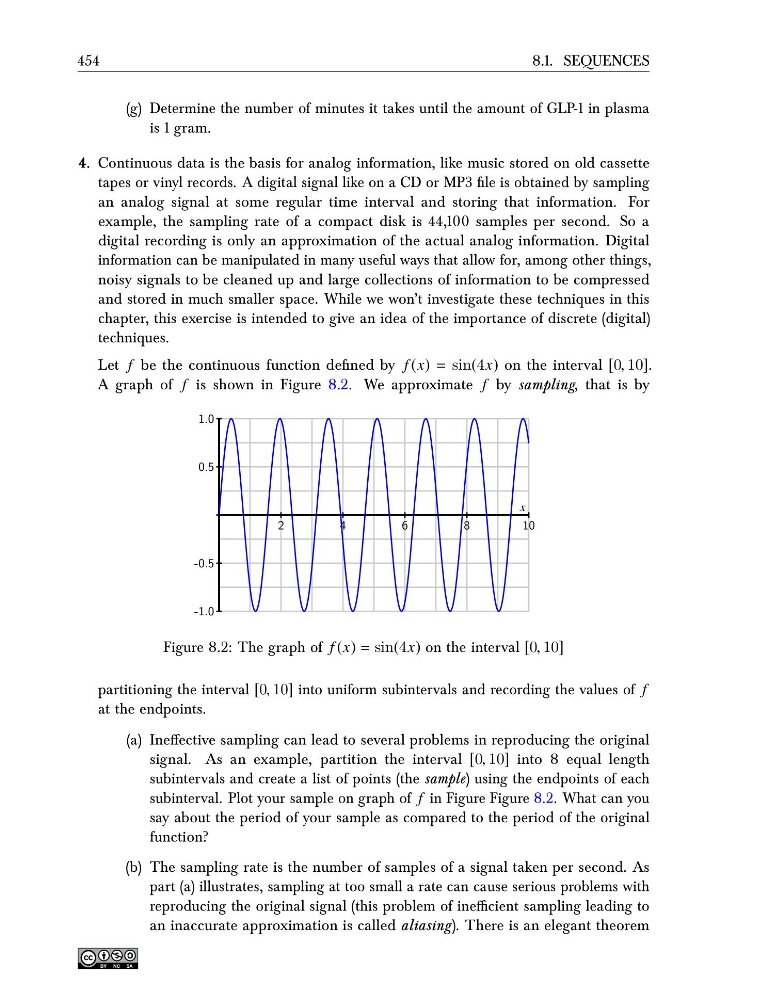
Let f be the continuous function defined by f (x) = sin(4x) on the interval [0, 10].
A graph of f is shown in Figure 8.2. We approximate f by sampling, that is by
2
4
6
8
10
-1.0
-0.5
0.5
1.0
x
Figure 8.2: The graph of f (x) = sin(4x) on the interval [0, 10]
partitioning the interval [0, 10] into uniform subintervals and recording the values of f
at the endpoints.
(a) Ineffective sampling can lead to several problems in reproducing the original
signal. As an example, partition the interval [0, 10] into 8 equal length
subintervals and create a list of points (the sample) using the endpoints of each
subinterval. Plot your sample on graph of f in Figure Figure 8.2. What can you
say about the period of your sample as compared to the period of the original
function?
(b) The sampling rate is the number of samples of a signal taken per second. As
part (a) illustrates, sampling at too small a rate can cause serious problems with
reproducing the original signal (this problem of inefficient sampling leading to
an inaccurate approximation is called aliasing). There is an elegant theorem
8.1. SEQUENCES
(g) Determine the number of minutes it takes until the amount of GLP-1 in plasma
is 1 gram.
4. Continuous data is the basis for analog information, like music stored on old cassette
tapes or vinyl records. A digital signal like on a CD or MP3 file is obtained by sampling
an analog signal at some regular time interval and storing that information. For
example, the sampling rate of a compact disk is 44,100 samples per second. So a
digital recording is only an approximation of the actual analog information. Digital
information can be manipulated in many useful ways that allow for, among other things,
noisy signals to be cleaned up and large collections of information to be compressed
and stored in much smaller space. While we won’t investigate these techniques in this
chapter, this exercise is intended to give an idea of the importance of discrete (digital)
techniques.
Let f be the continuous function defined by f (x) = sin(4x) on the interval [0, 10].
A graph of f is shown in Figure 8.2. We approximate f by sampling, that is by
2
4
6
8
10
-1.0
-0.5
0.5
1.0
x
Figure 8.2: The graph of f (x) = sin(4x) on the interval [0, 10]
partitioning the interval [0, 10] into uniform subintervals and recording the values of f
at the endpoints.
(a) Ineffective sampling can lead to several problems in reproducing the original
signal. As an example, partition the interval [0, 10] into 8 equal length
subintervals and create a list of points (the sample) using the endpoints of each
subinterval. Plot your sample on graph of f in Figure Figure 8.2. What can you
say about the period of your sample as compared to the period of the original
function?
(b) The sampling rate is the number of samples of a signal taken per second. As
part (a) illustrates, sampling at too small a rate can cause serious problems with
reproducing the original signal (this problem of inefficient sampling leading to
an inaccurate approximation is called aliasing). There is an elegant theorem