

448
8.1. SEQUENCES
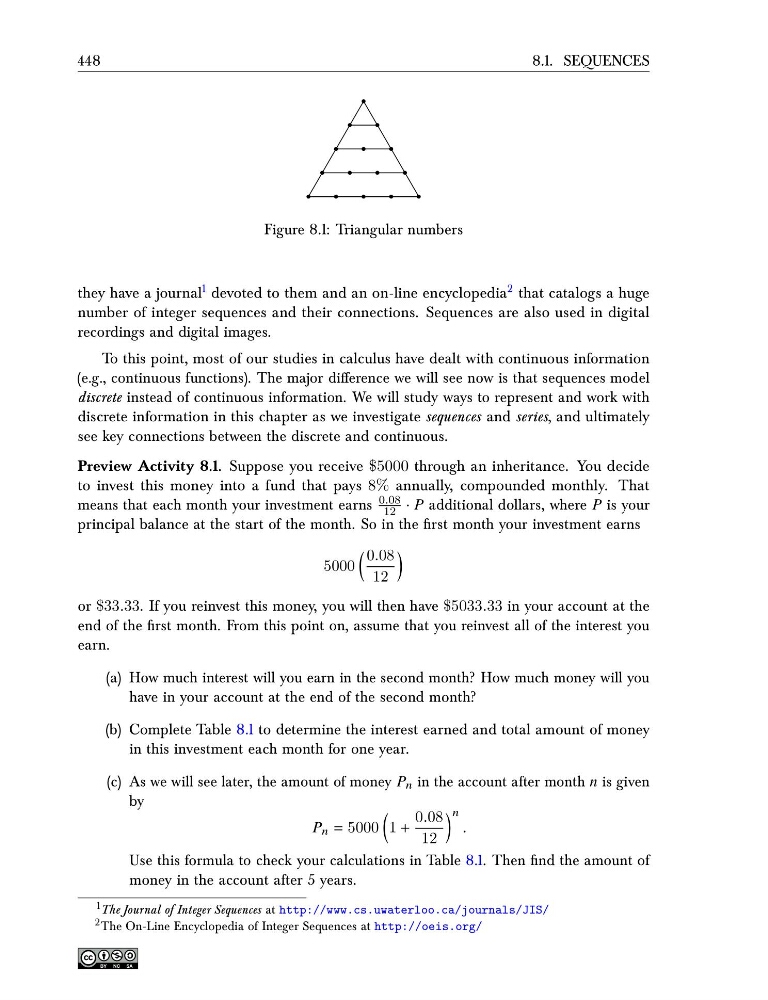
Figure 8.1: Triangular numbers
they have a journal 1 devoted to them and an on-line encyclopedia 2 that catalogs a huge
number of integer sequences and their connections. Sequences are also used in digital
recordings and digital images.
To this point, most of our studies in calculus have dealt with continuous information
(e.g., continuous functions). The major difference we will see now is that sequences model
discrete instead of continuous information. We will study ways to represent and work with
discrete information in this chapter as we investigate sequences and series, and ultimately
see key connections between the discrete and continuous.
Preview Activity 8.1. Suppose you receive $5000 through an inheritance. You decide
to invest this money into a fund that pays 8% annually, compounded monthly. That
means that each month your investment earns
0.08
12 · P additional dollars, where P is your
principal balance at the start of the month. So in the first month your investment earns
5000
0.08
12
or $33.33. If you reinvest this money, you will then have $5033.33 in your account at the
end of the first month. From this point on, assume that you reinvest all of the interest you
earn.
(a) How much interest will you earn in the second month? How much money will you
have in your account at the end of the second month?
(b) Complete Table 8.1 to determine the interest earned and total amount of money
in this investment each month for one year.
(c) As we will see later, the amount of money P n in the account after month n is given
by
P n = 5000
1 +
0.08
12
n
.
Use this formula to check your calculations in Table 8.1. Then find the amount of
money in the account after 5 years.
1 The Journal of Integer Sequences at http://www.cs.uwaterloo.ca/journals/JIS/
2 The On-Line Encyclopedia of Integer Sequences at http://oeis.org/
8.1. SEQUENCES
Figure 8.1: Triangular numbers
they have a journal 1 devoted to them and an on-line encyclopedia 2 that catalogs a huge
number of integer sequences and their connections. Sequences are also used in digital
recordings and digital images.
To this point, most of our studies in calculus have dealt with continuous information
(e.g., continuous functions). The major difference we will see now is that sequences model
discrete instead of continuous information. We will study ways to represent and work with
discrete information in this chapter as we investigate sequences and series, and ultimately
see key connections between the discrete and continuous.
Preview Activity 8.1. Suppose you receive $5000 through an inheritance. You decide
to invest this money into a fund that pays 8% annually, compounded monthly. That
means that each month your investment earns
0.08
12 · P additional dollars, where P is your
principal balance at the start of the month. So in the first month your investment earns
5000
0.08
12
or $33.33. If you reinvest this money, you will then have $5033.33 in your account at the
end of the first month. From this point on, assume that you reinvest all of the interest you
earn.
(a) How much interest will you earn in the second month? How much money will you
have in your account at the end of the second month?
(b) Complete Table 8.1 to determine the interest earned and total amount of money
in this investment each month for one year.
(c) As we will see later, the amount of money P n in the account after month n is given
by
P n = 5000
1 +
0.08
12
n
.
Use this formula to check your calculations in Table 8.1. Then find the amount of
money in the account after 5 years.
1 The Journal of Integer Sequences at http://www.cs.uwaterloo.ca/journals/JIS/
2 The On-Line Encyclopedia of Integer Sequences at http://oeis.org/