

7.6. POPULATION GROWTH AND THE LOGISTIC EQUATION
441
2 4 6 8 10 12 14 16 18 20
-0.10
-0.05
0.05
0.10
P
dP
dt
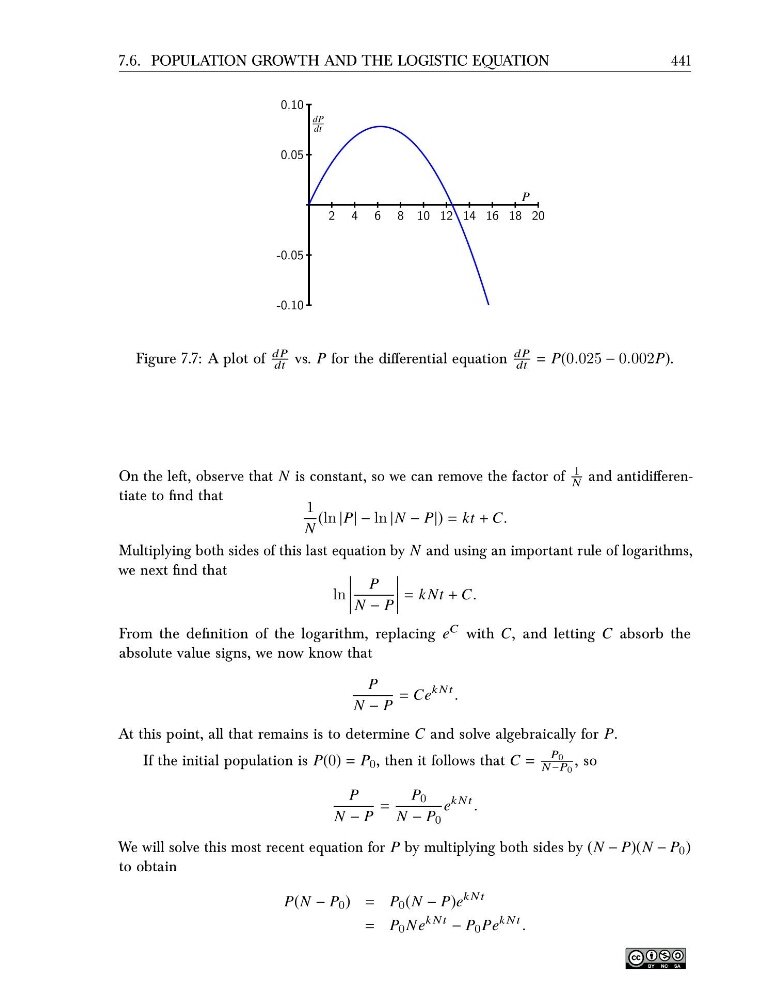
Figure 7.7: A plot of
dP
dt vs. P for the differential equation
dP
dt = P(0.025 − 0.002P).
On the left, observe that N is constant, so we can remove the factor of
1
N and antidifferentiate to find that
1
N
(ln |P| − ln |N − P|) = kt + C.
Multiplying both sides of this last equation by N and using an important rule of logarithms,
we next find that
ln
P
N − P
= k Nt + C.
From the definition of the logarithm, replacing e C with C, and letting C absorb the
absolute value signs, we now know that
P
N − P
= Ce
k N t .
At this point, all that remains is to determine C and solve algebraically for P.
If the initial population is P(0) = P 0 , then it follows that C =
P 0
N −P 0
, so
P
N − P
=
P 0
N − P 0
e
k N t .
We will solve this most recent equation for P by multiplying both sides by (N − P)(N − P 0 )
to obtain
P(N − P 0 ) = P 0 (N − P)e
k N t
= P 0 N e
k N t − P 0 Pe
k N t .
441
2 4 6 8 10 12 14 16 18 20
-0.10
-0.05
0.05
0.10
P
dP
dt
Figure 7.7: A plot of
dP
dt vs. P for the differential equation
dP
dt = P(0.025 − 0.002P).
On the left, observe that N is constant, so we can remove the factor of
1
N and antidifferentiate to find that
1
N
(ln |P| − ln |N − P|) = kt + C.
Multiplying both sides of this last equation by N and using an important rule of logarithms,
we next find that
ln
P
N − P
= k Nt + C.
From the definition of the logarithm, replacing e C with C, and letting C absorb the
absolute value signs, we now know that
P
N − P
= Ce
k N t .
At this point, all that remains is to determine C and solve algebraically for P.
If the initial population is P(0) = P 0 , then it follows that C =
P 0
N −P 0
, so
P
N − P
=
P 0
N − P 0
e
k N t .
We will solve this most recent equation for P by multiplying both sides by (N − P)(N − P 0 )
to obtain
P(N − P 0 ) = P 0 (N − P)e
k N t
= P 0 N e
k N t − P 0 Pe
k N t .