

7.5. MODELING WITH DIFFERENTIAL EQUATIONS
431
t
P
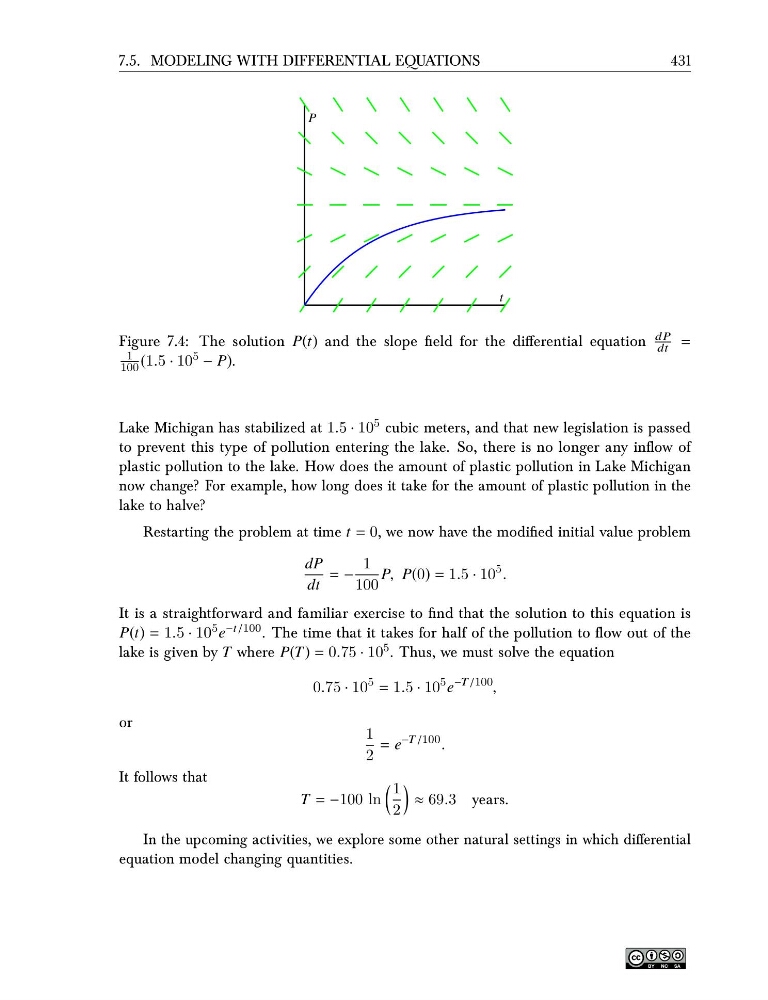
Figure 7.4: The solution P(t) and the slope field for the differential equation
dP
dt =
1
100 (1.5 · 10 5 − P).
Lake Michigan has stabilized at 1.5 · 10 5 cubic meters, and that new legislation is passed
to prevent this type of pollution entering the lake. So, there is no longer any inflow of
plastic pollution to the lake. How does the amount of plastic pollution in Lake Michigan
now change? For example, how long does it take for the amount of plastic pollution in the
lake to halve?
Restarting the problem at time t = 0, we now have the modified initial value problem
dP
dt
= −
1
100
P, P(0) = 1.5 · 10
5 .
It is a straightforward and familiar exercise to find that the solution to this equation is
P(t) = 1.5 · 10 5 e −t/100 . The time that it takes for half of the pollution to flow out of the
lake is given by T where P(T) = 0.75 · 10 5 . Thus, we must solve the equation
0.75 · 10
5 = 1.5 · 10
5 e
−T /100
,
or
1
2
= e
−T /100 .
It follows that
T = −100 ln
1
2
≈ 69.3 years.
In the upcoming activities, we explore some other natural settings in which differential
equation model changing quantities.
431
t
P
Figure 7.4: The solution P(t) and the slope field for the differential equation
dP
dt =
1
100 (1.5 · 10 5 − P).
Lake Michigan has stabilized at 1.5 · 10 5 cubic meters, and that new legislation is passed
to prevent this type of pollution entering the lake. So, there is no longer any inflow of
plastic pollution to the lake. How does the amount of plastic pollution in Lake Michigan
now change? For example, how long does it take for the amount of plastic pollution in the
lake to halve?
Restarting the problem at time t = 0, we now have the modified initial value problem
dP
dt
= −
1
100
P, P(0) = 1.5 · 10
5 .
It is a straightforward and familiar exercise to find that the solution to this equation is
P(t) = 1.5 · 10 5 e −t/100 . The time that it takes for half of the pollution to flow out of the
lake is given by T where P(T) = 0.75 · 10 5 . Thus, we must solve the equation
0.75 · 10
5 = 1.5 · 10
5 e
−T /100
,
or
1
2
= e
−T /100 .
It follows that
T = −100 ln
1
2
≈ 69.3 years.
In the upcoming activities, we explore some other natural settings in which differential
equation model changing quantities.