

408
7.2. QUALITATIVE BEHAVIOR OF SOLUTIONS TO DES
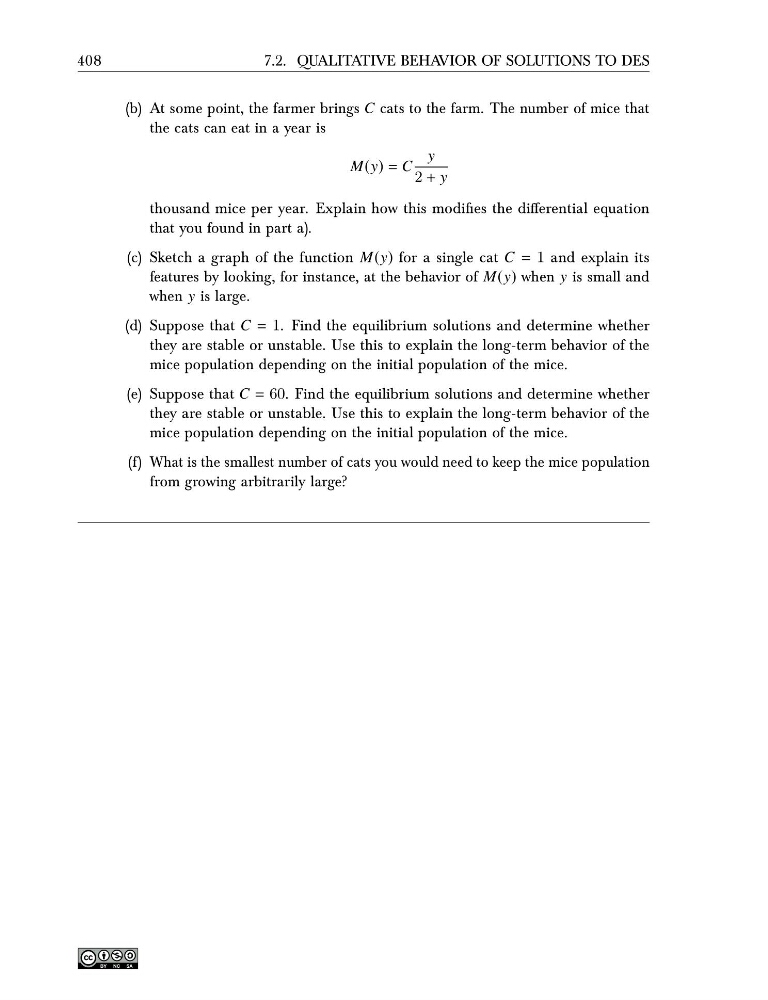
(b) At some point, the farmer brings C cats to the farm. The number of mice that
the cats can eat in a year is
M(y) = C
y
2 + y
thousand mice per year. Explain how this modifies the differential equation
that you found in part a).
(c) Sketch a graph of the function M(y) for a single cat C = 1 and explain its
features by looking, for instance, at the behavior of M(y) when y is small and
when y is large.
(d) Suppose that C = 1. Find the equilibrium solutions and determine whether
they are stable or unstable. Use this to explain the long-term behavior of the
mice population depending on the initial population of the mice.
(e) Suppose that C = 60. Find the equilibrium solutions and determine whether
they are stable or unstable. Use this to explain the long-term behavior of the
mice population depending on the initial population of the mice.
(f) What is the smallest number of cats you would need to keep the mice population
from growing arbitrarily large?
7.2. QUALITATIVE BEHAVIOR OF SOLUTIONS TO DES
(b) At some point, the farmer brings C cats to the farm. The number of mice that
the cats can eat in a year is
M(y) = C
y
2 + y
thousand mice per year. Explain how this modifies the differential equation
that you found in part a).
(c) Sketch a graph of the function M(y) for a single cat C = 1 and explain its
features by looking, for instance, at the behavior of M(y) when y is small and
when y is large.
(d) Suppose that C = 1. Find the equilibrium solutions and determine whether
they are stable or unstable. Use this to explain the long-term behavior of the
mice population depending on the initial population of the mice.
(e) Suppose that C = 60. Find the equilibrium solutions and determine whether
they are stable or unstable. Use this to explain the long-term behavior of the
mice population depending on the initial population of the mice.
(f) What is the smallest number of cats you would need to keep the mice population
from growing arbitrarily large?