

26
1.3. THE DERIVATIVE OF A FUNCTION AT A POINT
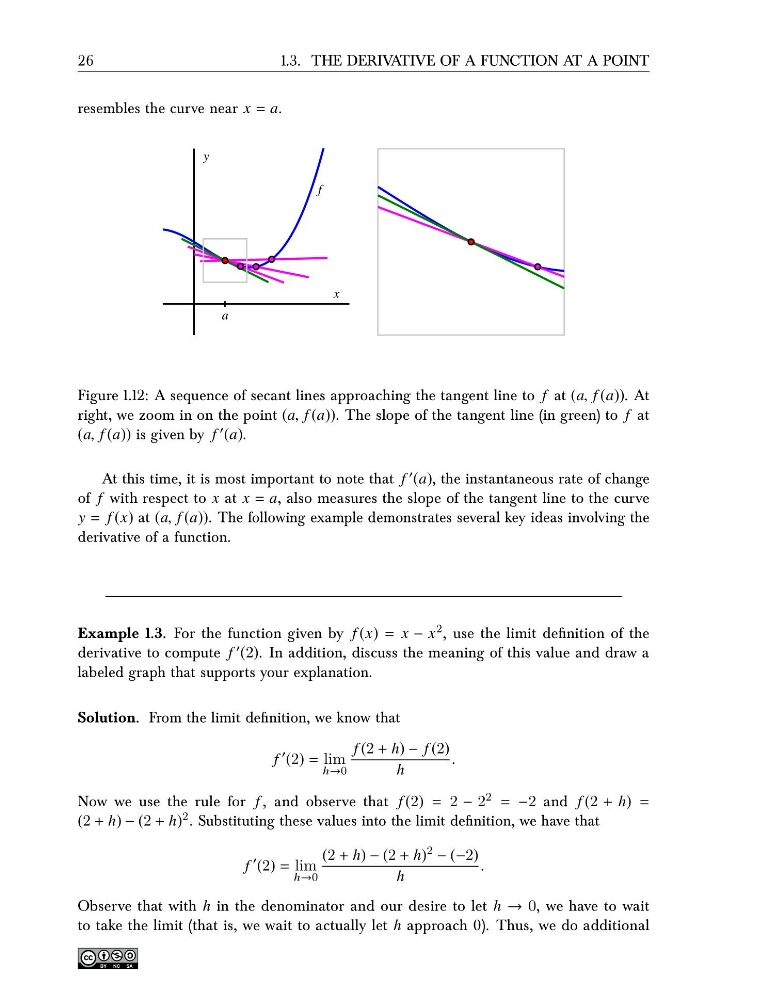
resembles the curve near x = a.
x
y
f
a
Figure 1.12: A sequence of secant lines approaching the tangent line to f at (a, f (a)). At
right, we zoom in on the point (a, f (a)). The slope of the tangent line (in green) to f at
(a, f (a)) is given by f ′ (a).
At this time, it is most important to note that f ′ (a), the instantaneous rate of change
of f with respect to x at x = a, also measures the slope of the tangent line to the curve
y = f (x) at (a, f (a)). The following example demonstrates several key ideas involving the
derivative of a function.
Example 1.3. For the function given by f (x) = x − x 2 , use the limit definition of the
derivative to compute f ′ (2). In addition, discuss the meaning of this value and draw a
labeled graph that supports your explanation.
Solution. From the limit definition, we know that
f
′ (2) = lim
h→0
f (2 + h) − f (2)
h
.
Now we use the rule for f , and observe that f (2) = 2 − 2 2 = −2 and f (2 + h) =
(2 + h) − (2 + h) 2 . Substituting these values into the limit definition, we have that
f
′ (2) = lim
h→0
(2 + h) − (2 + h) 2 − (−2)
h
.
Observe that with h in the denominator and our desire to let h → 0, we have to wait
to take the limit (that is, we wait to actually let h approach 0). Thus, we do additional
1.3. THE DERIVATIVE OF A FUNCTION AT A POINT
resembles the curve near x = a.
x
y
f
a
Figure 1.12: A sequence of secant lines approaching the tangent line to f at (a, f (a)). At
right, we zoom in on the point (a, f (a)). The slope of the tangent line (in green) to f at
(a, f (a)) is given by f ′ (a).
At this time, it is most important to note that f ′ (a), the instantaneous rate of change
of f with respect to x at x = a, also measures the slope of the tangent line to the curve
y = f (x) at (a, f (a)). The following example demonstrates several key ideas involving the
derivative of a function.
Example 1.3. For the function given by f (x) = x − x 2 , use the limit definition of the
derivative to compute f ′ (2). In addition, discuss the meaning of this value and draw a
labeled graph that supports your explanation.
Solution. From the limit definition, we know that
f
′ (2) = lim
h→0
f (2 + h) − f (2)
h
.
Now we use the rule for f , and observe that f (2) = 2 − 2 2 = −2 and f (2 + h) =
(2 + h) − (2 + h) 2 . Substituting these values into the limit definition, we have that
f
′ (2) = lim
h→0
(2 + h) − (2 + h) 2 − (−2)
h
.
Observe that with h in the denominator and our desire to let h → 0, we have to wait
to take the limit (that is, we wait to actually let h approach 0). Thus, we do additional