

7.1. AN INTRODUCTION TO DIFFERENTIAL EQUATIONS
393
Since
dv
dt and 1.5 − 0.5v agree for all values of t when v = 3 − 2e −0.5t , we have indeed
found a solution to the differential equation.
Activity 7.3.
Consider the differential equation
dv
dt
= 1.5 − 0.5v.
Which of the following functions are solutions of this differential equation?
(a) v(t) = 1.5t − 0.25t 2 .
(b) v(t) = 3 + 2e −0.5t .
(c) v(t) = 3.
(d) v(t) = 3 + Ce −0.5t where C is any constant.
⊳
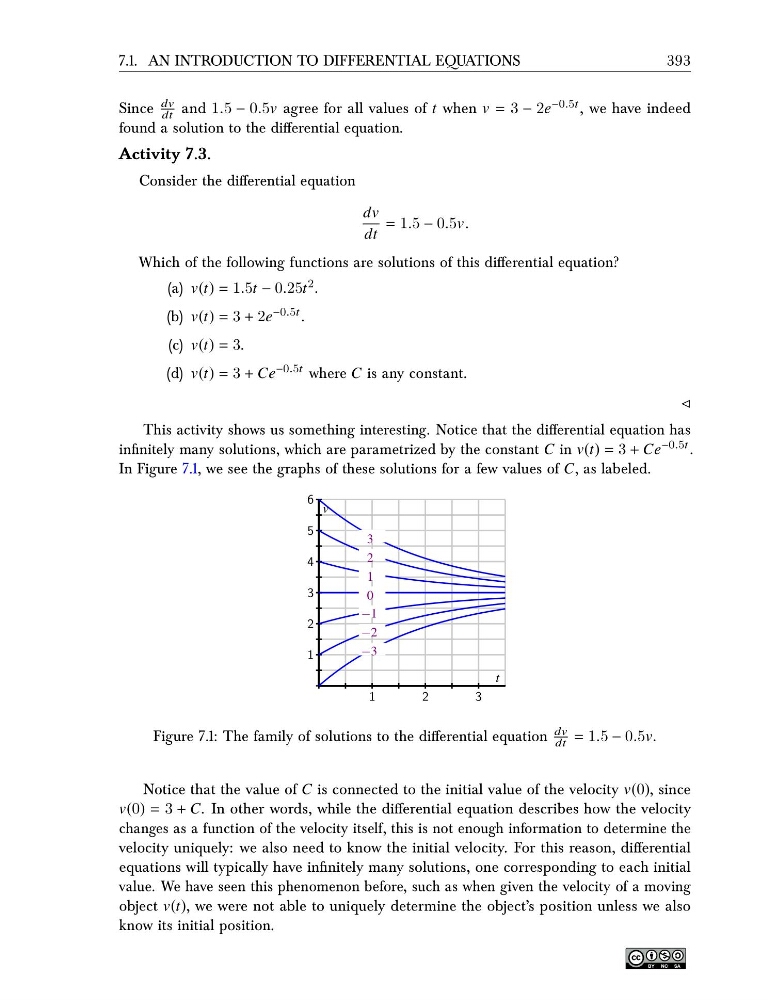
This activity shows us something interesting. Notice that the differential equation has
infinitely many solutions, which are parametrized by the constant C in v(t) = 3 + Ce −0.5t .
In Figure 7.1, we see the graphs of these solutions for a few values of C, as labeled.
1
2
3
1
2
3
4
5
6
−3
−2
−1
0
1
2
3
t
v
Figure 7.1: The family of solutions to the differential equation
dv
dt = 1.5 − 0.5v.
Notice that the value of C is connected to the initial value of the velocity v(0), since
v(0) = 3 + C. In other words, while the differential equation describes how the velocity
changes as a function of the velocity itself, this is not enough information to determine the
velocity uniquely: we also need to know the initial velocity. For this reason, differential
equations will typically have infinitely many solutions, one corresponding to each initial
value. We have seen this phenomenon before, such as when given the velocity of a moving
object v(t), we were not able to uniquely determine the object’s position unless we also
know its initial position.
393
Since
dv
dt and 1.5 − 0.5v agree for all values of t when v = 3 − 2e −0.5t , we have indeed
found a solution to the differential equation.
Activity 7.3.
Consider the differential equation
dv
dt
= 1.5 − 0.5v.
Which of the following functions are solutions of this differential equation?
(a) v(t) = 1.5t − 0.25t 2 .
(b) v(t) = 3 + 2e −0.5t .
(c) v(t) = 3.
(d) v(t) = 3 + Ce −0.5t where C is any constant.
⊳
This activity shows us something interesting. Notice that the differential equation has
infinitely many solutions, which are parametrized by the constant C in v(t) = 3 + Ce −0.5t .
In Figure 7.1, we see the graphs of these solutions for a few values of C, as labeled.
1
2
3
1
2
3
4
5
6
−3
−2
−1
0
1
2
3
t
v
Figure 7.1: The family of solutions to the differential equation
dv
dt = 1.5 − 0.5v.
Notice that the value of C is connected to the initial value of the velocity v(0), since
v(0) = 3 + C. In other words, while the differential equation describes how the velocity
changes as a function of the velocity itself, this is not enough information to determine the
velocity uniquely: we also need to know the initial velocity. For this reason, differential
equations will typically have infinitely many solutions, one corresponding to each initial
value. We have seen this phenomenon before, such as when given the velocity of a moving
object v(t), we were not able to uniquely determine the object’s position unless we also
know its initial position.