

7.1. AN INTRODUCTION TO DIFFERENTIAL EQUATIONS
391
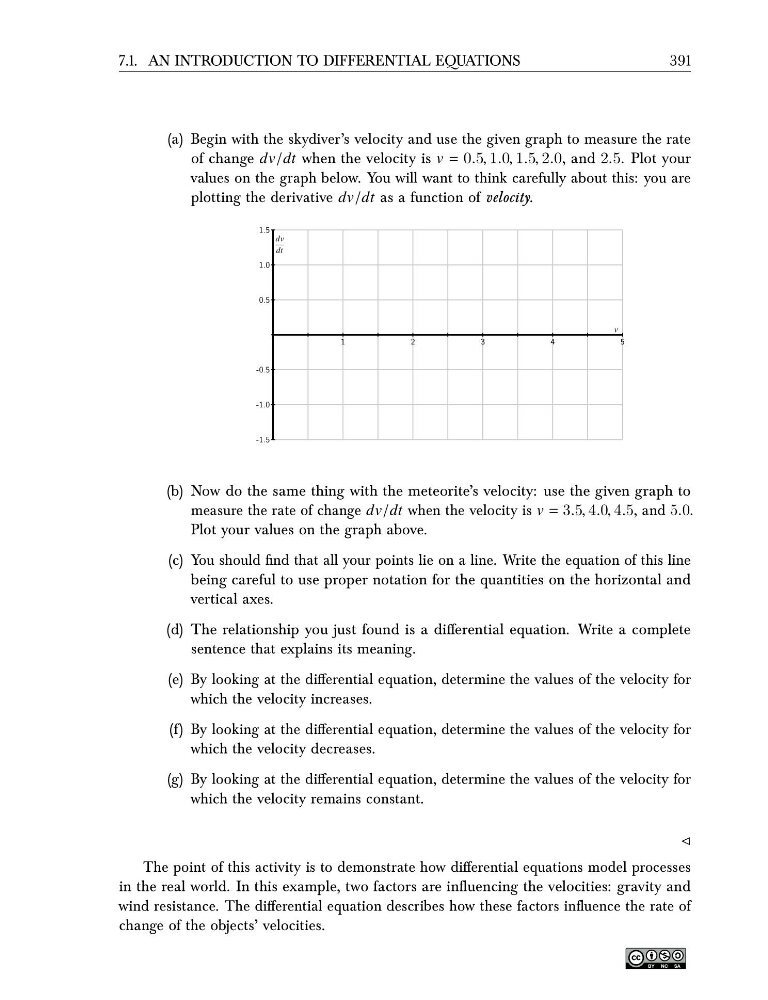
(a) Begin with the skydiver’s velocity and use the given graph to measure the rate
of change dv/dt when the velocity is v = 0.5, 1.0, 1.5, 2.0, and 2.5. Plot your
values on the graph below. You will want to think carefully about this: you are
plotting the derivative dv/dt as a function of velocity.
1
2
3
4
5
-1.5
-1.0
-0.5
0.5
1.0
1.5
v
dv
dt
(b) Now do the same thing with the meteorite’s velocity: use the given graph to
measure the rate of change dv/dt when the velocity is v = 3.5, 4.0, 4.5, and 5.0.
Plot your values on the graph above.
(c) You should find that all your points lie on a line. Write the equation of this line
being careful to use proper notation for the quantities on the horizontal and
vertical axes.
(d) The relationship you just found is a differential equation. Write a complete
sentence that explains its meaning.
(e) By looking at the differential equation, determine the values of the velocity for
which the velocity increases.
(f) By looking at the differential equation, determine the values of the velocity for
which the velocity decreases.
(g) By looking at the differential equation, determine the values of the velocity for
which the velocity remains constant.
⊳
The point of this activity is to demonstrate how differential equations model processes
in the real world. In this example, two factors are influencing the velocities: gravity and
wind resistance. The differential equation describes how these factors influence the rate of
change of the objects’ velocities.
391
(a) Begin with the skydiver’s velocity and use the given graph to measure the rate
of change dv/dt when the velocity is v = 0.5, 1.0, 1.5, 2.0, and 2.5. Plot your
values on the graph below. You will want to think carefully about this: you are
plotting the derivative dv/dt as a function of velocity.
1
2
3
4
5
-1.5
-1.0
-0.5
0.5
1.0
1.5
v
dv
dt
(b) Now do the same thing with the meteorite’s velocity: use the given graph to
measure the rate of change dv/dt when the velocity is v = 3.5, 4.0, 4.5, and 5.0.
Plot your values on the graph above.
(c) You should find that all your points lie on a line. Write the equation of this line
being careful to use proper notation for the quantities on the horizontal and
vertical axes.
(d) The relationship you just found is a differential equation. Write a complete
sentence that explains its meaning.
(e) By looking at the differential equation, determine the values of the velocity for
which the velocity increases.
(f) By looking at the differential equation, determine the values of the velocity for
which the velocity decreases.
(g) By looking at the differential equation, determine the values of the velocity for
which the velocity remains constant.
⊳
The point of this activity is to demonstrate how differential equations model processes
in the real world. In this example, two factors are influencing the velocities: gravity and
wind resistance. The differential equation describes how these factors influence the rate of
change of the objects’ velocities.