

6.4. PHYSICS APPLICATIONS: WORK, FORCE, AND PRESSURE
375
x +
y +
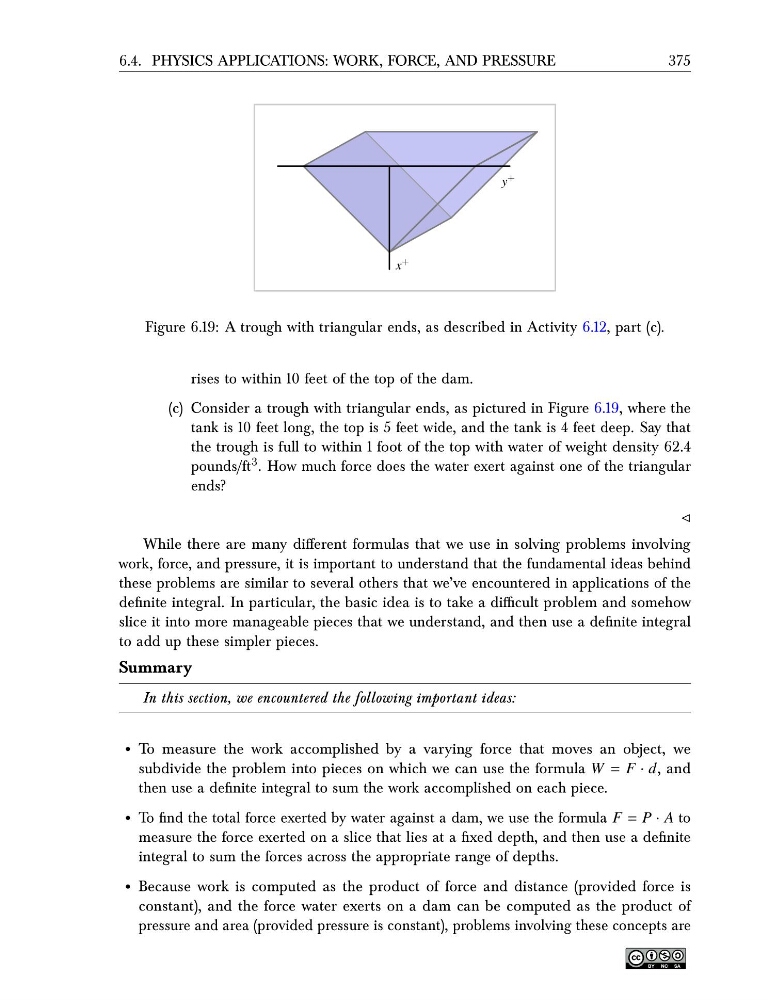
Figure 6.19: A trough with triangular ends, as described in Activity 6.12, part (c).
rises to within 10 feet of the top of the dam.
(c) Consider a trough with triangular ends, as pictured in Figure 6.19, where the
tank is 10 feet long, the top is 5 feet wide, and the tank is 4 feet deep. Say that
the trough is full to within 1 foot of the top with water of weight density 62.4
pounds/ft 3 . How much force does the water exert against one of the triangular
ends?
⊳
While there are many different formulas that we use in solving problems involving
work, force, and pressure, it is important to understand that the fundamental ideas behind
these problems are similar to several others that we’ve encountered in applications of the
definite integral. In particular, the basic idea is to take a difficult problem and somehow
slice it into more manageable pieces that we understand, and then use a definite integral
to add up these simpler pieces.
Summary
In this section, we encountered the following important ideas:
• To measure the work accomplished by a varying force that moves an object, we
subdivide the problem into pieces on which we can use the formula W = F · d, and
then use a definite integral to sum the work accomplished on each piece.
• To find the total force exerted by water against a dam, we use the formula F = P · A to
measure the force exerted on a slice that lies at a fixed depth, and then use a definite
integral to sum the forces across the appropriate range of depths.
• Because work is computed as the product of force and distance (provided force is
constant), and the force water exerts on a dam can be computed as the product of
pressure and area (provided pressure is constant), problems involving these concepts are
375
x +
y +
Figure 6.19: A trough with triangular ends, as described in Activity 6.12, part (c).
rises to within 10 feet of the top of the dam.
(c) Consider a trough with triangular ends, as pictured in Figure 6.19, where the
tank is 10 feet long, the top is 5 feet wide, and the tank is 4 feet deep. Say that
the trough is full to within 1 foot of the top with water of weight density 62.4
pounds/ft 3 . How much force does the water exert against one of the triangular
ends?
⊳
While there are many different formulas that we use in solving problems involving
work, force, and pressure, it is important to understand that the fundamental ideas behind
these problems are similar to several others that we’ve encountered in applications of the
definite integral. In particular, the basic idea is to take a difficult problem and somehow
slice it into more manageable pieces that we understand, and then use a definite integral
to add up these simpler pieces.
Summary
In this section, we encountered the following important ideas:
• To measure the work accomplished by a varying force that moves an object, we
subdivide the problem into pieces on which we can use the formula W = F · d, and
then use a definite integral to sum the work accomplished on each piece.
• To find the total force exerted by water against a dam, we use the formula F = P · A to
measure the force exerted on a slice that lies at a fixed depth, and then use a definite
integral to sum the forces across the appropriate range of depths.
• Because work is computed as the product of force and distance (provided force is
constant), and the force water exerts on a dam can be computed as the product of
pressure and area (provided pressure is constant), problems involving these concepts are