

1.3. THE DERIVATIVE OF A FUNCTION AT A POINT
23
In a similar way, we make the following definition for an arbitrary function y = f (x).
Definition 1.2. For a function f , the average rate of change of f on the interval [a, a + h]
is given by the value
AV [a,a+h] =
f (a + h) − f (a)
h
.
Equivalently, if we want to consider the average rate of change of f on [a, b], we compute
AV [a,b] =
f (b) − f (a)
b − a
.
It is essential to understand how the average rate of change of f on an interval is connected
to its graph.
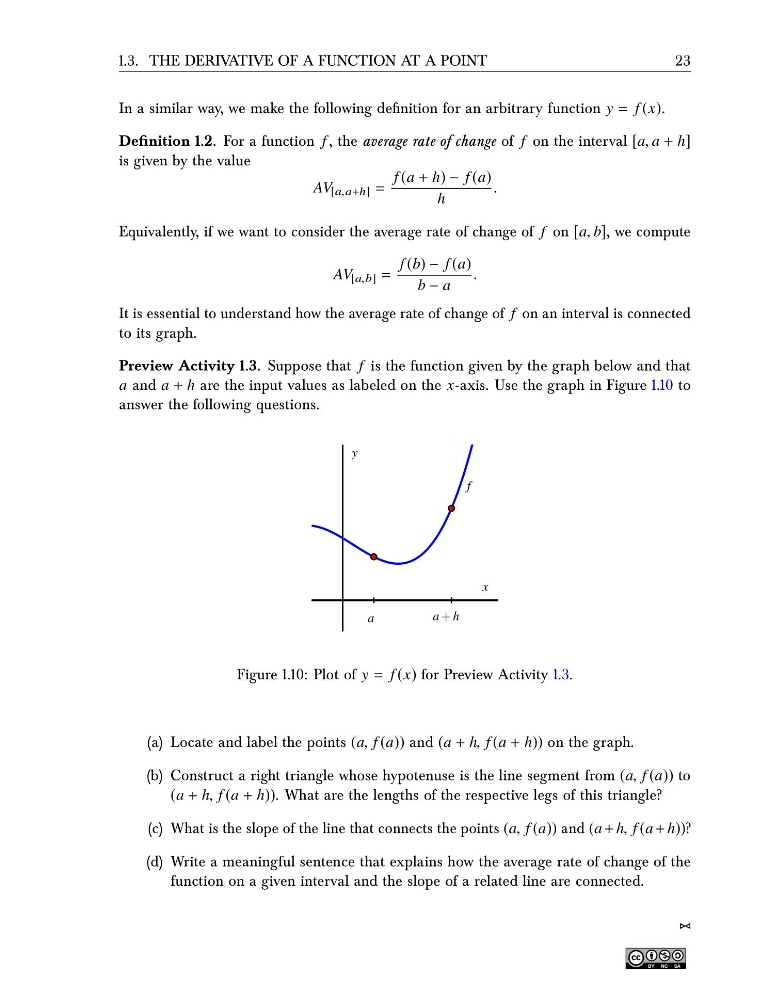
Preview Activity 1.3. Suppose that f is the function given by the graph below and that
a and a + h are the input values as labeled on the x-axis. Use the graph in Figure 1.10 to
answer the following questions.
x
y
f
a
a + h
Figure 1.10: Plot of y = f (x) for Preview Activity 1.3.
(a) Locate and label the points (a, f (a)) and (a + h, f (a + h)) on the graph.
(b) Construct a right triangle whose hypotenuse is the line segment from (a, f (a)) to
(a + h, f (a + h)). What are the lengths of the respective legs of this triangle?
(c) What is the slope of the line that connects the points (a, f (a)) and (a + h, f (a + h))?
(d) Write a meaningful sentence that explains how the average rate of change of the
function on a given interval and the slope of a related line are connected.
⊲⊳
23
In a similar way, we make the following definition for an arbitrary function y = f (x).
Definition 1.2. For a function f , the average rate of change of f on the interval [a, a + h]
is given by the value
AV [a,a+h] =
f (a + h) − f (a)
h
.
Equivalently, if we want to consider the average rate of change of f on [a, b], we compute
AV [a,b] =
f (b) − f (a)
b − a
.
It is essential to understand how the average rate of change of f on an interval is connected
to its graph.
Preview Activity 1.3. Suppose that f is the function given by the graph below and that
a and a + h are the input values as labeled on the x-axis. Use the graph in Figure 1.10 to
answer the following questions.
x
y
f
a
a + h
Figure 1.10: Plot of y = f (x) for Preview Activity 1.3.
(a) Locate and label the points (a, f (a)) and (a + h, f (a + h)) on the graph.
(b) Construct a right triangle whose hypotenuse is the line segment from (a, f (a)) to
(a + h, f (a + h)). What are the lengths of the respective legs of this triangle?
(c) What is the slope of the line that connects the points (a, f (a)) and (a + h, f (a + h))?
(d) Write a meaningful sentence that explains how the average rate of change of the
function on a given interval and the slope of a related line are connected.
⊲⊳