

6.4. PHYSICS APPLICATIONS: WORK, FORCE, AND PRESSURE
365
6.4 Physics Applications: Work, Force, and Pressure
Motivating Questions
In this section, we strive to understand the ideas generated by the following important
questions:
• How do we measure the work accomplished by a varying force that moves an
object a certain distance?
• What is the total force exerted by water against a dam?
• How are both of the above concepts and their corresponding use of definite
integrals similar to problems we have encountered in the past involving formulas
such as “distance equals rate times time” and “mass equals density times volume”?
Introduction
y = f (x)
a
b
f (x)
△x
y
t
y = v(t)
v(t)
△t
a
b
△x
ρ(x)
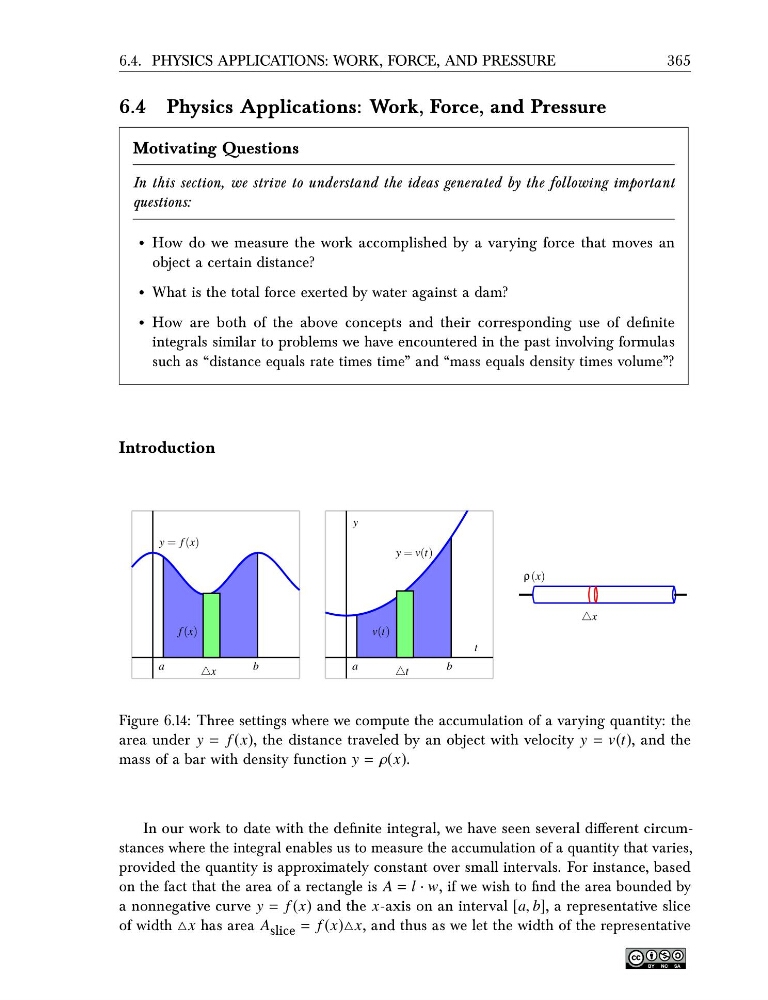
Figure 6.14: Three settings where we compute the accumulation of a varying quantity: the
area under y = f (x), the distance traveled by an object with velocity y = v(t), and the
mass of a bar with density function y = ρ(x).
In our work to date with the definite integral, we have seen several different circumstances where the integral enables us to measure the accumulation of a quantity that varies,
provided the quantity is approximately constant over small intervals. For instance, based
on the fact that the area of a rectangle is A = l · w, if we wish to find the area bounded by
a nonnegative curve y = f (x) and the x-axis on an interval [a, b], a representative slice
of width △x has area A slice = f (x)△x, and thus as we let the width of the representative
365
6.4 Physics Applications: Work, Force, and Pressure
Motivating Questions
In this section, we strive to understand the ideas generated by the following important
questions:
• How do we measure the work accomplished by a varying force that moves an
object a certain distance?
• What is the total force exerted by water against a dam?
• How are both of the above concepts and their corresponding use of definite
integrals similar to problems we have encountered in the past involving formulas
such as “distance equals rate times time” and “mass equals density times volume”?
Introduction
y = f (x)
a
b
f (x)
△x
y
t
y = v(t)
v(t)
△t
a
b
△x
ρ(x)
Figure 6.14: Three settings where we compute the accumulation of a varying quantity: the
area under y = f (x), the distance traveled by an object with velocity y = v(t), and the
mass of a bar with density function y = ρ(x).
In our work to date with the definite integral, we have seen several different circumstances where the integral enables us to measure the accumulation of a quantity that varies,
provided the quantity is approximately constant over small intervals. For instance, based
on the fact that the area of a rectangle is A = l · w, if we wish to find the area bounded by
a nonnegative curve y = f (x) and the x-axis on an interval [a, b], a representative slice
of width △x has area A slice = f (x)△x, and thus as we let the width of the representative