

6.2. USING DEFINITE INTEGRALS TO FIND VOLUME
349
Example 6.3. Find the volume of the solid of revolution generated when the finite region
R that lies between y =
√
x and y = x 4 is revolved about the y-axis.
Solution.
We observe that these two curves intersect when x = 1, hence at the point (1, 1). When
we take the region R that lies between the curves and revolve it about the y-axis, we get
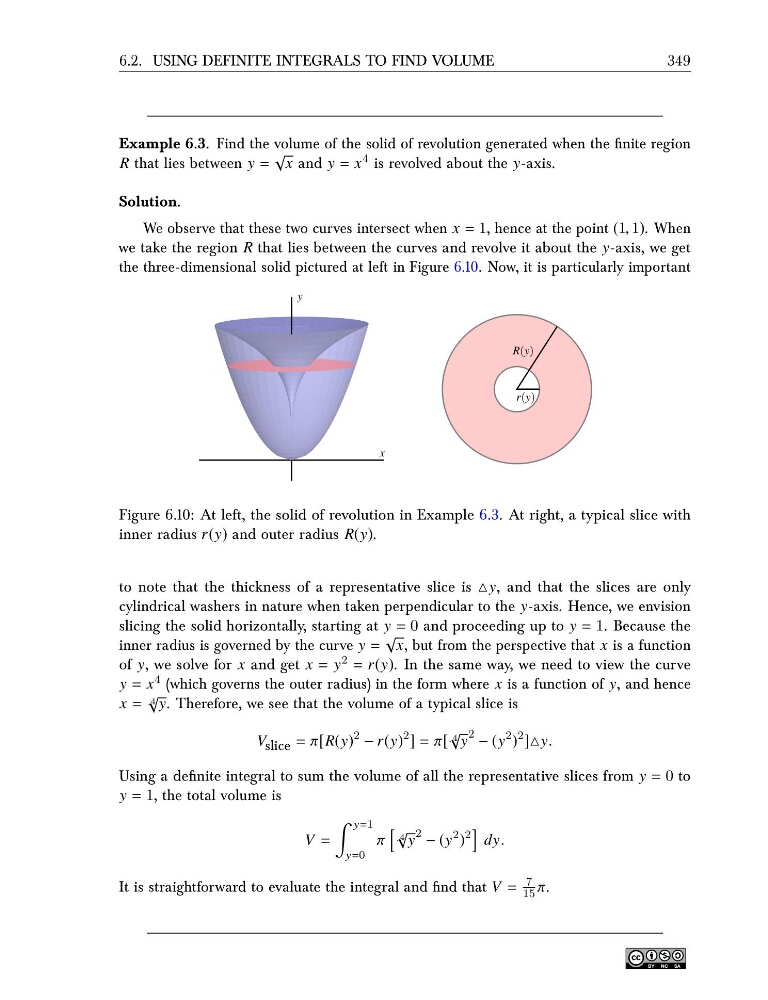
the three-dimensional solid pictured at left in Figure 6.10. Now, it is particularly important
x
y
r(y)
R(y)
Figure 6.10: At left, the solid of revolution in Example 6.3. At right, a typical slice with
inner radius r(y) and outer radius R(y).
to note that the thickness of a representative slice is △y, and that the slices are only
cylindrical washers in nature when taken perpendicular to the y-axis. Hence, we envision
slicing the solid horizontally, starting at y = 0 and proceeding up to y = 1. Because the
inner radius is governed by the curve y =
√
x, but from the perspective that x is a function
of y, we solve for x and get x = y 2 = r(y). In the same way, we need to view the curve
y = x 4 (which governs the outer radius) in the form where x is a function of y, and hence
x = 4
√
y. Therefore, we see that the volume of a typical slice is
V slice = π[R(y)
2 − r(y)
2 ] = π[
4
√
y
2 − (y
2 )
2 ]△y.
Using a definite integral to sum the volume of all the representative slices from y = 0 to
y = 1, the total volume is
V =
y=1
y=0
π
4
√
y
2 − (y
2 )
2
dy.
It is straightforward to evaluate the integral and find that V =
7
15 π.
349
Example 6.3. Find the volume of the solid of revolution generated when the finite region
R that lies between y =
√
x and y = x 4 is revolved about the y-axis.
Solution.
We observe that these two curves intersect when x = 1, hence at the point (1, 1). When
we take the region R that lies between the curves and revolve it about the y-axis, we get
the three-dimensional solid pictured at left in Figure 6.10. Now, it is particularly important
x
y
r(y)
R(y)
Figure 6.10: At left, the solid of revolution in Example 6.3. At right, a typical slice with
inner radius r(y) and outer radius R(y).
to note that the thickness of a representative slice is △y, and that the slices are only
cylindrical washers in nature when taken perpendicular to the y-axis. Hence, we envision
slicing the solid horizontally, starting at y = 0 and proceeding up to y = 1. Because the
inner radius is governed by the curve y =
√
x, but from the perspective that x is a function
of y, we solve for x and get x = y 2 = r(y). In the same way, we need to view the curve
y = x 4 (which governs the outer radius) in the form where x is a function of y, and hence
x = 4
√
y. Therefore, we see that the volume of a typical slice is
V slice = π[R(y)
2 − r(y)
2 ] = π[
4
√
y
2 − (y
2 )
2 ]△y.
Using a definite integral to sum the volume of all the representative slices from y = 0 to
y = 1, the total volume is
V =
y=1
y=0
π
4
√
y
2 − (y
2 )
2
dy.
It is straightforward to evaluate the integral and find that V =
7
15 π.