

6.2. USING DEFINITE INTEGRALS TO FIND VOLUME
347
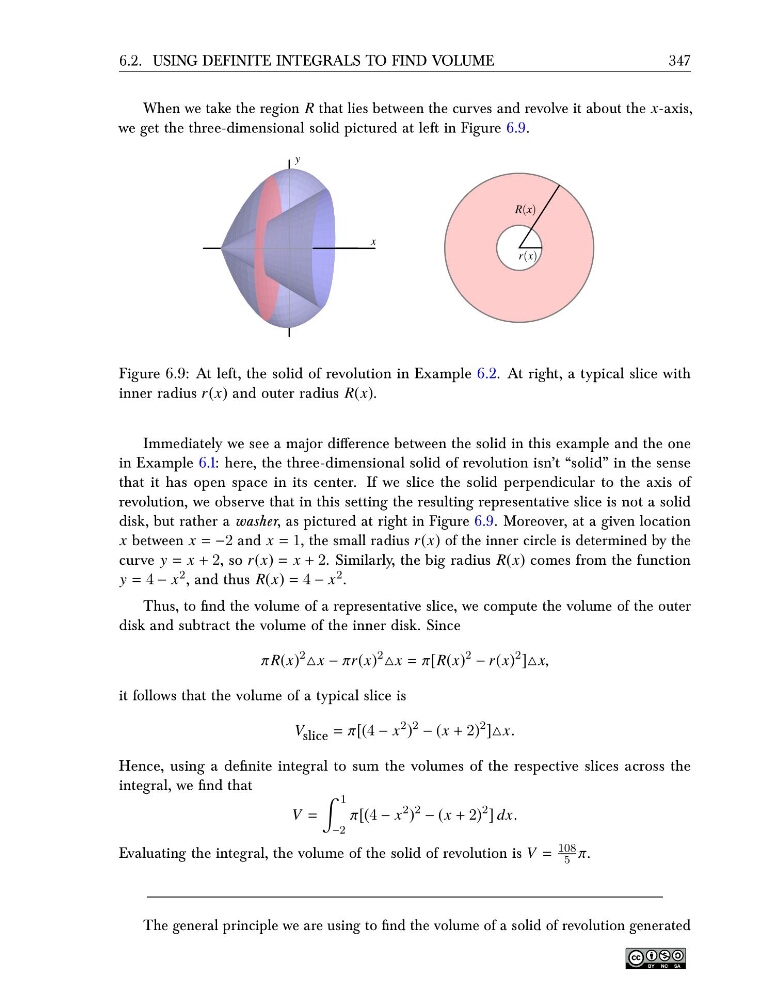
When we take the region R that lies between the curves and revolve it about the x-axis,
we get the three-dimensional solid pictured at left in Figure 6.9.
x
y
r(x)
R(x)
Figure 6.9: At left, the solid of revolution in Example 6.2. At right, a typical slice with
inner radius r(x) and outer radius R(x).
Immediately we see a major difference between the solid in this example and the one
in Example 6.1: here, the three-dimensional solid of revolution isn’t “solid” in the sense
that it has open space in its center. If we slice the solid perpendicular to the axis of
revolution, we observe that in this setting the resulting representative slice is not a solid
disk, but rather a washer, as pictured at right in Figure 6.9. Moreover, at a given location
x between x = −2 and x = 1, the small radius r(x) of the inner circle is determined by the
curve y = x + 2, so r(x) = x + 2. Similarly, the big radius R(x) comes from the function
y = 4 − x 2 , and thus R(x) = 4 − x 2 .
Thus, to find the volume of a representative slice, we compute the volume of the outer
disk and subtract the volume of the inner disk. Since
πR(x)
2 △x − πr(x)
2 △x = π[R(x)
2 − r(x)
2 ]△x,
it follows that the volume of a typical slice is
V slice = π[(4 − x
2 )
2 − (x + 2)
2 ]△x.
Hence, using a definite integral to sum the volumes of the respective slices across the
integral, we find that
V =
1
−2
π[(4 − x
2 )
2 − (x + 2)
2 ] dx.
Evaluating the integral, the volume of the solid of revolution is V =
108
5 π.
The general principle we are using to find the volume of a solid of revolution generated
347
When we take the region R that lies between the curves and revolve it about the x-axis,
we get the three-dimensional solid pictured at left in Figure 6.9.
x
y
r(x)
R(x)
Figure 6.9: At left, the solid of revolution in Example 6.2. At right, a typical slice with
inner radius r(x) and outer radius R(x).
Immediately we see a major difference between the solid in this example and the one
in Example 6.1: here, the three-dimensional solid of revolution isn’t “solid” in the sense
that it has open space in its center. If we slice the solid perpendicular to the axis of
revolution, we observe that in this setting the resulting representative slice is not a solid
disk, but rather a washer, as pictured at right in Figure 6.9. Moreover, at a given location
x between x = −2 and x = 1, the small radius r(x) of the inner circle is determined by the
curve y = x + 2, so r(x) = x + 2. Similarly, the big radius R(x) comes from the function
y = 4 − x 2 , and thus R(x) = 4 − x 2 .
Thus, to find the volume of a representative slice, we compute the volume of the outer
disk and subtract the volume of the inner disk. Since
πR(x)
2 △x − πr(x)
2 △x = π[R(x)
2 − r(x)
2 ]△x,
it follows that the volume of a typical slice is
V slice = π[(4 − x
2 )
2 − (x + 2)
2 ]△x.
Hence, using a definite integral to sum the volumes of the respective slices across the
integral, we find that
V =
1
−2
π[(4 − x
2 )
2 − (x + 2)
2 ] dx.
Evaluating the integral, the volume of the solid of revolution is V =
108
5 π.
The general principle we are using to find the volume of a solid of revolution generated