

318
5.5. OTHER OPTIONS FOR FINDING ALGEBRAIC ANTIDERIVATIVES
(c)
x 2 − x − 1
(x − 3) 3 dx
2. For each of the following integrals involving radical functions, (1) use an appropriate
u-substitution along with Appendix A to evaluate the integral without the assistance
of technology, and (2) use a CAS to evaluate the original integral to test and compare
your result in (1).
(a)
1
x
√
9x 2 + 25
dx
(b)
x
√
1 + x 4 dx
(c)
e
x
√
4 + e 2x dx
(d)
tan(x)
9 − cos 2 (x)
dx
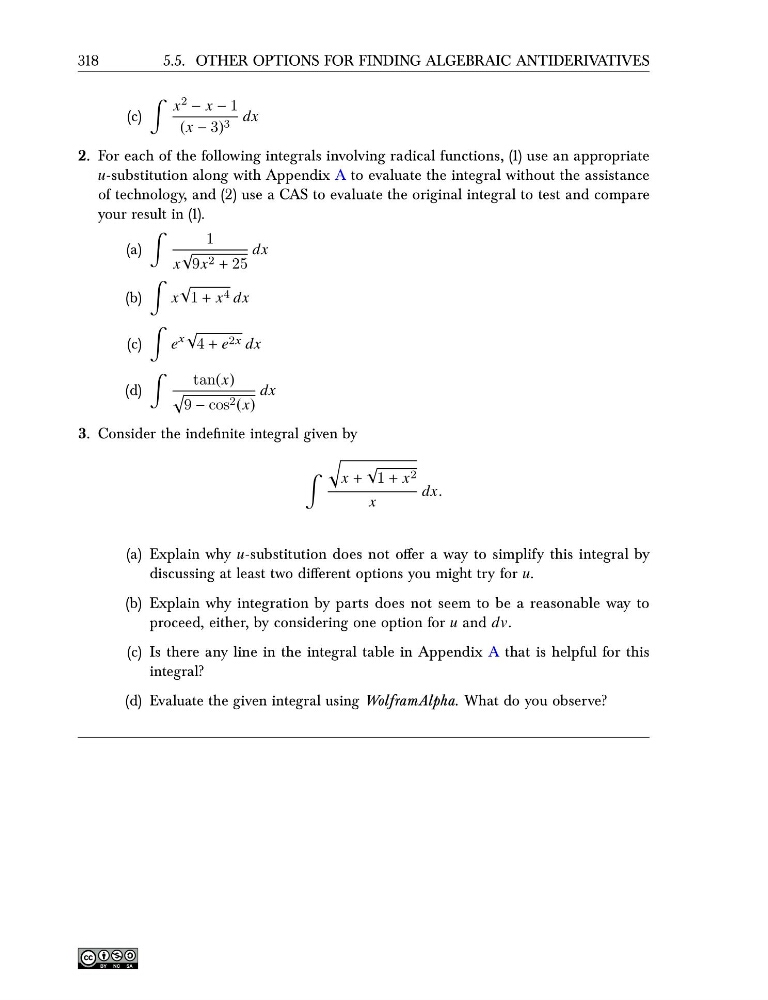
3. Consider the indefinite integral given by
x +
√
1 + x 2
x
dx.
(a) Explain why u-substitution does not offer a way to simplify this integral by
discussing at least two different options you might try for u.
(b) Explain why integration by parts does not seem to be a reasonable way to
proceed, either, by considering one option for u and dv.
(c) Is there any line in the integral table in Appendix A that is helpful for this
integral?
(d) Evaluate the given integral using WolframAlpha. What do you observe?
5.5. OTHER OPTIONS FOR FINDING ALGEBRAIC ANTIDERIVATIVES
(c)
x 2 − x − 1
(x − 3) 3 dx
2. For each of the following integrals involving radical functions, (1) use an appropriate
u-substitution along with Appendix A to evaluate the integral without the assistance
of technology, and (2) use a CAS to evaluate the original integral to test and compare
your result in (1).
(a)
1
x
√
9x 2 + 25
dx
(b)
x
√
1 + x 4 dx
(c)
e
x
√
4 + e 2x dx
(d)
tan(x)
9 − cos 2 (x)
dx
3. Consider the indefinite integral given by
x +
√
1 + x 2
x
dx.
(a) Explain why u-substitution does not offer a way to simplify this integral by
discussing at least two different options you might try for u.
(b) Explain why integration by parts does not seem to be a reasonable way to
proceed, either, by considering one option for u and dv.
(c) Is there any line in the integral table in Appendix A that is helpful for this
integral?
(d) Evaluate the given integral using WolframAlpha. What do you observe?