

314
5.5. OTHER OPTIONS FOR FINDING ALGEBRAIC ANTIDERIVATIVES
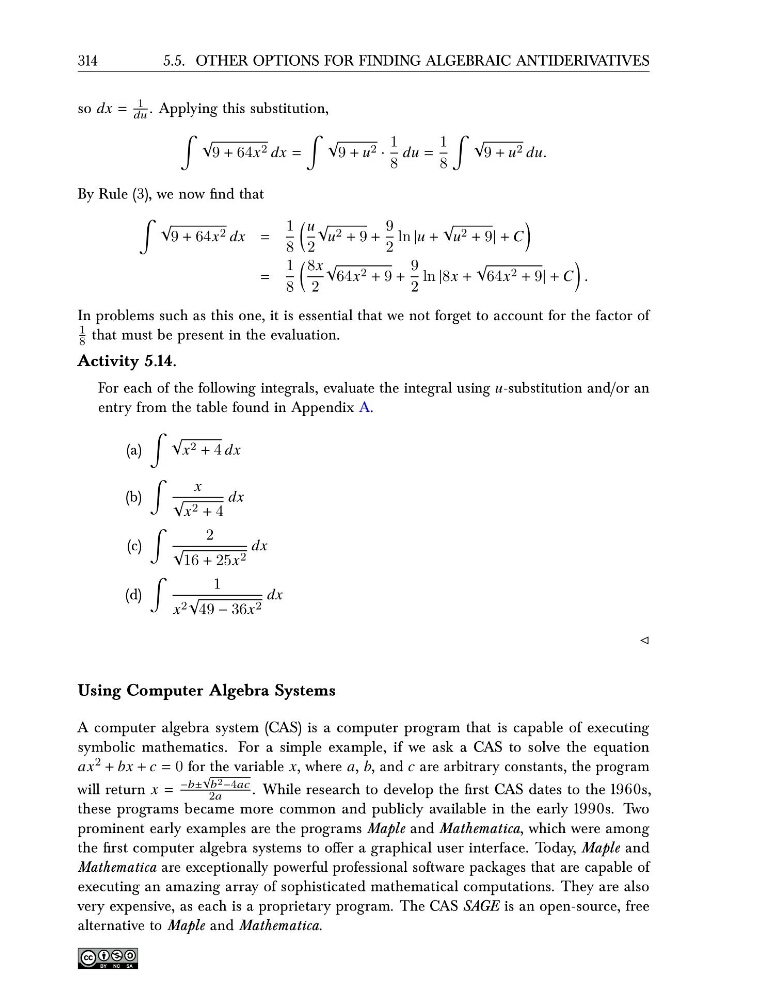
so dx =
1
du . Applying this substitution,
√
9 + 64x 2 dx =
√
9 + u 2 ·
1
8
du =
1
8
√
9 + u 2 du.
By Rule (3), we now find that
√
9 + 64x 2 dx =
1
8
u
2
√
u 2 + 9 +
9
2
ln |u +
√
u 2 + 9| + C
=
1
8
8x
2
√
64x 2 + 9 +
9
2
ln |8x +
√
64x 2 + 9| + C
.
In problems such as this one, it is essential that we not forget to account for the factor of
1
8 that must be present in the evaluation.
Activity 5.14.
For each of the following integrals, evaluate the integral using u-substitution and/or an
entry from the table found in Appendix A.
(a)
√
x 2 + 4 dx
(b)
x
√
x 2 + 4
dx
(c)
2
√
16 + 25x 2
dx
(d)
1
x 2
√
49 − 36x 2
dx
⊳
Using Computer Algebra Systems
A computer algebra system (CAS) is a computer program that is capable of executing
symbolic mathematics. For a simple example, if we ask a CAS to solve the equation
ax 2 + bx + c = 0 for the variable x, where a, b, and c are arbitrary constants, the program
will return x =
−b±
√
b 2 −4ac
2a
. While research to develop the first CAS dates to the 1960s,
these programs became more common and publicly available in the early 1990s. Two
prominent early examples are the programs Maple and Mathematica, which were among
the first computer algebra systems to offer a graphical user interface. Today, Maple and
Mathematica are exceptionally powerful professional software packages that are capable of
executing an amazing array of sophisticated mathematical computations. They are also
very expensive, as each is a proprietary program. The CAS SAGE is an open-source, free
alternative to Maple and Mathematica.
5.5. OTHER OPTIONS FOR FINDING ALGEBRAIC ANTIDERIVATIVES
so dx =
1
du . Applying this substitution,
√
9 + 64x 2 dx =
√
9 + u 2 ·
1
8
du =
1
8
√
9 + u 2 du.
By Rule (3), we now find that
√
9 + 64x 2 dx =
1
8
u
2
√
u 2 + 9 +
9
2
ln |u +
√
u 2 + 9| + C
=
1
8
8x
2
√
64x 2 + 9 +
9
2
ln |8x +
√
64x 2 + 9| + C
.
In problems such as this one, it is essential that we not forget to account for the factor of
1
8 that must be present in the evaluation.
Activity 5.14.
For each of the following integrals, evaluate the integral using u-substitution and/or an
entry from the table found in Appendix A.
(a)
√
x 2 + 4 dx
(b)
x
√
x 2 + 4
dx
(c)
2
√
16 + 25x 2
dx
(d)
1
x 2
√
49 − 36x 2
dx
⊳
Using Computer Algebra Systems
A computer algebra system (CAS) is a computer program that is capable of executing
symbolic mathematics. For a simple example, if we ask a CAS to solve the equation
ax 2 + bx + c = 0 for the variable x, where a, b, and c are arbitrary constants, the program
will return x =
−b±
√
b 2 −4ac
2a
. While research to develop the first CAS dates to the 1960s,
these programs became more common and publicly available in the early 1990s. Two
prominent early examples are the programs Maple and Mathematica, which were among
the first computer algebra systems to offer a graphical user interface. Today, Maple and
Mathematica are exceptionally powerful professional software packages that are capable of
executing an amazing array of sophisticated mathematical computations. They are also
very expensive, as each is a proprietary program. The CAS SAGE is an open-source, free
alternative to Maple and Mathematica.