

5.3. INTEGRATION BY SUBSTITUTION
295
• Check your work by differentiating the function of x. You should come up with
the integrand originally given.
(a)
x 2
5x 3 + 1
dx
(b)
e
x sin(e
x ) dx
(c)
cos(
√
x)
√
x
dx
⊳
Evaluating Definite Integrals via u-substitution
We have just introduced u-substitution as a means to evaluate indefinite integrals of
functions that can be written, up to a constant multiple, in the form f (g(x))g ′ (x). This
same technique can be used to evaluate definite integrals involving such functions, though
we need to be careful with the corresponding limits of integration. Consider, for instance,
the definite integral
5
2
xe
x 2 dx.
Whenever we write a definite integral, it is implicit that the limits of integration correspond
to the variable of integration. To be more explicit, observe that
5
2
xe
x 2 dx =
x=5
x=2
xe
x 2 dx.
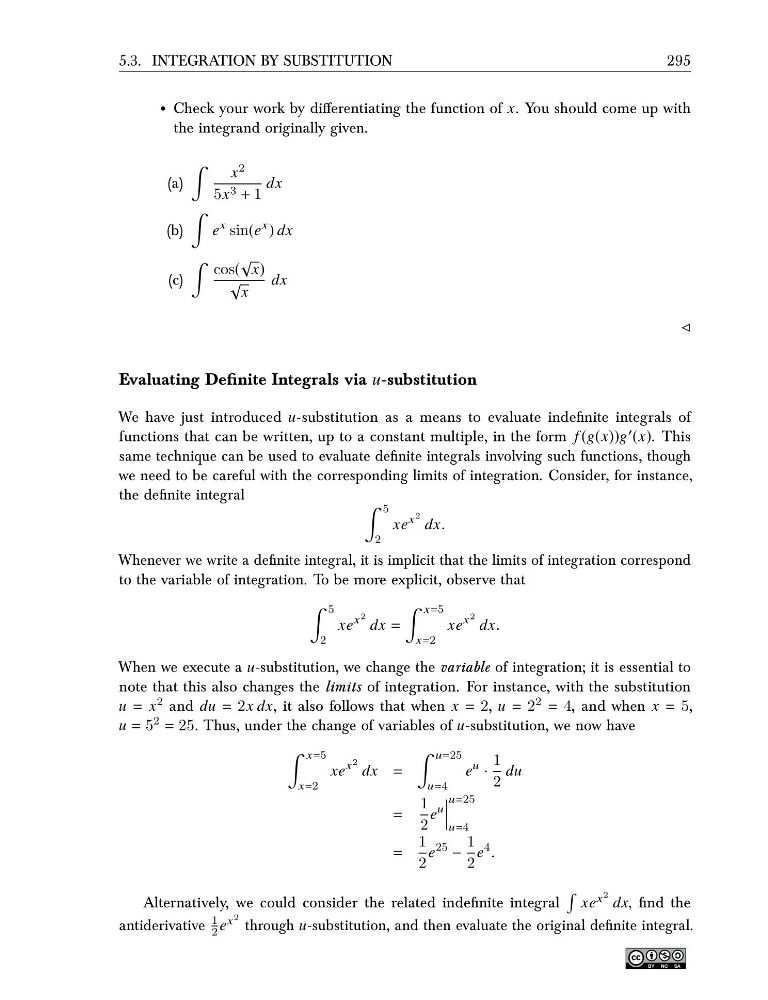
When we execute a u-substitution, we change the variable of integration; it is essential to
note that this also changes the limits of integration. For instance, with the substitution
u = x 2 and du = 2x dx, it also follows that when x = 2, u = 2 2 = 4, and when x = 5,
u = 5 2 = 25. Thus, under the change of variables of u-substitution, we now have
x=5
x=2
xe
x 2 dx =
u=25
u=4
e
u ·
1
2
du
=
1
2
e
u
u=25
u=4
=
1
2
e
25 −
1
2
e
4 .
Alternatively, we could consider the related indefinite integral
xe x 2 dx, find the
antiderivative
1
2 e x 2 through u-substitution, and then evaluate the original definite integral.
295
• Check your work by differentiating the function of x. You should come up with
the integrand originally given.
(a)
x 2
5x 3 + 1
dx
(b)
e
x sin(e
x ) dx
(c)
cos(
√
x)
√
x
dx
⊳
Evaluating Definite Integrals via u-substitution
We have just introduced u-substitution as a means to evaluate indefinite integrals of
functions that can be written, up to a constant multiple, in the form f (g(x))g ′ (x). This
same technique can be used to evaluate definite integrals involving such functions, though
we need to be careful with the corresponding limits of integration. Consider, for instance,
the definite integral
5
2
xe
x 2 dx.
Whenever we write a definite integral, it is implicit that the limits of integration correspond
to the variable of integration. To be more explicit, observe that
5
2
xe
x 2 dx =
x=5
x=2
xe
x 2 dx.
When we execute a u-substitution, we change the variable of integration; it is essential to
note that this also changes the limits of integration. For instance, with the substitution
u = x 2 and du = 2x dx, it also follows that when x = 2, u = 2 2 = 4, and when x = 5,
u = 5 2 = 25. Thus, under the change of variables of u-substitution, we now have
x=5
x=2
xe
x 2 dx =
u=25
u=4
e
u ·
1
2
du
=
1
2
e
u
u=25
u=4
=
1
2
e
25 −
1
2
e
4 .
Alternatively, we could consider the related indefinite integral
xe x 2 dx, find the
antiderivative
1
2 e x 2 through u-substitution, and then evaluate the original definite integral.