

286
5.2. THE SECOND FUNDAMENTAL THEOREM OF CALCULUS
1 2 3 4 5 6
-4
-2
2
4
6
A 1
A 2
A 3
A 4
y = g(t)
-1
1 2 3 4 5 6
-10
-5
5
10
15
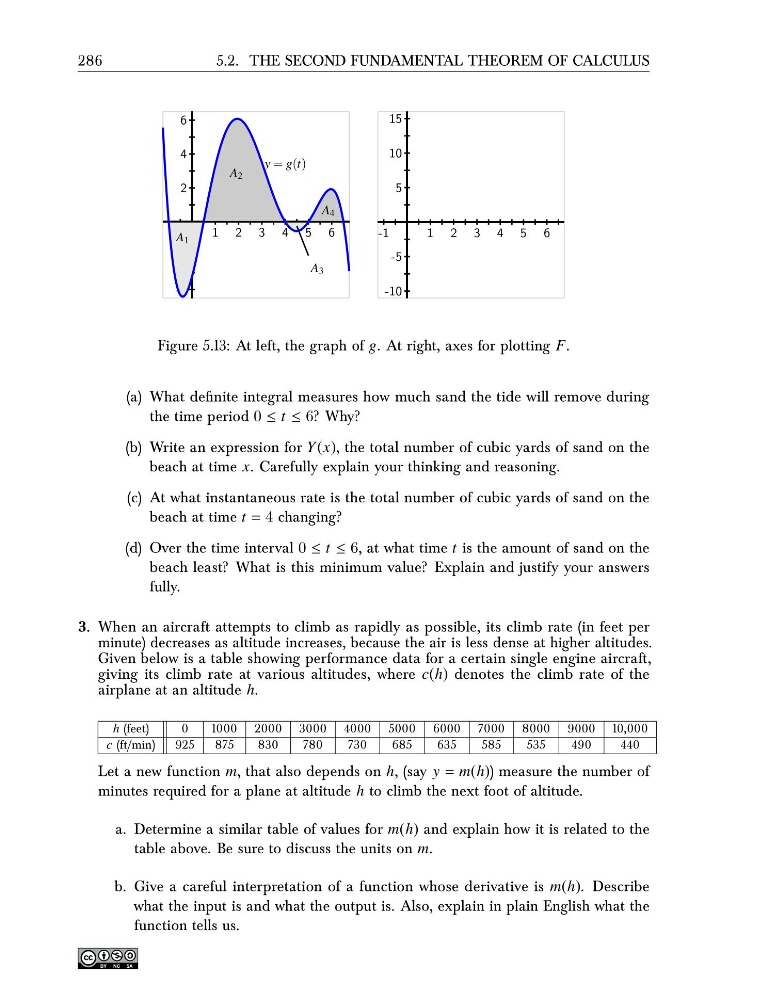
Figure 5.13: At left, the graph of g. At right, axes for plotting F.
(a) What definite integral measures how much sand the tide will remove during
the time period 0 ≤ t ≤ 6? Why?
(b) Write an expression for Y (x), the total number of cubic yards of sand on the
beach at time x. Carefully explain your thinking and reasoning.
(c) At what instantaneous rate is the total number of cubic yards of sand on the
beach at time t = 4 changing?
(d) Over the time interval 0 ≤ t ≤ 6, at what time t is the amount of sand on the
beach least? What is this minimum value? Explain and justify your answers
fully.
3. When an aircraft attempts to climb as rapidly as possible, its climb rate (in feet per
minute) decreases as altitude increases, because the air is less dense at higher altitudes.
Given below is a table showing performance data for a certain single engine aircraft,
giving its climb rate at various altitudes, where c(h) denotes the climb rate of the
airplane at an altitude h.
h (feet)
0
1000 2000 3000 4000 5000 6000 7000 8000 9000 10,000
c (ft/min)
925
875
830
780
730
685
635
585
535
490
440
Let a new function m, that also depends on h, (say y = m(h)) measure the number of
minutes required for a plane at altitude h to climb the next foot of altitude.
a. Determine a similar table of values for m(h) and explain how it is related to the
table above. Be sure to discuss the units on m.
b. Give a careful interpretation of a function whose derivative is m(h). Describe
what the input is and what the output is. Also, explain in plain English what the
function tells us.
5.2. THE SECOND FUNDAMENTAL THEOREM OF CALCULUS
1 2 3 4 5 6
-4
-2
2
4
6
A 1
A 2
A 3
A 4
y = g(t)
-1
1 2 3 4 5 6
-10
-5
5
10
15
Figure 5.13: At left, the graph of g. At right, axes for plotting F.
(a) What definite integral measures how much sand the tide will remove during
the time period 0 ≤ t ≤ 6? Why?
(b) Write an expression for Y (x), the total number of cubic yards of sand on the
beach at time x. Carefully explain your thinking and reasoning.
(c) At what instantaneous rate is the total number of cubic yards of sand on the
beach at time t = 4 changing?
(d) Over the time interval 0 ≤ t ≤ 6, at what time t is the amount of sand on the
beach least? What is this minimum value? Explain and justify your answers
fully.
3. When an aircraft attempts to climb as rapidly as possible, its climb rate (in feet per
minute) decreases as altitude increases, because the air is less dense at higher altitudes.
Given below is a table showing performance data for a certain single engine aircraft,
giving its climb rate at various altitudes, where c(h) denotes the climb rate of the
airplane at an altitude h.
h (feet)
0
1000 2000 3000 4000 5000 6000 7000 8000 9000 10,000
c (ft/min)
925
875
830
780
730
685
635
585
535
490
440
Let a new function m, that also depends on h, (say y = m(h)) measure the number of
minutes required for a plane at altitude h to climb the next foot of altitude.
a. Determine a similar table of values for m(h) and explain how it is related to the
table above. Be sure to discuss the units on m.
b. Give a careful interpretation of a function whose derivative is m(h). Describe
what the input is and what the output is. Also, explain in plain English what the
function tells us.